
It’s 10:20 on a Sunday night in Silver Lake. Your kitchen closed twenty minutes ago, but a hungry couple is on your website right now, thumbs hovering, trying to answer three simple questions before they commit to next Friday: Do you have a table for six? Is the patio dog-friendly? Can we bring our own cake? There’s no one to ask. Your host went home, your contact form promises a reply “within 24 hours,” and your Instagram DMs are a graveyard. So they close the tab and book the place down Sunset that answered instantly. You never even knew they were there.
That silent leak — real demand arriving after the phone stops ringing — is exactly what an AI chat widget plugs. This is the practical, restaurant-specific playbook for adding one to your Los Angeles restaurant website in 2026: what it is, why LA operators need it now, and the exact step-by-step to install a chat widget that answers guests, books tables, and hands off to a real text conversation — around the clock.
Table of Contents
- The 30-second answer
- What is an AI chat widget for a restaurant?
- Why Los Angeles restaurants need one in 2026
- How to add an AI chat widget to your restaurant website, step by step
- AI chat widget vs contact form vs live staff
- Restaurants are already moving to AI
- Mistakes LA operators make with chat widgets
- Frequently asked questions
The 30-Second Answer
To add an AI chat widget to your Los Angeles restaurant website, you connect a smart chat bubble to your booking calendar and a registered business text number, train it on your menu, hours, and policies, and set it to hand warm conversations off to SMS so no inquiry is ever dropped. Done right, the widget greets every visitor, answers the questions that used to tie up your host, books or waitlists the table inside the chat, and — when a guest wants a human — routes the thread to your team by text, all while staying compliant with TCPA and A2P 10DLC rules. You can bolt a basic widget on in an afternoon; a done-for-you version that actually books tables and follows up is installed as part of a restaurant-tuned AI Chatbot system.
What Is an AI Chat Widget for a Restaurant?
An AI chat widget is the little “Chat with us” bubble in the corner of your website — but powered by an AI assistant instead of a form that emails you later. For a restaurant, it plays the role of a tireless digital host. It can:
- Answer the repetitive questions that eat your staff’s time: hours, parking, the gluten-free options, whether you take walk-ins, corkage, private-dining minimums, patio and dog policies.
- Check availability and book the table by talking to your reservation calendar, or add the guest to a waitlist when you’re full.
- Capture the lead — name and mobile number — the moment interest is highest, so even an unfinished conversation becomes a follow-up instead of a lost tab.
- Hand off to SMS or a human when the guest wants to talk to a person or the request gets complex (a 30-top buyout, an allergy question for the chef).
Crucially, it’s not your POS, your reservation provider, or a delivery app — it sits in front of the tools you already run and catches the demand they never see. Think of it as the front-of-house greeter for the 60–70% of your web traffic that arrives when nobody’s standing at the host stand.
Why Los Angeles Restaurants Need One in 2026
Los Angeles is one of the most crowded, most digital dining markets in the country. LA County’s Department of Public Health inspects more than 26,000 restaurants (LA County Public Health, 2025), and margins are already tight — 52% of LA operators raised menu prices heading into 2025, above the 47% national average (TouchBistro, 2025). In a market that dense, the difference between a full Friday and a soft one is often just who answered the guest first.
And the guest is deciding on their phone, before they ever call. Look at how the modern dining decision actually flows on your website:
How diners behave online before they book (% of diners). Sources: TouchBistro 2024 Diner Trends Report, Toast 2025 Reservation Data, and Zendesk 2025 CX Trends.
The pattern is clear: your website is where the decision gets made, and a growing share of guests would rather get an instant answer from a bot than wait on a human. Now layer on the speed problem. The classic Harvard Business Review audit of 2,241 U.S. companies found the average first response to a web inquiry took 42 hours, and firms that replied within an hour were roughly 7× more likely to qualify that lead (Harvard Business Review, 2011). The MIT / InsideSales Lead Response study put an even finer point on it: contacting a lead within five minutes rather than thirty made you about 21× more likely to qualify it (MIT Lead Response Management Study).
No human host can win the 42-hour race at 10 p.m. on a Sunday. A chat widget can — it answers in seconds, every hour of every day, which in a 26,000-restaurant market is the whole game.
How to Add an AI Chat Widget to Your Restaurant Website, Step by Step
Here’s the exact sequence we use when we install a chat widget for an LA restaurant. You can follow it with an off-the-shelf tool, or have it built for you — either way, the order matters.
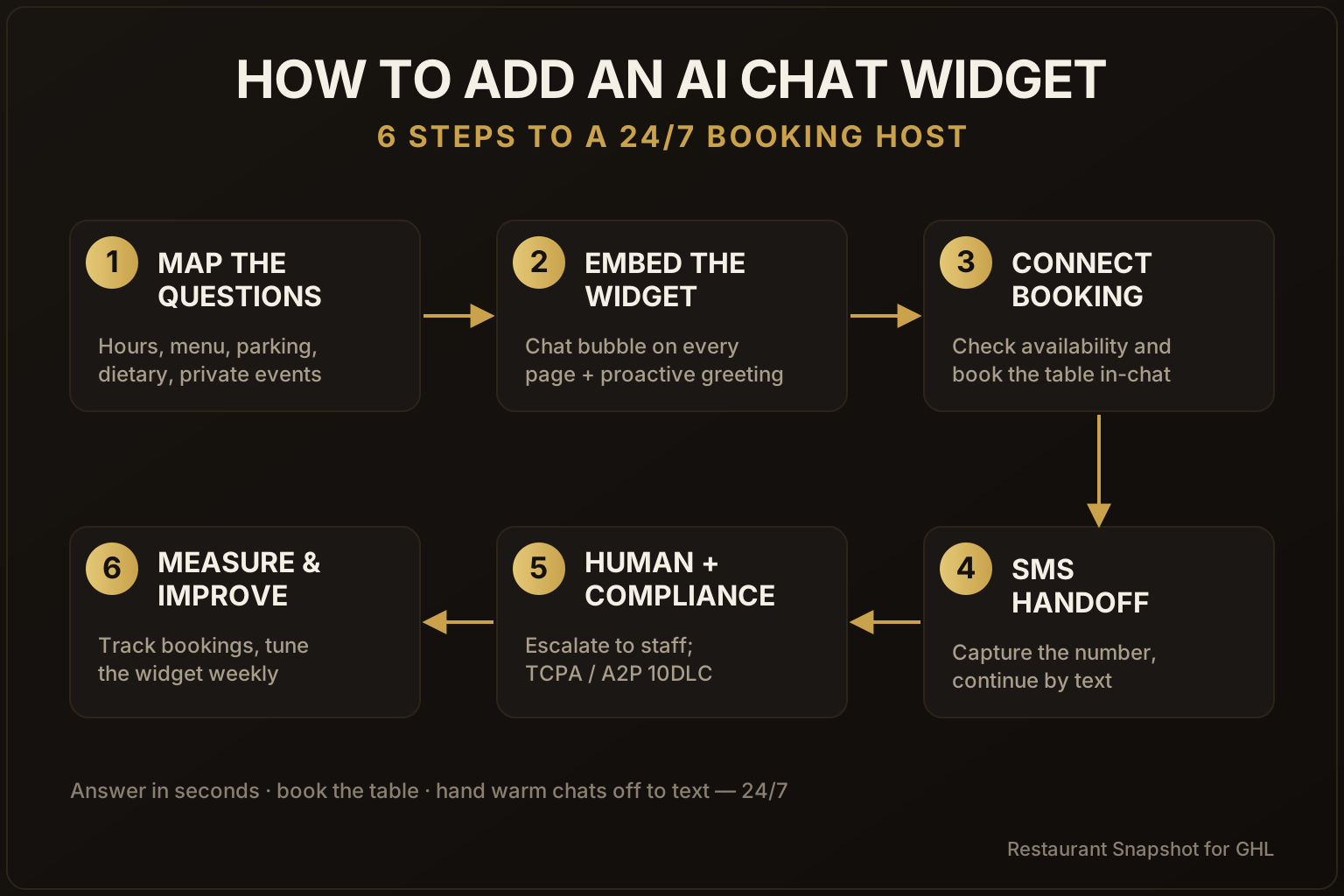
Step 1 — Map the questions the widget must answer
Before you touch any software, list the 20–30 questions your host and phone answer every week: hours, reservations, parking, dietary options, private events, corkage, dog policy, gift cards, dress code. Pull the exact answers from your menu and policies. This becomes the widget’s knowledge base — the difference between an assistant that sounds like your restaurant and a generic bot that says “please call us.”
Step 2 — Embed the widget on your website
Add the chat bubble to every page, with a friendly, on-brand opening line (“Hi! Want a table this week, or have a question about the menu?”). If you’re on a fast, modern site this is a one-line snippet; if your site is slow or hard to edit, that friction is a sign it’s time for a purpose-built restaurant website that loads instantly and won’t drag your chat down with it. Place a proactive greeting on high-intent pages (menu, reservations, private events) — Tidio found proactive chat invitations earn roughly 3× more engagement than a passive bubble (Tidio, 2024).
Step 3 — Connect it to your booking calendar
This is the step that turns a chat toy into a chat tool. Wire the widget to your reservation calendar so it can check real availability and confirm a table inside the conversation — not just say “we’ll get back to you.” When you’re fully committed, it should offer a waitlist slot or an alternative time. If you don’t yet have online booking that a bot can talk to, start with a proper online reservation system and connect the widget to it.
Step 4 — Set the after-hours and SMS handoff
Most of your website’s after-hours visitors won’t finish a booking in one sitting — so capture the mobile number early and continue by text. Messaging is where guests actually respond: 89% of U.S. consumers have opted in to texts from at least one business and 87% read a business text within 15 minutes (EZ Texting, 2026). Configure the widget to pass the conversation to SMS so a half-finished 10:20 p.m. chat becomes a confirmed Friday table by morning. (This is the same missed-call text-back logic, applied to your website.)
Step 5 — Add human routing and TCPA compliance
Set clear escalation rules: allergy questions, large buyouts, or an unhappy guest should route to a real person by text or a flagged inbox — fast. And because the widget collects phone numbers and sends texts, build it compliant from day one. U.S. business texting is governed by the TCPA and the A2P 10DLC registration system: get explicit consent, identify your restaurant, and honor STOP opt-outs automatically. (Our deeper TCPA guide for restaurant SMS covers the details.)
Step 6 — Measure, then tighten
Track four numbers weekly: conversations started, questions answered without a human, tables booked or waitlisted, and numbers captured for follow-up. Feed the questions the bot couldn’t answer back into Step 1. Within a few weeks you’ll have a widget that resolves the vast majority of guest questions on its own — Tidio reports 64% of sales and marketing leaders say chatbots helped them generate more qualified leads (Tidio, 2024).
AI Chat Widget vs Contact Form vs Live Staff
Why not just keep the contact form, or answer everything by hand? Because neither scales to LA’s after-hours demand. Here’s the honest comparison:
How guests get answered: chat widget vs form vs staff
| Plan | AI Chat Widget recommended | Contact Form | Live Staff Only |
|---|---|---|---|
| Price | Answers 24/7 | Replies later | Business hours |
| Feature 1 | Responds in seconds, every hour of every day | No instant answer — guest waits on email | Warm and personal — when someone's free |
| Feature 2 | Checks availability and books the table in-chat | Can't check availability or book anything | Ties up the host during the dinner rush |
| Feature 3 | Captures the mobile number, hands off to SMS | Often answered hours later (or never) | Nobody answering after close or on days off |
| Feature 4 | Answers the top 20-30 questions without staff | No conversation, no follow-up loop | Doesn't scale past one busy phone line |
| Feature 5 | Scales across every location on one system | Loses the after-hours visitor entirely | Great for escalations, not for volume |
| Feature 6 | Compliant TCPA / A2P 10DLC texting built in | Feels like a black hole to the diner | 42-hour average reply across businesses (HBR) |
The point isn’t to replace your people — it’s to let the widget handle the repetitive, round-the-clock volume so your staff can do what only humans do: run a great room and handle the guest who genuinely needs a person.
Restaurants Are Already Moving to AI
If this feels early, it isn’t. Restaurant AI adoption crossed the tipping point in 2026, and the #1 place operators are putting it is exactly here — guest communication and marketing, not the kitchen:
How U.S. restaurant operators are using AI (% of operators). Source: National Restaurant Association, 2026 State of the Restaurant Industry, via Restaurant Dive.
Marketing and guest-facing communication is where AI is landing first — and roughly 69% of operators who adopted new tech in the past few years say it made their restaurant more efficient (National Restaurant Association, 2026). Guests are on board too: beyond the 51% who prefer a bot for an instant answer, Zendesk found fewer than 40% of businesses even let customers reach out and get helped whenever is convenient (Zendesk, 2025). That gap is your opening.
The Bottom Line
Your Los Angeles restaurant’s website is already doing the hardest part — getting a hungry, high-intent guest to show up and consider you. An AI chat widget makes sure that someone’s home when they do. Answer in seconds, book the table in the chat, hand the warm ones off to text, stay compliant, and tune it weekly. In a 26,000-restaurant market where the diner you don’t answer just books someone else, that always-on greeter is one of the highest-leverage upgrades you can make this year.
Frequently Asked Questions
AI chat widget for LA restaurants — common questions
What is an AI chat widget for a restaurant website?
It's an AI-powered chat bubble on your website that acts like a 24/7 digital host. It answers common guest questions (hours, menu, parking, dietary options, private events), checks availability and books the table inside the conversation, captures the guest's mobile number, and hands warm conversations off to SMS or a real person. Unlike a contact form, it responds in seconds instead of hours.
How do I add an AI chat widget to my Los Angeles restaurant website?
Six steps: (1) map the 20-30 questions your staff answer weekly and pull the real answers from your menu and policies; (2) embed the chat bubble on every page with a proactive greeting on high-intent pages; (3) connect it to your reservation calendar so it can book real tables; (4) set an after-hours SMS handoff so half-finished chats continue by text; (5) add human-escalation rules and register for TCPA / A2P 10DLC compliant texting; (6) measure weekly and feed unanswered questions back in. You can assemble a basic one in an afternoon, or have a restaurant-tuned version installed for you.
Will an AI chat widget replace my host or staff?
No — it handles the repetitive, around-the-clock volume (the same questions, the after-hours bookings) so your team can focus on running the room and handling the requests that genuinely need a person, like a large buyout or a chef allergy question. The widget routes those escalations straight to a human.
Is it legal to text guests from the chat widget?
Yes, when it's done correctly. U.S. business texting is governed by the TCPA and the A2P 10DLC registration system, which require clear consent, sender identification, and automatic STOP opt-out handling. A properly built widget captures consent in the chat and is registered before it ever sends a text, so you stay compliant from day one.
Do LA restaurants actually get results from AI chat?
The signals are strong: 85% of diners check a restaurant's menu online before visiting and 65% book directly on the restaurant's own website (TouchBistro 2024; Toast 2025), so your site is where the decision happens. 51% of consumers now prefer a bot for an instant answer (Zendesk 2025), and 64% of sales and marketing leaders say chatbots helped them generate more qualified leads (Tidio 2024). In a market with 26,000+ restaurants, answering instantly is a real edge.
What if my website is too slow for a chat widget?
A chat widget can't rescue a page that takes several seconds to load — visitors leave before the bubble even appears. If your current site is slow or hard to edit, it's worth moving to a fast, purpose-built restaurant website first, then layering the chat widget on top. We build blazing-fast restaurant sites and install the widget as part of the same system.
Devon runs a small agency that builds and resells GoHighLevel systems to hospitality clients, from food trucks to fine dining. A former line cook turned funnel nerd, he’s obsessed with the unsexy plumbing of restaurant marketing: A2P 10DLC registration, two-way SMS, and chat flows that book tables without annoying guests. His posts lean technical without losing the operator who has to live with the system.
Related reading
- AI phone answering for restaurants: catch every call you miss
- Missed-call text-back for restaurants
- The restaurant online reservation system that fills tables
- Turn Instagram DMs into booked tables
- GoHighLevel for restaurants: the complete 2026 guide
Sources
- TouchBistro — 2024 American Diner Trends Report (85% check the menu online)
- Toast — 2025 Reservation Data (65% book direct on the restaurant website)
- Harvard Business Review — The Short Life of Online Sales Leads (42-hour average; ~7× within an hour)
- MIT / InsideSales — Lead Response Management Study (21× to qualify within 5 minutes)
- Zendesk — 2025 CX Trends Report (51% prefer a bot for an instant answer)
- Zendesk — What is conversational business? (fewer than 40% of businesses always available)
- Tidio — Chatbot for Lead Generation (64% generated more qualified leads)
- Tidio — Live Chat Statistics (proactive chat ≈ 3× engagement)
- National Restaurant Association — 2026 State of the Restaurant Industry (26% use AI; marketing is #1)
- Restaurant Dive — NRA AI adoption coverage
- TouchBistro — 2025 LA State of Restaurants Report (52% of LA operators raised prices)
- LA County Public Health — Restaurants & Retail Food Stores (26,000+ restaurants)
- EZ Texting — 2026 SMS Marketing Statistics (89% opted in; 87% read within 15 min)