
It is 9:15 on a Monday when your phone buzzes. One star. “Booked a table for our anniversary, waited 35 minutes past our time, nobody said sorry, and the risotto came out cold. We won’t be back.” Your stomach drops, and your first instinct is to argue, because you remember that night and it was slammed.
Here is the reframe that changes everything: that guest is not attacking you. They are handing you, in writing and for free, the exact reason a paying customer walked, plus a way to reach them. Most people who had the same night never told you. They just stopped coming. This one spoke up, which makes them the easiest guest in your building to win back, if you have a system for it.
Table of Contents
- The 30-second answer
- What a bad review actually costs you
- Recover the guest, not just the star rating
- The 6-stage review recovery system
- Steal this: the exact recovery copy
- Run it for a solo spot, a busy independent, and a small group
- The compliance part you cannot skip
- Objections, answered straight
- Frequently asked questions
The 30-Second Answer
You turn a bad review into a recovered guest by treating it as the start of a conversation, not the end of one. The star rating is the symptom. The lost guest is the disease, and the guest is what is worth chasing.
The move is always the same. Reply in public fast and human, so future diners see an owner who owns it. Take it private, reach the person, and find out what happened. Fix the specific thing, invite them back on your dime, and treat that return like a first date, not a closed ticket. Only after they have had a good night do you ask them to update the review. Do it backwards, leading with “please change your review,” and you lose them and risk breaking the law.
What a Bad Review Actually Costs You
Most unhappy guests are silent. The classic TARP research found that for every customer who complains, around 25 others walk and never say a word (John Goodman, TARP). The one-star review is the only piece of that iceberg you can grab.
Now the money. Michael Luca’s Harvard Business School study matched Yelp ratings to state revenue data and found a one-star jump in rating raises a restaurant’s revenue by 5% to 9%, with the effect in independent restaurants, not chains (Harvard Business School). Chains ride on brand recognition; you ride on your rating.
The reply itself is the highest-return move here, because it is written for everyone except the reviewer: 89% of consumers read business responses to negative reviews and 42% avoid a business that never replies (BrightLocal, 2026). A calm, human reply is a sales pitch aimed at the next hundred bookings.
How U.S. consumers act on reviews and review responses (% of respondents). Source: BrightLocal Local Consumer Review Survey, 2026.
Recover the Guest, Not Just the Star Rating
Most reputation advice stops at “reply to the review.” That is stage two of six, and it aims at the wrong target: a public reply that never reaches the guest gets you a nicer thread and zero recovered covers. The point is to get the person back into a chair, telling friends you made it right.
There is real science behind why this works. It is the service recovery paradox: a customer whose problem gets resolved fairly and quickly can end up more loyal than a customer who never had a problem at all. A 2025 study in the Journal of Brand Management (638 responses) found that satisfying recovery, driven by a fair outcome (the make-good) and a fair process (how fast and clearly you handled it), turns dissatisfied customers into loyal ones (Journal of Brand Management, 2025). A guest whose ruined anniversary you personally rescued feels something a flawless-night guest never does.
The 6-Stage Review Recovery System
Six stages, each with what it does and, just as important, how it breaks. The failure modes are where operators lose guests they could have kept.
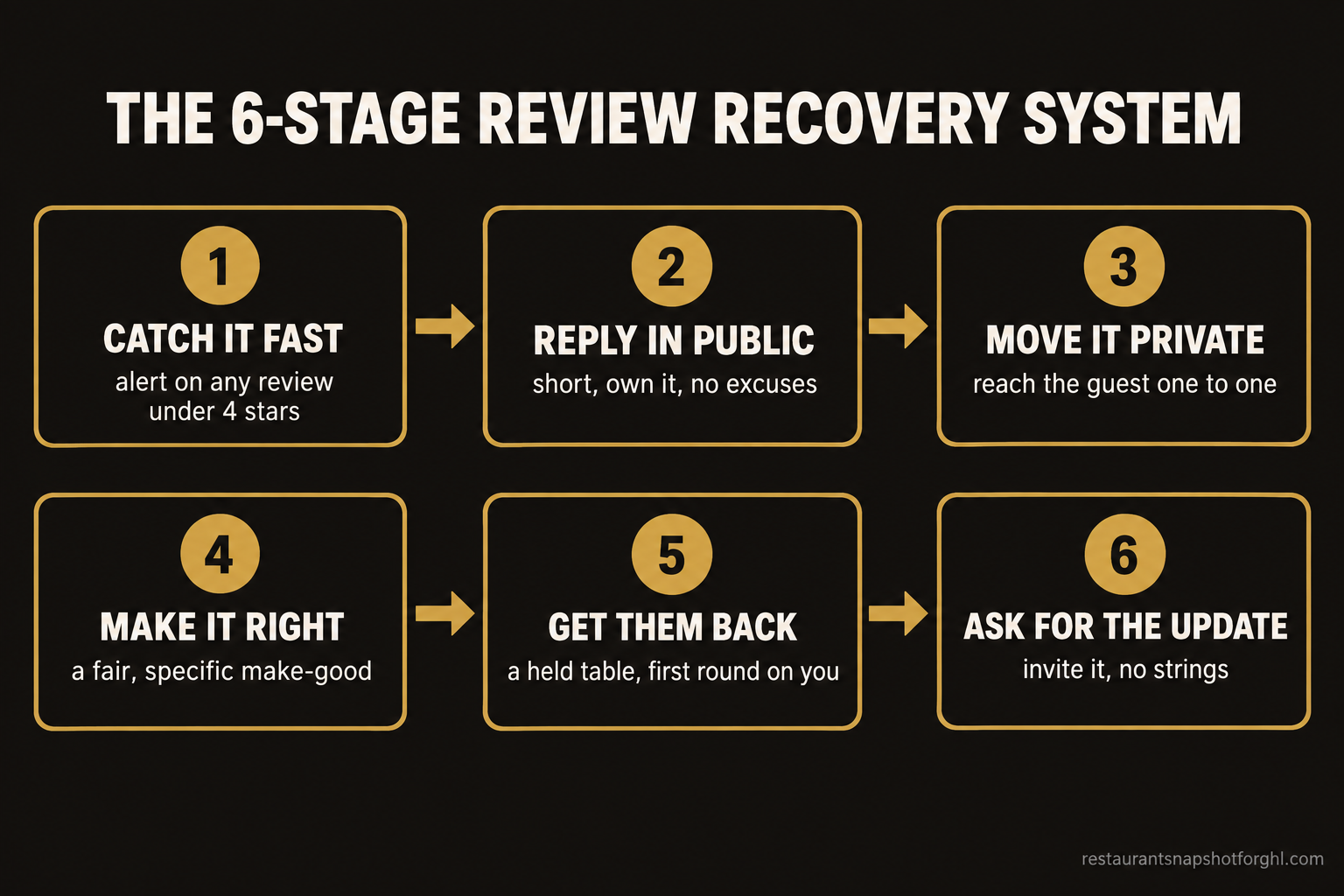
The six stages, from the alert to the recovered regular. restaurantsnapshotforghl.com
Stage 1: Catch it fast, before it hardens
Speed is the ballgame. More than half of consumers expect a response within 24 hours, with 19% expecting one the same day and 32% by the next day (BrightLocal, 2026). Set up alerts so any review under four stars pings your phone and your manager’s within minutes.
How it breaks: you rely on remembering to check your Google page, so a bad review sits for a week gathering agreement. Fix: pipe every new review into one inbox with instant alerts, and route anything under four stars to a person on shift. Our reputation management playbook covers the monitoring setup.
Stage 2: Reply in public like an owner, not a lawyer
Your public reply is for the audience, not the reviewer. Keep it short, own it without excuses, and move details offline. Do not argue the facts or blame the guest, because every future diner is watching, and restaurants that reply to reviews tend to see their rating climb (Harvard Business Review, 2018).
How it breaks: you write a paragraph defending the kitchen and correcting the guest, so it reads as a fight and the audience sides with the customer. Fix: three sentences, own it, offer a direct line, done.
Stage 3: Move it to a private, human conversation
The public reply is the invitation; the recovery happens one to one. If you can match the review to a reservation or order, reach out directly by text, email, or call. The message is not “please take down your review,” but “I am the owner, and I want to understand what happened and make it right.”
How it breaks: you never reach the person, because the review is anonymous and your reply had no contact path. Fix: build a private feedback channel that captures a phone or email at the source. A short post-visit text, “How was everything tonight? Reply 1 if great, 2 if something was off,” routes the 2s straight to a manager. See how to get reviews without burning out staff for the routing.
Stage 4: Make it genuinely right
This is the fairness the paradox is built on. The guest needs a fair outcome (you fix the problem or make a real gesture) and a fair process (fast, clear, human). Match the make-good to the miss: a cold entree earns a redo and a comp; a blown anniversary earns a gesture that fits the occasion.
How it breaks: you offer a generic 10%-off coupon for a specific, personal failure, and it reads as a brush-off. Fix: make the gesture specific to what went wrong, and give it with a genuine apology, not a discount code. One guardrail: never tie the make-good to changing the review. More in the compliance section.
Stage 5: Get them back through the door
A recovered guest who never returns is not recovered, just less angry. The point is the next visit, so make it easy and specific: a held table, their name on the booking, and a heads-up to the floor that this guest had a rough one and gets extra care.
How it breaks: you apologize, they feel better, and nothing happens, so the relationship quietly ends anyway. Fix: put a concrete return offer and a date-based nudge into the flow, and flag the guest so the team looks after them, the same muscle as the 60-day win-back for lapsed diners aimed at one guest.
Stage 6: Ask for the update, then keep them
Only now, after a genuinely good night, is it fair to raise the review, and even here you never ask them to change it for anything. You simply invite them to share the new experience; many will, on their own, because people want to be fair when treated well.
How it breaks: you ask too early, or you offer something to do it. The first feels transactional; the second is a legal problem. Fix: let the good visit do the persuading, ask lightly and once, and route the recovered guest into your loyalty or birthday flow. See the loyalty program that needs no stamp cards.
Steal This: The Exact Recovery Copy
Do not reinvent these under pressure at 9am. Keep the structure, match the wording to your voice, and keep it human.
Public reply to a one-star review (three sentences):
Hi [Name], I'm [Owner], the owner. I'm genuinely sorry your anniversary
didn't go the way it should have, and a 35-minute wait with a cold plate
is on us, not you. I'd like to make this right in person, so please email
me at [owner@email] or call [number]. Thank you for telling us.
Private text once you have matched them to a booking (replying to a guest who reached out):
Hi [Name], this is [Owner] from [Restaurant]. I saw your note about
Saturday and I'm sorry, that's not us on a good night. I'd love to hear
what happened and make it right. Is now an ok time for a quick call, or
would you rather tell me here?
The make-good message (specific, not a coupon):
Thank you for talking it through with me. Here's what I'd like to do:
come back in as my guests, I'll hold your favorite table, and the first
round is on me so we can give you the anniversary dinner you came for.
Text me a date that works and I'll take care of the rest.
The review-update ask (after a good return visit, once, no strings):
It was so good to have you back, and I'm glad tonight landed the way it
should have. No pressure at all, but if you felt like sharing how the
return visit went, it would mean a lot. Either way, we're just happy you
gave us another shot.
None of these argue, over-explain, or offer anything in exchange for editing the review. The make-good is given freely; the review update is invited only after, with no strings. That order keeps you right with both the guest and the FTC.
Run It for a Solo Spot, a Busy Independent, and a Small Group
The system is the same. What changes is who does each stage and how much runs on autopilot.
The solo operator. You are the alert system, the reply, and the make-good. Turn on Google and Yelp email notifications, set a rule that any review under four stars gets a reply and private outreach within 24 hours, and keep the templates saved on your phone. Your edge is that you literally are the brand, so an owner reaching out lands harder than any chain can.
The busy independent (a GM and a floor team). Split the work. Reviews route to one shared inbox the GM owns, replies go up within the hour, and the make-good has a standing budget so a manager can comp a return without hunting you down. Add the post-visit “1 or 2” text so unhappy guests reach you before they post. This is where a light automation layer pays for itself.
The small group (two to five locations). Consistency is the risk, because one location that never replies drags the whole brand down in search. Centralize monitoring in one dashboard, standardize the templates so every manager sounds like the brand, and track recovery as a number: caught, reached, returned. A restaurant CRM that owns your guest data across locations makes this possible without ten spreadsheets.
The Compliance Part You Cannot Skip
Recovery touches two regulated areas: how you text guests, and how you handle reviews.
Texting an unhappy guest (TCPA and A2P 10DLC). Replying to a guest who reached out first is customer care and is generally fine. Proactively texting a guest, especially with an offer, needs prior express consent, and every marketing text must honor STOP (FCC). Keep recovery one to one, get opt-in before adding anyone to a promo list, and never blast “we’re sorry, here’s 20% off” to numbers grabbed at the host stand. Our TCPA-compliant SMS guide has the consent language.
Handling the review (FTC). As of October 2024, the FTC’s rule bans conditioning any incentive on the content of a review, positive or negative, and bans review suppression, with penalties into the tens of thousands of dollars per violation (Federal Trade Commission, 2024). In plain terms: you can comp a guest to make a bad night right, but you cannot say “here’s a free dinner if you take down your one star.” The make-good and the review stay separate. And do not build a funnel that sends only happy guests to Google while steering unhappy ones away, which is review-gating and runs into the same rules.
Objections, Answered Straight
“Won’t replying just draw more attention to the bad review?” No. The review is already public and already being read. The only question is whether the next reader sees an owner who owns it or an empty box. With 89% of consumers reading the response, silence is the loud choice (BrightLocal, 2026).
“What if the reviewer is just wrong, or lying?” You still reply calmly for the audience, without calling them a liar. “We have no record of a reservation that night, but we’d like to understand, please reach me at [number]” reads as confident and fair, and a fake review that breaks platform policy can be reported and often removed.
“I don’t have time to chase every one-star.” You do not. You catch every one and personally chase the ones you can identify. Automation handles catching, routing, and a first draft of the reply; you handle the human part, which for a recoverable guest is a five-minute text worth years of covers.
“Isn’t comping a return visit just losing money?” One recovered guest costs you a plate of food; losing them costs every visit they would have made, plus the friends they tell. With a new customer costing five to twenty-five times as much as keeping one (Harvard Business Review), a comped dinner is the cheapest marketing on your menu.
Frequently Asked Questions
Review recovery, answered
How fast should I respond to a bad restaurant review?
Within 24 hours, and sooner is better. In BrightLocal's 2026 survey, 19% of consumers expect a same-day response and 32% expect one by the next day. Set instant alerts for any review under four stars so it never sits for a week.
Can I offer a free meal to get someone to change their review?
No. Since October 2024, the FTC's rule bans conditioning any incentive on the content of a review. You can comp a guest to genuinely make a bad experience right, but keep that make-good separate from any request to change the review. Give the gesture freely, invite an update with no strings.
What if I can't figure out which guest left the review?
Then your public reply is your only channel, so include a direct way to reach you. Going forward, add a post-visit feedback text that captures a phone or email, so unhappy guests reach you before they post publicly.
Does responding to reviews actually help my Google ranking?
Yes. Review signals make up roughly 20% of local pack ranking weight in Whitespark's 2026 survey, and review recency, including active owner responses, moved into the top five local ranking factors in 2025. Replying feeds the exact signals Google uses for the map pack.
Can recovering a guest really make them more loyal than before?
It can. It is the service recovery paradox: a guest whose problem is resolved quickly and fairly can end up more loyal than one who never had a problem. The catch is that the fix has to be fast and genuine, and it only works once per guest.
Related reading
- Restaurant reputation management: how to respond to Google reviews
- How to get 5-star reviews without asking every guest at the door
- The 60-day win-back playbook for lapsed diners
- Own your restaurant’s guest list instead of renting it from OpenTable
- Why regulars stop coming in, and how to catch them early
Back to that Monday and the cold-risotto one star. You reply in public before 9:30, match the name to the booking, text the guest by 10, hold their table for Friday, and put the first round on the house. They come in, have the night they came for, and two days later they post an update on their own: “The owner reached out personally and made it more than right. This is how a real restaurant handles a bad night. We’ll be back.” That is not damage control. That is a regular, made on your worst review of the month.