
There’s a four-top that used to sit at the same table every Thursday. Same wine, same waiter, they knew the busser’s kid’s name. Then one Thursday they weren’t there. You didn’t clock it, you were slammed Saturday and short a line cook, and Thursday’s a blur anyway. Three months later you’re staring at a slow week and realize you can’t remember the last time you saw them. Nobody complained. Nobody sent back a plate. They just stopped.
That’s how regulars leave. Not with a bad review or a scene at the host stand. They fade, quietly, so you find out from a soft month instead of a warning. Here’s the honest version of why it happens, how to catch it while you still can, and the exact system (message copy included) that pulls a slipping regular back before they’re gone.
Table of Contents
- The 30-second answer
- What silent churn actually costs you
- Why regulars really stop coming in
- The life cycle of a fading regular
- The six-stage system to catch and keep them
- The messages you can steal tonight
- Run it for a solo spot, a mid-size team, and a group
- The compliance part nobody warns you about
- Objections, answered straight
- Frequently asked questions
The 30-Second Answer
Regulars stop coming in because life gets in the way and nothing pulls them back. A schedule changes, a favorite server leaves, a birthday gets celebrated somewhere new, and the habit quietly breaks. It is almost never one bad night. It is the absence of a reason to return, plus a restaurant that never noticed the gap.
You can’t stop life from happening. What you can do is notice the slip early and give the guest a reason to come back before the habit is fully gone. That means three things:
- Track recency. Know when a returning guest’s normal rhythm breaks. The data lives in your POS or booking tool already.
- Reach out like a human, not a coupon machine. A short “we miss you” beats a 20%-off blast every time.
- Make it automatic. No operator has time to hand-check who hasn’t been in. A system does it for you, quietly, in the background.
Do that and you turn silent churn into a recoverable event. Skip it and you keep replacing regulars with strangers, which is the most expensive way to run a dining room.
What Silent Churn Actually Costs You
Start with why this is worth your Tuesday. The industry will do a projected $1.55 trillion in sales in 2026 (National Restaurant Association), but that top line hides a hard truth for any single operator: your revenue isn’t spread evenly across your guests. A small core of regulars carries it. Repeat guests generate roughly 60% of a restaurant’s revenue (Olo). A returning guest averages nearly seven visits and is worth about 26 times a one-time visitor, and yet roughly 77% of first-time guests never come back at all (Bloom Intelligence, 2026).
Look closer and it gets starker. In a cohort of restaurants Toast studied in early 2026, just 7% of a business’s guest base was multi-visit, yet that small group drove up to 50% of total order volume (Toast, 2026). Half your covers can ride on a sliver of loyal guests. Lose a handful of them and you don’t feel it as one empty table. You feel it as a whole soft section, three months late.
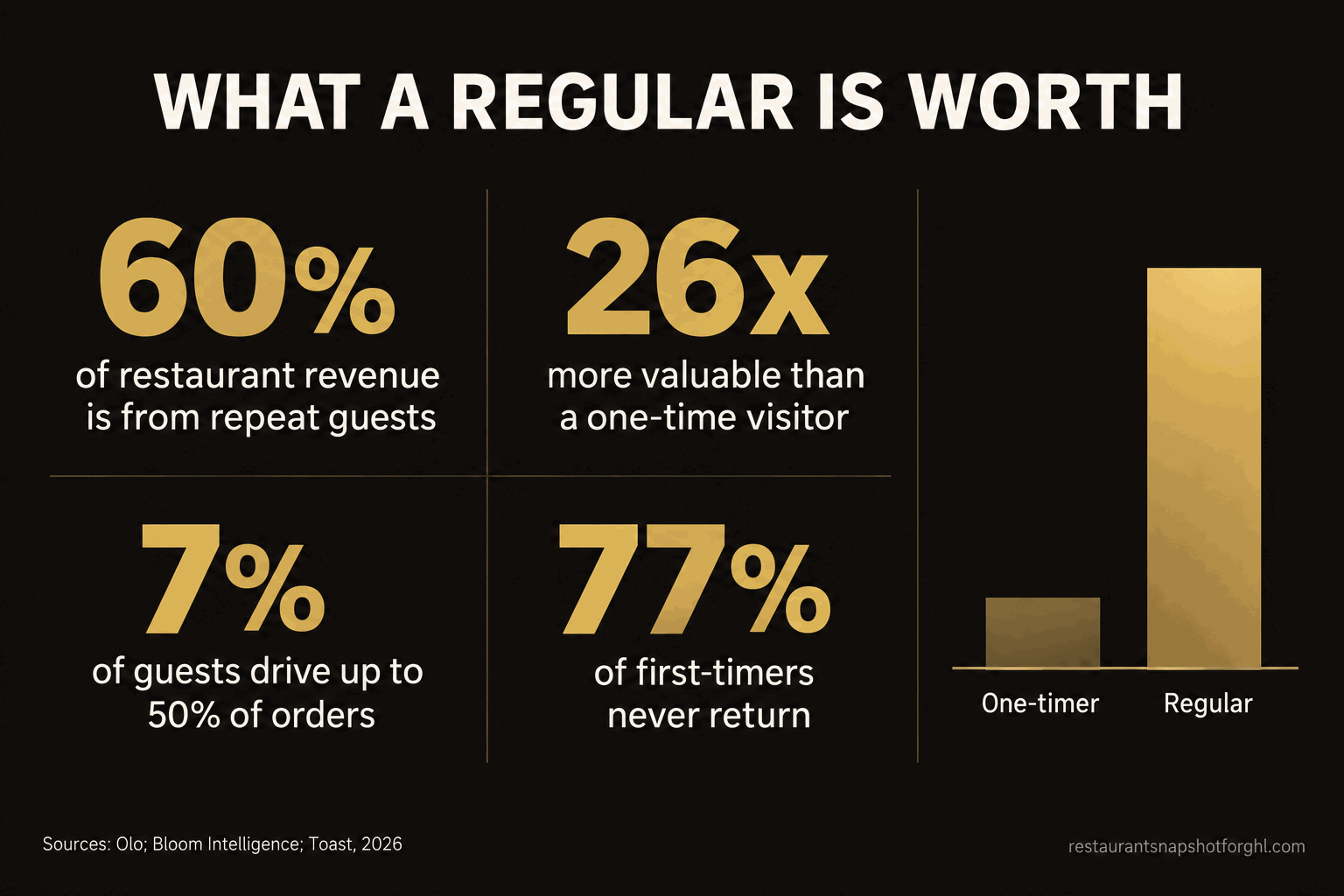
A regular is worth roughly 26 times a one-time visitor, while most first-timers never return. Sources: Olo; Bloom Intelligence, 2026; Toast, 2026.
Now put money on it. Margins here are thin: independents typically net just 3% to 5% after everything is paid, and every cover you lose to churn you tend to replace with a marketplace or delivery cover that costs 15% to 30% in commission (Independent Restaurant Coalition, 2025). The fading regular hurts twice: you lose your best-margin guest, then pay a toll to fill the seat with a worse one.
Here’s the part that should sting: keeping the guest you already earned is far cheaper than buying a new one. Research puts the cost of acquiring a customer at five to twenty-five times the cost of retaining one (Harvard Business Review, 2014), and the foundational Reichheld and Sasser study found that cutting your defection rate by just 5% raised profits by 25% to 85% (HBR via Bain). Chasing strangers to replace regulars you could have kept is the slow, expensive way to stand still.
Why Regulars Really Stop Coming In
If you ask a lapsed regular why they stopped, most won’t give you a clean answer, because there usually isn’t one. The reasons cluster into five buckets, and only one of them is about your food.
- Life changed, not their opinion of you. New job, new commute, a move across town, a kid’s schedule. The Thursday habit had nothing holding it up once the routine shifted.
- The person left. Their server, the bartender who remembered their order, the owner who used to stop by the table. When the relationship walked out the door, the reason to return went with them.
- They felt like a stranger. This is the quiet killer. Guests rarely walk over one bad plate. They drift when nothing signals that the place actually cares whether they come back. It’s the same reason roughly three in four first-timers never return, most of them without a word (Bloom Intelligence, 2026). Nobody was rude. Nobody was warm either.
- Something small chipped away. A price bump they didn’t expect, a favorite dish 86’d one too many times, a wait on a night they’d never waited before. Any one is survivable. Three in a row rewrites the habit.
- A competitor gave them a reason. The new spot two blocks over texted them a birthday offer. You didn’t have their birthday, or their number, so you couldn’t.
Notice what almost none of these are: a formal complaint. That’s the whole problem. Complaints are the loudest, rarest signal. For every guest who tells you what went wrong, many more just stop showing up and say nothing. If your only early warning is “did anyone complain,” you’re blind on the exact guests who matter most. Watch behavior, when they last came in, not just opinions. By the time feedback shows up, they’re already gone.
The Life Cycle of a Fading Regular
A regular doesn’t blink out. They dim on a predictable curve, and each stage has a window where a small nudge does big work:
- The habit. Visits on rhythm, every Thursday or every two weeks. Full value. Don’t break it.
- The first slip. One missed cycle. Harmless alone, but the first sign the rhythm changed. The cheapest moment to act, and the one everybody ignores.
- The drift. Two or three cycles missed. The habit is loosening. A warm reach-out here recovers a lot of guests for almost nothing.
- The fade. Roughly 45 to 60 days past their normal. Now filed under “used to go there.” Recovery takes a real reason, not just a hello.
- The lapse. 90-plus days. A win-back target now, competing with wherever they’ve been going instead.
- Gone. No contact, no data, no way back except paying to reacquire them like a stranger.
The math is brutal: the earlier you act, the cheaper the save. A check-in at the first slip costs a text; a win-back at the lapse costs a discount and a coin flip. Build the system to act at stages two and three, not stage five.
The Six-Stage System to Catch and Keep Them
Here’s the actual build. Six stages, each with what it does and, just as important, how it breaks. That last part is what most “loyalty program” advice skips, and it’s where operators lose the thread.
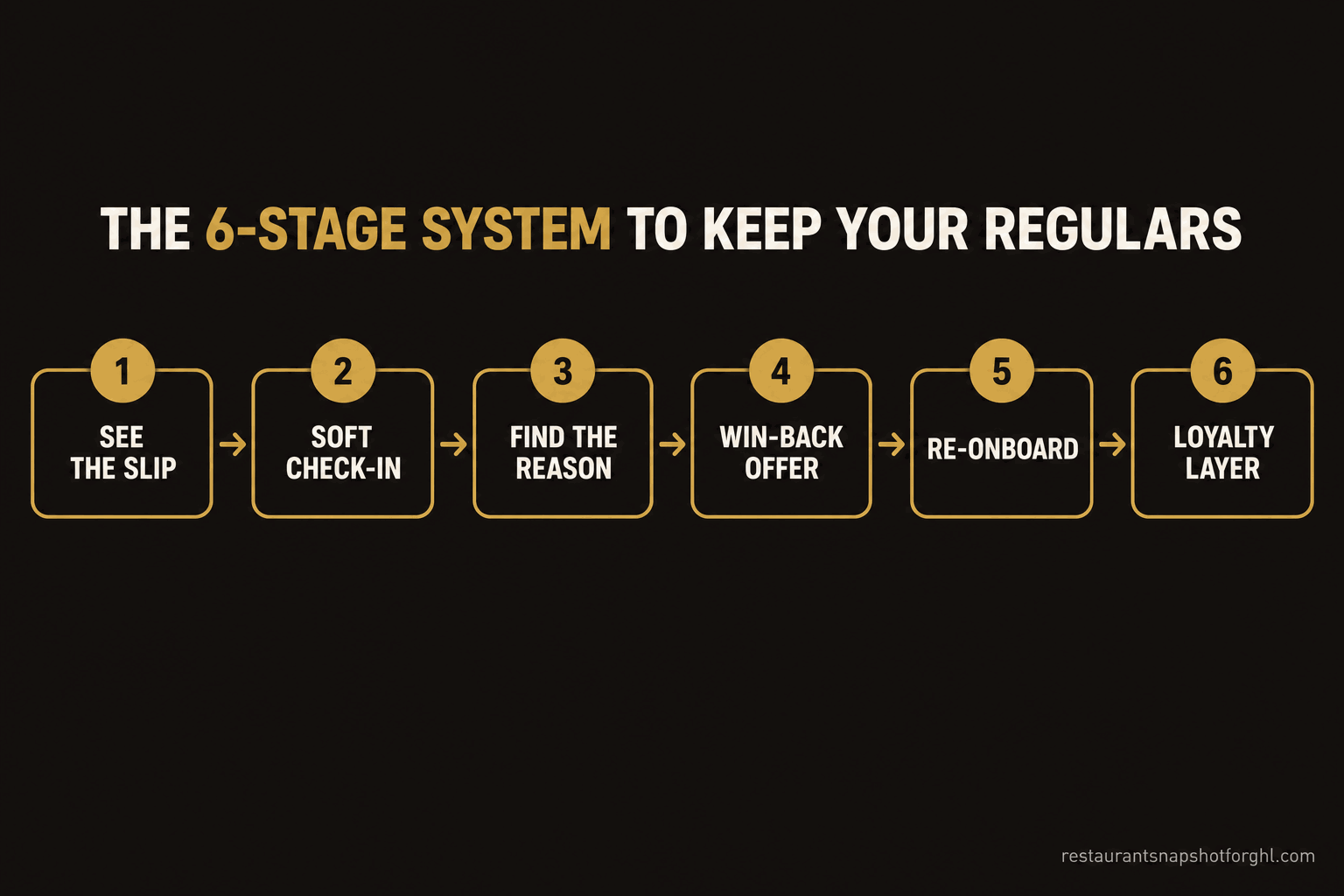
Flag a returning guest whose normal rhythm has broken. Not “hasn’t been in 30 days” for everyone, but “hasn’t been in for their pattern.” A weekly regular quiet for three weeks matters more than a monthly guest at day 25. Pull visit data from your POS or booking tool into one place, tag guests by rough frequency, and trigger an alert when someone passes 1.5x their normal gap.
How it breaks: your data is scattered across a POS, a booking app, and a notebook, so no single view of “who’s slipping” exists. Fix: consolidate guest records into one CRM so recency is one query, not a manual audit nobody has time to run.
Stage 2: The soft check-in (the first-slip touch)
A light, human, no-strings message when a guest first drifts past their rhythm. No offer yet, just “we noticed, we like you, come see us.” Automate a single friendly SMS or email off the Stage 1 trigger, and make it read like the owner typed it.
How it breaks: you make it a coupon on day one and train guests that going quiet earns a discount. Fix: lead with warmth, not money. Save the offer for later stages, and only if the warm touch doesn’t work.
Stage 3: Find the reason (the ask)
Give the guest a frictionless way to tell you what changed, so you can fix real problems and personalize the save. A one-question text works: “Everything good last time? Reply 1 if you loved it, 2 if something was off.”
How it breaks: the feedback goes into a void nobody reads, or a bad answer sits for a week. Fix: route negative replies to a manager instantly and respond within the hour. A guest who feels heard often comes back on that alone. See our restaurant reputation management playbook for turning a rough visit into a recovered guest.
Stage 4: The honest win-back offer (the fade)
For guests who’ve drifted to 45 to 60 days, a specific, genuine reason to return, not a desperate blast. Trigger one clear offer (a favorite dish on the house, a chef’s-table night) and keep it personal: use their name and, if you have it, their usual.
How it breaks: you over-discount and gut your margin, or you fire at everyone including active regulars who’d have come anyway. Fix: scope the trigger tightly to guests who’ve actually gone quiet, and cap the discount. The deeper segmentation and offer mechanics are in our 60-day silent win-back playbook.
Stage 5: Re-onboard the returner (don’t let them slip again)
Treat a recovered guest like a new relationship, not a closed ticket. After a win-back visit, put them back into a normal rhythm: a thank-you, a next-visit nudge on their timeline, birthday and anniversary capture.
How it breaks: you win them back once, celebrate, and drop them, so they fade again in 60 days. Fix: the recovery visit is the start of a new cycle, not the finish line. Loop them back to Stage 1.
Stage 6: Give regulars a standing reason to return (the loyalty layer)
Reduce churn at the source by making “come back” the default. Guests with a standing reason to return, a loyalty program or a birthday club, simply lapse less. Keep it dead simple and SMS-native; it needs no stamp card or app.
How it breaks: the program is complicated, so nobody joins, or it lives in an app the guest never opens. Fix: keep it frictionless. Toast found that getting a guest into a loyalty program lifted their return rate from about 7% to nearly 30% (Toast, 2026). Run one without the plastic using our loyalty program without stamps guide and the birthday club that fills slow Tuesdays.
Guest return rate, baseline versus after joining a loyalty program. Giving a guest a standing reason to return more than quadruples the odds they come back. Source: Toast Regulars Report, 2026.
The Messages You Can Steal Tonight
The system only works if the words feel human. Below is the exact sequence, plain and warm, that you can copy and adapt. Swap in your restaurant name, your voice, and your hours. Every marketing message includes an opt-out, because it has to (more on that below).
The soft check-in (Stage 2, first slip, no offer):
“Hey [First name], it’s [Name] from [Restaurant]. Realized it’s been a minute since we’ve seen you and just wanted to say we miss having you in. No catch, we’d just love to feed you again soon. Reply STOP to opt out.”
The reason-finding ask (Stage 3):
“Quick one, [First name], was everything good the last time you were in at [Restaurant]? Reply 1 if you loved it, 2 if something was off. Either way it helps us. Reply STOP to opt out.”
The instant recovery reply (when they answer “2 / something was off”):
“Thanks for telling me, [First name], that really helps. I’d love to make it right in person, first round or dessert’s on us next time you’re in. When works for you? Just reply here. [Owner name]”
The honest win-back (Stage 4, roughly 45 to 60 days out):
“We saved your table, [First name]. It’s been too long. Come back this week and your [their usual, or ‘first plate’] is on the house, our way of saying we’d love to see you again. Book here: [direct link]. Reply STOP to opt out.”
The re-onboarding thank-you (Stage 5, after the win-back visit):
“So good to have you back, [First name]. Thanks for giving us another shot. Next time you’re planning a night out, we’re holding a seat. Want us to remember your birthday for something special? Reply YES.”
The birthday capture and reward (Stage 6, the standing reason):
“Happy birthday week, [First name]! Come celebrate at [Restaurant] and dessert’s on us, all week. Book your table: [direct link]. Reply STOP to opt out.”
Notice what these have in common: a real name on both ends, a reason that isn’t just a discount, and no begging. The first touch gives before it asks. That’s the difference between “we value you” and “please buy something,” and guests feel it in one sentence. Our restaurant SMS marketing guide covers timing, cadence, and what not to send.
Run It for a Solo Spot, a Mid-Size Team, and a Group
The system is the same. What changes is how much you automate and who runs it. Here’s the honest version for three sizes of operation.
The solo operator (one location, every hat). You have no time to track recency by hand, so automation matters most for you. Get last-visit data into one place and let the first-slip check-in and the win-back fire on their own. Keep offers small and personal; a note that reads like the owner typed it beats any corporate coupon. Skip the fancy loyalty app. A birthday capture and an SMS “come back” flow do more than a punch card ever did. Start with two automations, not ten.
The mid-size team (two to five locations). Now consistency is the risk. One location runs a beautiful win-back, another does nothing, and you can’t see the gap until the quarter closes. Centralize the guest database so a regular at one spot is known at all of them, and standardize the templates so the voice matches everywhere. Assign one person, a manager or a virtual assistant, to own the reason-finding replies, because a negative answer sitting unread for a week is worse than no survey at all. Our restaurant VA overview covers how a trained assistant runs this without adding to your plate.
The multi-unit group (five-plus locations). Here silent churn is a number on a dashboard, not a face you recognize, and that’s the danger. You need reporting on retention and win-back recovery by location so you can catch a slipping venue before its regulars are gone. Shared loyalty is table stakes: a guest should earn and redeem anywhere, with their history following them. Automate ruthlessly, and audit compliance hard, since one careless promo blast across a big list is exactly what draws a TCPA complaint. Solo or fifty locations, the move is the same: get guest data into one system, watch recency, automate the human touch. Only the scale changes.
The Compliance Part Nobody Warns You About
The second you start texting guests, you’re bound by the Telephone Consumer Protection Act (TCPA) and A2P 10DLC carrier rules. This is not optional, and the penalties are real: TCPA violations run $500 to $1,500 per message (FCC). A single non-compliant blast to a few hundred guests can turn into a number that closes a small restaurant.
The classic violation in this niche feels completely innocent: you collect phone numbers at the host stand or on a reservation form, then text everyone a “we miss you” promo. That’s marketing without proper marketing consent. Two rules keep you clean:
- Separate transactional from marketing. A reservation confirmation or a “your table’s ready” note is transactional. A win-back offer or a birthday deal is marketing, and marketing needs its own clear opt-in. Get consent for offers specifically, not buried in a booking checkbox.
- Every marketing message needs an easy opt-out, honored instantly. That’s why STOP is on every promotional text above. When someone replies STOP, they’re out, automatically, no exceptions.
Compliant consent language for your booking or Wi-Fi sign-up form:
“Text me the occasional offer and news from [Restaurant]. Msg & data rates may apply, frequency varies. Reply STOP to cancel, HELP for help. Consent isn’t required to book.”
Log every consent with a timestamp, keep the marketing opt-in separate from the reservation flow, and automate STOP handling so a human forgetting to update a list never becomes your problem. It’s unglamorous plumbing, and it’s exactly what keeps an owner-operator out of a settlement. Our full TCPA and A2P 10DLC guide for restaurants walks through registration and templates.
Objections, Answered Straight
“Won’t a ‘we miss you’ text feel desperate?” Only if it’s a coupon with no heart. A short, warm, no-strings note from a place a guest genuinely liked reads as flattering. The desperate version is the 30%-off blast to everyone; the good version is one human sentence to a guest who’s actually gone quiet. Send the second one.
“I don’t have time to track who’s slipping.” You don’t have to. That’s the point of Stage 1. The system watches recency and only surfaces a name when a guest breaks their pattern, so your time goes into the reply, not the tracking. If even that’s too much, a trained assistant can run it.
“Isn’t a win-back discount just training people to wait for deals?” It can be, if you fire it at everyone constantly. It isn’t, if you scope it to guests who’ve genuinely lapsed and lead with warmth first. Most early-stage saves need no discount at all, just the acknowledgment. Save the offer for the fade stage, and cap it.
“I already have a POS with a loyalty feature. Isn’t that enough?” A loyalty tab is Stage 6, and only if guests use it. It usually doesn’t watch recency, fire a personal check-in when someone slips, or give you ownership of the guest data, which often lives with the vendor. This system wraps around whatever POS you run. For what these tools really cost, see what restaurant marketing software actually costs in 2026.
“My regulars know I care. I don’t need software to prove it.” They know it when you see them. The problem is the ones you don’t see, because the fade happens off your floor, on the weeks they don’t come in. Software doesn’t replace your warmth. It notices the gap you physically can’t, because you were on the line.
Frequently Asked Questions
Why do restaurant regulars stop coming in?
Usually because life changed, not because they got mad. A schedule shift, a move, a favorite server leaving, or simply the absence of a reason to return quietly breaks the habit. Most churn is silent, not tied to a specific complaint, which is why you rarely get a warning and have to watch visit recency instead.
How do I know a regular is about to churn?
Track recency against their own pattern. A guest who came every two weeks and hasn't been in for six has broken their rhythm, that's your signal. The data is already in your POS or booking tool; the trick is getting it into one place and setting an automatic alert when a guest passes about 1.5x their normal gap between visits.
What's the best way to win back a lapsed guest?
Reach out early and warm before you reach out with a discount. A no-strings 'we miss you' at the first slip recovers many guests for the cost of a text. For guests who've drifted 45 to 60 days, a specific offer (a favorite dish on the house, a chef's-table invite) beats a generic percentage off. Keep it personal and cap the discount.
How much is a regular actually worth to a restaurant?
A lot. Repeat guests drive about 60% of restaurant revenue (Olo), and a returning guest averages nearly seven visits and is worth roughly 26 times a one-time visitor while most first-timers never return at all (Bloom Intelligence, 2026). In one restaurant cohort, just 7% of guests, the multi-visit ones, drove up to 50% of total order volume (Toast, 2026).
Is texting lapsed guests legal?
Yes, if you follow the rules. Marketing texts are governed by the TCPA and A2P 10DLC. You need a clear marketing opt-in (separate from a reservation confirmation), an easy opt-out (STOP) on every promotional message, honored instantly, and logged consent. Transactional messages like booking confirmations are treated differently from marketing offers. Violations run $500 to $1,500 per message, so automate compliance.
Do I need to be technical to run a retention system?
No. The setup is a one-time build, tracking, message flows, and a guest database, and then it runs in the background. A done-for-you install handles the technical side, and you just approve the wording and reply to the guests who write back. A trained assistant can even own the replies if your week is already full.
Related reading
- Win back lapsed diners with a 60-day silent trigger
- Restaurant customer lifetime value: how to calculate it (and double it)
- Run a loyalty program without stamps or an app
- The birthday club that fills slow Tuesdays
- Restaurant SMS marketing: cadence, copy, and compliance
- TCPA & A2P 10DLC: what restaurants need to know before sending one SMS
- Get the Restaurant Snapshot installed in 24 hours
Sources
- Olo, 60% of restaurant sales are from repeat guests
- Bloom Intelligence, Restaurant customer retention 2026 guide (26x value, ~77% of first-timers never return) and Turn first-time guests into super guests
- Toast, Regulars Report 2026: restaurant loyalty and retention data
- Reichheld & Sasser, Zero Defections: Quality Comes to Services, HBR (5% retention lift raises profits 25% to 85%)
- Harvard Business Review, The Value of Keeping the Right Customers (5-25x acquisition cost, 2014)
- National Restaurant Association, 2026 State of the Restaurant Industry ($1.55T sales, 15.8M jobs)
- Independent Restaurant Coalition, Delivery apps and independent restaurant margins (2025)
- FCC, Telephone Consumer Protection Act (TCPA)