
It’s 11:40 on a Tuesday night. Service ended two hours ago, the last cook clocked out, and you’re the one still awake — not prepping tomorrow’s specials, but hunched over your phone answering an Instagram DM from someone who wanted a table for six tonight. You missed it during the rush. You’ll answer three more like it before bed, forget to ask the couple at table 9 for a Google review, and never text the regular who hasn’t been in since March. In Miami, where there are nearly 9,000 restaurants competing for the same guests, that quiet pile of missed follow-ups is exactly where covers leak out.
This is the hidden second shift almost every independent operator works: the marketing shift. And it’s the reason a growing number of Miami restaurants have stopped trying to do it themselves and started handing the whole system to a trained GoHighLevel VA instead. This piece is the honest accounting — what the DIY approach really costs you, the five pain points it creates, and what changes when someone who lives in the CRM runs it for you.
Table of Contents
- The 30-second answer
- The hidden second shift: what your marketing really costs
- Why Miami is the hardest market to wing it in
- The five pain points a stretched owner can’t fix alone
- The DIY math: doing it yourself vs. hiring in-house vs. a GHL VA
- What a GoHighLevel VA actually runs for your restaurant
- How to know you’re ready for a GHL VA
- Frequently asked questions
The 30-Second Answer
Miami restaurants hire a GoHighLevel VA because doing the marketing themselves quietly costs more than paying someone to do it right. A GHL VA is a trained specialist who runs your GoHighLevel account — the missed-call text-backs, the reservation reminders that kill no-shows, the review requests, the win-back texts to lapsed regulars — so the system that fills your tables actually runs every day instead of only on the nights you have energy for it.
The alternative isn’t “free.” It’s your own 50-to-60-hour week (ECPI, 2025) stretched even thinner, or a ~$107,000 in-house hire you can’t justify on a 3–5% margin. A VA sits in the gap: expert help for the price of a part-time host, with no payroll tax, no benefits, and no six-month learning curve on the software. For an owner who’d rather be expediting than editing automations, that’s the trade that finally makes sense.
The Hidden Second Shift: What Your Marketing Really Costs
Restaurant owners don’t skip marketing because they don’t believe in it. They skip it because the day is already full. Food-service managers and owner-operators routinely work 50 to 60 hours a week (ECPI, 2025), and almost none of those hours are calm. Marketing becomes the thing you do after — after the line is broken down, after the deposit, after the schedule. Which usually means it doesn’t get done at all.
The industry knows it. In the National Restaurant Association’s 2025 State of the Restaurant Industry report, 83% of operators said technology gives them a competitive advantage, and a majority are leaning on it precisely because they can’t staff up their way out of the problem — 54% report difficulty filling back-of-house and management roles (National Restaurant Association, 2025). Separately, 95% of operators say back-of-house automation would free up time to focus on the business (Toast, 2026). Translation: owners are stretched, hiring is hard, and everyone knows a system should be doing the repetitive work.
Here’s the part that stings on a thin margin. Full-service restaurants average just a 3–5% net profit (Toast, 2026). When margins are that tight, the covers you already earned — the caller you missed, the regular who drifted, the happy guest who never got asked for a review — are the cheapest revenue on the planet. Losing them to a follow-up you didn’t have time for isn’t a marketing miss. It’s money left on table 9.
Why Miami Is the Hardest Market to Wing It In
Every city is competitive. Miami is a different animal. There are roughly 8,720 restaurants across Miami-Dade’s urban and coastal neighborhoods (Current Backyard, 2025), and in 2025 Miami was ranked the #1 best foodie city in America (Islands, 2025). New concepts open constantly, from Brickell to Little River, and well-capitalized groups are bidding up rent and staff against the mom-and-pop spots that built the scene.
What that means for you is simple and brutal: the guest you don’t answer has ten other options within a mile, and every one of them is one tap away. In a sleepy market, a slow reply costs you a little. In Miami, it costs you the table — to a competitor who happened to respond first.
The Five Pain Points a Stretched Owner Can’t Fix Alone
When one person is chef, GM, and marketer, five specific leaks open up. None of them is dramatic on any single night — which is exactly why they go unnoticed until you add up a slow month.
1. The inquiries you never answer in time
A hungry party calls during the 7:30 crush, gets voicemail, and books elsewhere before you’ve plated the next ticket. This isn’t a small effect. The average business takes 42 hours to respond to a new inquiry, and firms that reach out within an hour are about 7× more likely to qualify the lead than those that wait even one hour longer (Harvard Business Review, 2011). In restaurants, the window is tighter still — a dinner decision is made in minutes.
A missed-call text-back that fires the instant you can’t pick up turns that lost voicemail into a booked table — and it never gets tired at 7:30.
2. No-shows you never confirmed against
A booked table that doesn’t show is a double loss: the empty seats and the walk-in you turned away to hold them. Without automated confirmations and reminders, every reservation is a coin flip. The fix — a simple SMS confirm-and-remind sequence — is well understood, but it only works if it runs every single day. That’s precisely the kind of task that dies when the person responsible is also on the line. (We break the full sequence down in the no-show recovery playbook.)
3. The guest list that’s quietly rotting
Every diner who’s ever called, booked, or scanned a QR code is an asset — and for most restaurants, that list sits untouched. That’s expensive, because acquiring a brand-new customer costs 5 to 25× more than keeping one you already have (Harvard Business Review, 2014), and a 5% lift in retention can raise profit by 25–95% (Bain & Company). A 60-day win-back text to a lapsed regular is nearly free and converts like almost nothing else — but only if someone builds and runs it.
4. Reviews you keep meaning to ask for
Reviews are the currency of the Miami map pack, and the best time to ask is at the peak of a great meal — which is also the exact moment you’re slammed. So the ask never happens, your review count stalls, and you slide down the local results while the spot down the block, with an automated request firing after every visit, climbs. Reputation and local SEO are the same motion, and both depend on a system that asks so you don’t have to.
5. Marketing that starts, stops, and starts again
The most common pattern isn’t no marketing — it’s streaky marketing. A burst of energy in January, a specials blast in March, then silence through a busy summer. Guests can feel the inconsistency, and algorithms punish it. A system doesn’t have moods. It sends the birthday club text, the Tuesday special, and the win-back on schedule whether or not you slept.
The DIY Math: Doing It Yourself vs. Hiring In-House vs. a GHL VA
When owners finally decide the leaks are too costly, they face three doors. Only one of them fits a restaurant’s economics.
Door 1 — Keep doing it yourself. No cash outlay, but it costs the scarcest thing you have: your hours and your focus. On a 50-to-60-hour week, “I’ll get to the marketing” is a promise you break most nights, and the leaks keep leaking.
Door 2 — Hire an in-house marketer. A dedicated marketing manager averages ~$107,000 a year (Glassdoor, 2025) before benefits, payroll tax, and overhead — a number that’s almost impossible to justify against a 3–5% margin, and overkill when what you actually need is someone to run the system, not build a brand from scratch.
Door 3 — A trained GoHighLevel VA. Restaurant-specific expertise, starting around $700/month — less than many restaurants pay a single part-time host — with no payroll tax, no benefits load, and no ramp time on the software. It’s the only door where the cost matches the job.
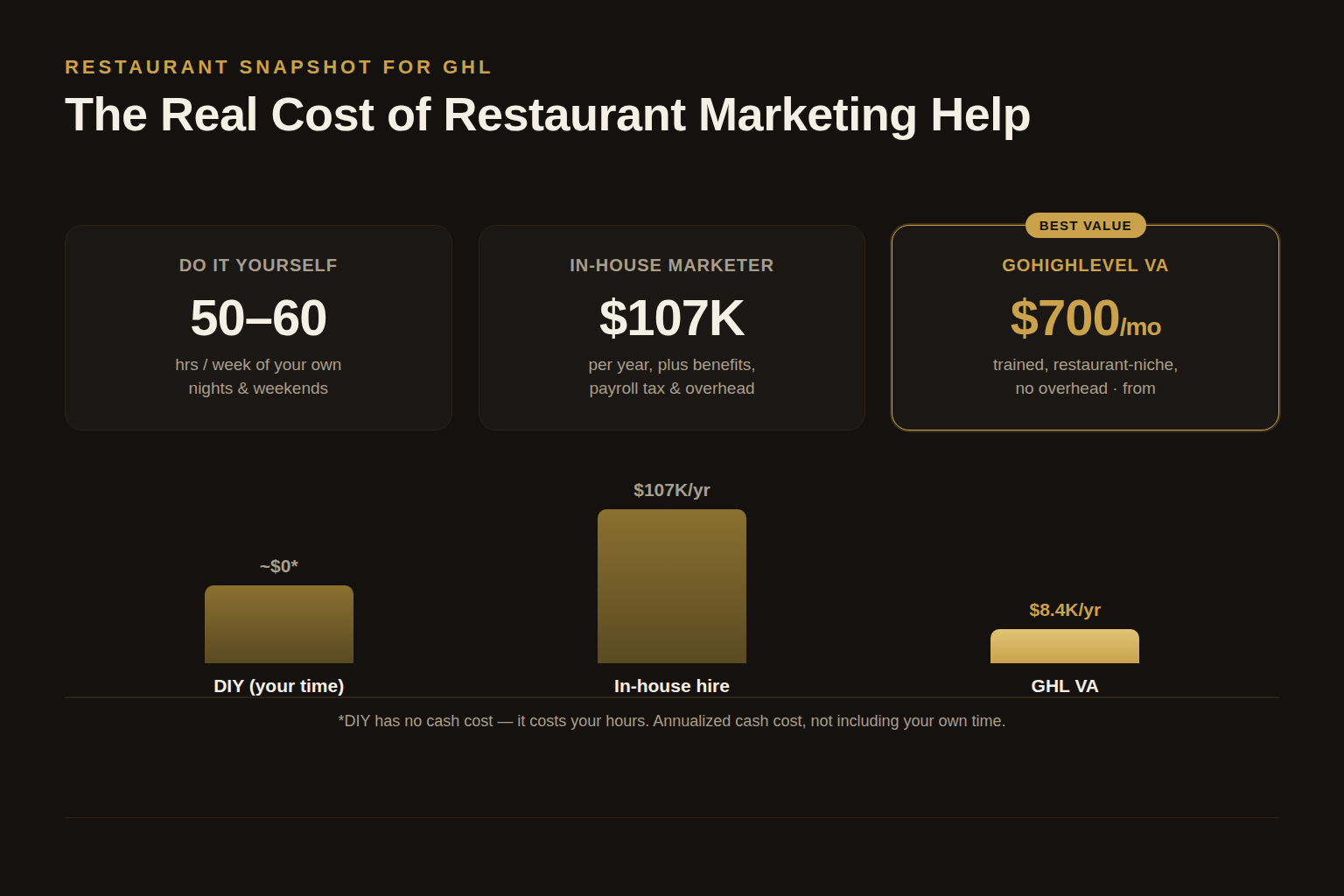
Three ways to run your restaurant's marketing
| Plan | Do it yourself | In-house marketer | GoHighLevel VA recommended |
|---|---|---|---|
| Price | Your nights | ~$107K/yr | From $700/mo |
| Feature 1 | $0 cash — but 50–60 hr weeks get thinner | ~$107,000/year before benefits & overhead | Trained on restaurant GHL from day one |
| Feature 2 | Follow-ups happen only when you have energy | Hard to justify on a 3–5% margin | Runs capture, booking, reminders, reviews & win-backs |
| Feature 3 | No one registers A2P 10DLC or fixes broken flows | Weeks to recruit; harder in a tight labor market | Handles A2P 10DLC & TCPA-compliant texting |
| Feature 4 | Marketing is streaky: bursts, then silence | Overkill when you need a runner, not a brand-builder | No payroll tax, benefits, or long-term contract |
| Feature 5 | You're the bottleneck for every campaign | Still needs training on GoHighLevel specifically | Scales hours up or down with your season |
| Feature 6 | Covers leak quietly and you rarely see why | You carry payroll tax, PTO, and turnover risk | You run the floor; the system runs itself |
| See VA plans → |
What a GoHighLevel VA Actually Runs for Your Restaurant
“VA” undersells it. A restaurant-niche GoHighLevel VA isn’t a generalist answering emails — they’re the operator of your entire guest-communication engine. Here’s the loop they own, end to end.
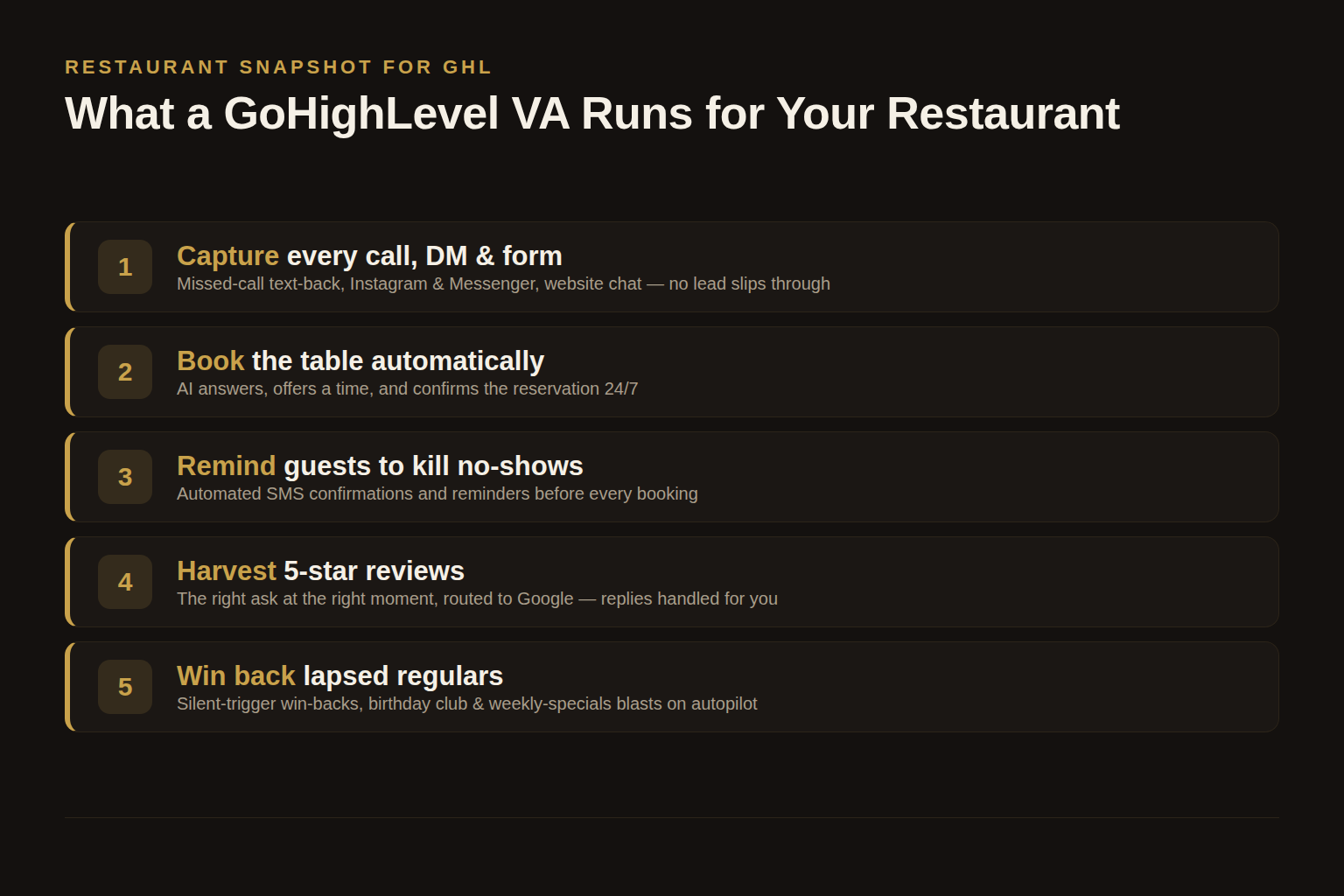
- Capture everything. Missed-call text-back, Instagram and Messenger DM-to-booking flows, website chat, and web forms — all routed into one inbox so no inquiry dies in a notification pile.
- Book the table. The AI answers a booking question, offers an available time, and confirms — 24/7, in the middle of your rush or at 2 a.m.
- Kill no-shows. Automated confirmations and reminders go out before every reservation, and the waitlist auto-fills a cancellation.
- Harvest reviews. The ask fires at the right moment after a visit, routes happy guests to Google, and quietly flags an unhappy one to a manager before it becomes a public one-star.
- Win back the lapsed. A silent 60-day trigger, the birthday club, and the weekly-specials blast run on schedule — turning your existing list into repeat covers.
Your VA builds these workflows, keeps them compliant, watches what’s converting, and adjusts — the ongoing operating work that a set-it-and-forget-it tool never does on its own. If you want the full system pre-built, the Restaurant Snapshot installs the whole engine in about 24 hours; a VA is who then runs it for you day to day. Want the deeper background on the platform itself? Start with GoHighLevel for restaurants.
How to Know You’re Ready for a GHL VA
A VA isn’t for every restaurant on day one. You’re ready when most of these are true:
- You’re the bottleneck. Campaigns, replies, and review asks only happen when you personally do them — so they mostly don’t.
- You already have (or want) GoHighLevel or a snapshot, but it’s underused — the workflows aren’t built, or they broke and nobody fixed them.
- You can see the leaks. Missed calls, no-shows, a stale guest list, a review count that hasn’t moved in months.
- You’d rather buy hours than salary. You want expert help without a $107K hire or a full-time headcount you can’t staff.
- You want consistency, not heroics. The goal is a system that runs every day, not a marketing sprint every quarter.
If you’re nodding along, the move is simple: start with a free walkthrough of where your covers are leaking, and see whether a VA plan — or the done-for-you snapshot plus a VA to run it — fits your restaurant. Either way, the second shift ends.
Frequently Asked Questions
Miami GoHighLevel VA — common questions
What exactly is a GoHighLevel VA for a restaurant?
A GoHighLevel VA is a trained specialist who runs your GoHighLevel (GHL) account for you — building and maintaining the automations that capture inquiries, book tables, send reservation reminders, request reviews, and win back lapsed guests. Unlike a general virtual assistant, a restaurant-niche GHL VA already knows the platform and the restaurant playbook, so they operate your guest-communication engine day to day instead of you doing it at midnight. Plans start around $700/month with no long-term contract.
Why not just hire an in-house marketer for my Miami restaurant?
You can, but the math rarely works for an independent restaurant. A full-time marketing manager averages roughly $107,000 a year before benefits and overhead (Glassdoor, 2025), which is hard to justify against a 3–5% net margin (Toast, 2026). It's also more than you need: most restaurants don't need someone to invent a brand — they need someone to run a proven system. A GoHighLevel VA gives you that operating expertise for a fraction of the cost, with no payroll tax, benefits, or turnover risk.
Do I need to already own GoHighLevel or the Restaurant Snapshot?
Not necessarily. Some owners come in already using GoHighLevel and just need someone to run it; others start fresh. A common path is the done-for-you Restaurant Snapshot, which installs the full booking, reminder, review, and win-back engine in about 24 hours, paired with a VA who then operates it. If you already have an account, the VA audits what you have, fixes or rebuilds the workflows, and takes over from there.
How much time will a GHL VA actually save me?
Most of the recurring marketing work that eats your nights — answering inquiries, chasing no-shows, asking for reviews, texting lapsed guests, running specials — moves off your plate entirely. Owner-operators commonly work 50–60 hour weeks (ECPI, 2025), and this is the slice of that week you get back. Just as important, the work now happens consistently and on time, which is where the extra covers come from.
Is automated texting to guests legal and compliant?
Yes, when it's done correctly. U.S. business texting is governed by the TCPA and the A2P 10DLC registration system, which require proper consent, clear opt-outs (reply STOP), and registered messaging. A trained GoHighLevel VA handles that registration and builds your flows to be compliant from the start — one of the biggest reasons to have a specialist run it rather than winging it yourself.
Why does response speed matter so much for a restaurant?
Because dining decisions are made in minutes and Miami guests have thousands of alternatives. Research shows the average business takes 42 hours to respond to a new inquiry, and replying within an hour makes you about 7× more likely to qualify that lead (Harvard Business Review, 2011). A restaurant that answers instantly — via missed-call text-back and AI chat — captures the table before a competitor down the block ever gets the chance.
Marisol spent nine years running front-of-house and marketing for a three-location Tex-Mex group before going all-in on automation. She now designs GoHighLevel snapshots for independent restaurants and small multi-unit operators, with a soft spot for AI booking flows and review pipelines that actually fill slow weeknights. She writes the way she ran her floor: practical, fast, and allergic to fluff.
Related reading
- GoHighLevel for restaurants: the complete 2026 guide
- Missed-call text-back for restaurants
- The no-show recovery playbook
- Win back lapsed diners with a 60-day silent trigger
- Restaurant customer lifetime value: how to calculate it (and double it)
Sources
- Current Backyard — Miami Food & Dining Scene: 2025 City Stats (≈8,720 restaurants in Miami-Dade)
- Islands — This Florida City Is America’s Best For Foodies In 2025 (Miami #1)
- Harvard Business Review — The Short Life of Online Sales Leads (42-hour average; ~7× within an hour)
- Harvard Business Review — The Value of Keeping the Right Customers (5–25× acquisition cost)
- Bain & Company / Fred Reichheld — Prescription for Cutting Costs (5% retention → 25–95% profit)
- Toast — Average Restaurant Profit Margin (3–5% full-service)
- Toast — Restaurant Management Statistics (95% say automation frees time)
- National Restaurant Association — 2025 State of the Restaurant Industry (83% tech advantage; 54% hiring difficulty)
- ECPI University — How Many Hours Does a Food Service Manager Work? (50–60 hrs/week)
- Glassdoor — In-House Marketing Manager Salary (~$107K average, 2025)