
It’s a Sunday night and you’re doing the thing every owner does at least once a year: laptop open on the pass, three tabs of software invoices, a legal pad, trying to answer one question. How much am I spending every month to market this place? An hour later you still don’t have a clean number. There’s the POS add-on, the website tool, the loyalty thing your last manager signed up for, a texting line, and a reservation platform that bills a little more every busy month. None shows the real total on one screen, and that’s not an accident.
This is a straight, numbers-first teardown of what restaurant marketing software costs an independent operator in 2026: the sticker prices, the add-ons that don’t show up until the second invoice, and three honest budgets for a solo spot, a busy room, and a small group. No spin, just the math.
Table of Contents
- The 30-second answer
- Why restaurant marketing software pricing is so hard to pin down
- The five buckets your marketing dollars fall into
- What each tool actually costs in 2026
- Three real budgets: solo, busy independent, small group
- The 8 questions to ask before you sign anything
- The compliance line item nobody quotes you
- Objections, answered straight
- Frequently asked questions
The 30-Second Answer
Most independent restaurants overpay because they buy marketing software by the sticker price and get billed by the transaction. Price out the whole stack, per-unit fees included, before you sign. A lean solo setup runs about $350 to $450/mo; a busy one-location room with the full kit lands near $900 to $1,300/mo; a three-location group often runs $5,000 to $8,000/mo before per-order and per-cover fees.
The single biggest lever isn’t which vendor you pick. It’s how much of your demand you own versus rent: every per-cover and per-order fee buys a guest whose data lives on someone else’s platform.
Why Restaurant Marketing Software Pricing Is So Hard to Pin Down
Three things make this category almost impossible to shop honestly.
First, the important prices are gated. Toast doesn’t list its Marketing add-on on its public pricing page; Popmenu, Thanx, and Punchh route you to a “book a demo” wall before a number. A gated price usually flexes with how much they think you’ll pay.
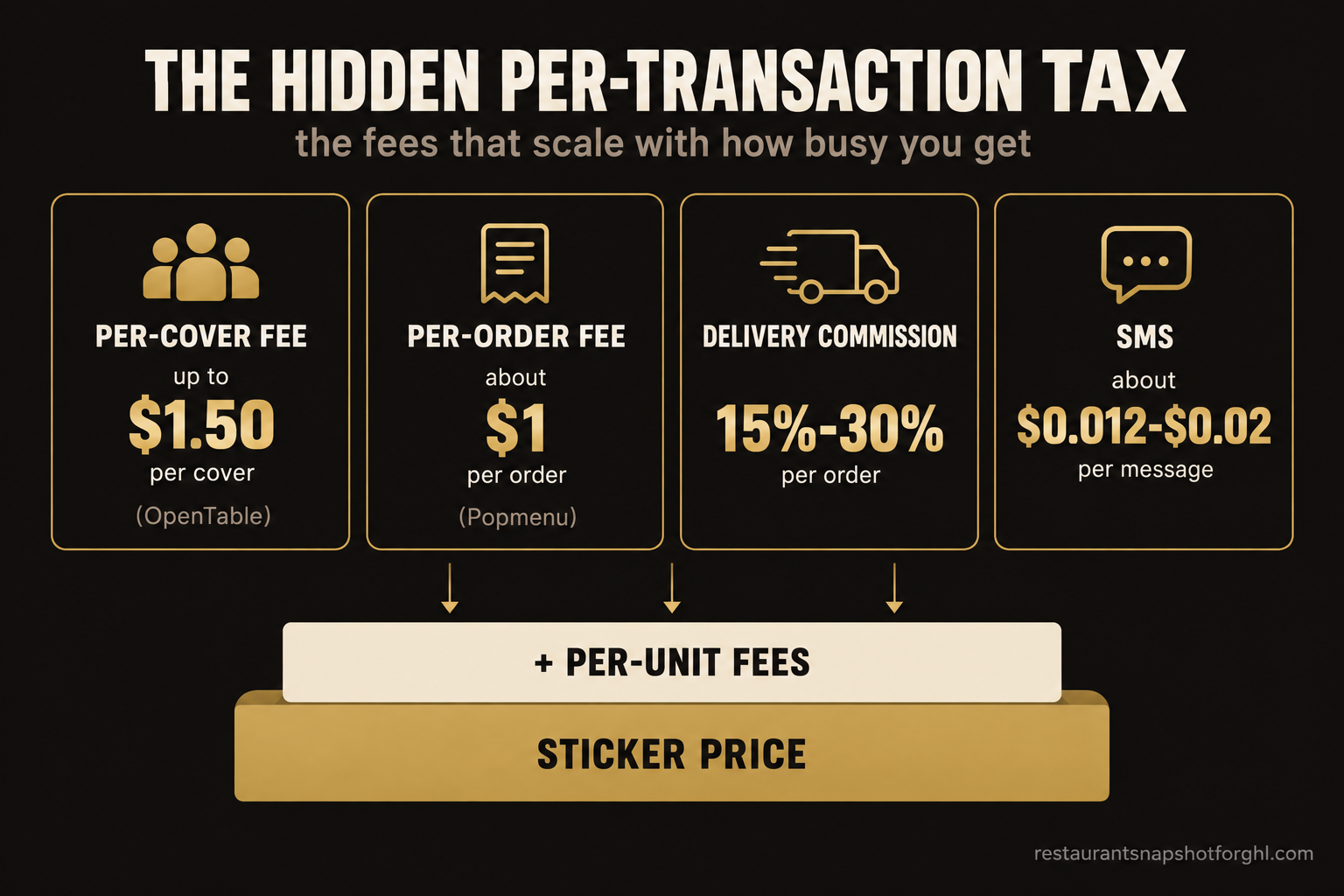
Second, the sticker is a fraction of the bill. A plan says $149 or $185 a month, then per-cover fees, per-order fees, processing points, and per-message charges stack on top, all scaling with how busy you are. You have a great month, and your software quietly bills you more for it.
Third, no single vendor sells you the whole stack, so nobody shows you the total. Each invoice looks reasonable alone; added up, they’re a line cook’s wages.
The National Restaurant Association projects $1.55 trillion in industry sales for 2026, yet reports 42% of operators were not profitable in 2025 (NRA, 2026). On a net margin that typically runs just 3% to 5% (Level CFO, 2026), a bloated software stack is the difference between a profitable year and a flat one.
The Five Buckets Your Marketing Dollars Fall Into
Almost every marketing-software dollar an independent spends falls into one of five buckets:
- POS-bundled marketing. Email, gift cards, and loyalty as an add-on to your point of sale (Toast Marketing).
- All-in-one website and ordering. A branded site with menus, ordering, and marketing baked in (Popmenu).
- Loyalty and guest CRM. Points, rewards, and guest profiles (Thanx, Punchh) at the pricier enterprise end.
- Reservations and discovery. OpenTable, Resy, Yelp Guest Manager, where the fee model, not the sticker, decides the real cost.
- The plumbing: SMS and email. The lines that carry your promotions, priced per message and per carrier.
Let’s price each.
What Each Tool Actually Costs in 2026
Entry sticker prices, before the per-transaction charges that do real damage:
Entry monthly sticker prices, single location, 2026 reporting. Loyalty (Punchh) is quote-only; the bar shows a widely reported floor, and real quotes run higher. Sources: Yelp, EatApp OpenTable pricing, RestoLabs on Popmenu, UpMenu on Toast, ITQlick on Punchh.
POS-bundled marketing: Toast Marketing
If you run Toast, the base POS is cheap to start: a $0/mo Starter Kit and a $69/mo Point of Sale tier (Toast pricing). The marketing is where it adds up. Toast Marketing, the bundle that pulls in email, loyalty, and gift cards, is not listed on that public pricing page. Third parties consistently report it around $185/mo, quoted only after you talk to sales, with a lighter email-only tier near $75/mo (UpMenu, 2026). Card processing (commonly reported around 2.49% plus $0.15 per in-person swipe) isn’t marketing, but it’s real money on every cover, so count it too (Merchant Insiders, 2026).
Where it breaks: the marketing tools are only as good as the guest data inside them, and that data is tied to Toast. Leave, and the email list, loyalty balances, and guest history get complicated fast. Right call when: you’re committed to Toast anyway and have priced the add-on against a standalone email and SMS tool.
All-in-one website and ordering: Popmenu
Popmenu sells one tool for your website, ordering, and marketing. Base plans are reported at $179, $299, and $499/mo (Starter, Essentials, Premier), roughly 10% off annually (RestoLabs, 2026). That’s the sticker; the bill is bigger.
Online ordering is commonly an add-on around $50/mo plus about $1 per order, an extra location runs a few hundred a month, and catering can carry a processing percentage (RestoLabs, 2026). A spot doing 800 online orders a month pays another $800 in per-order fees alone.
Where it breaks: that per-order fee scales with your success like a delivery commission, and it applies to your own direct orders, undercutting the whole reason to run a branded ordering page. Right call when: you genuinely need website plus ordering plus marketing and your order volume keeps the per-order fee small.
Loyalty and guest CRM: Thanx and Punchh
This is where the numbers go dark. Neither Thanx nor Punchh publishes a price. Aggregators put Thanx entry around $99/mo with enterprise near $500 per location (SaaSworthy, 2026), and Punchh (owned by PAR) reportedly starting around $500/mo and climbing with users, locations, and setup fees (ITQlick, 2026). Treat all of these as estimates; the only real number is your quote.
Where it breaks: enterprise loyalty is built for chains with a marketing department, and the pricing assumes one. A one-to-three location independent often pays chain money for a program guests touch a few times a year. Right call when: you’re a growing group with the volume to justify it, and you’ve compared it against loyalty inside a CRM you already pay for.
Reservations and discovery: OpenTable, Resy, Yelp
Reservation platforms get their own deep dive: OpenTable vs Resy vs Tock vs SevenRooms, priced out. For your budget, the short version: OpenTable runs $149 to $499/mo plus a per-cover fee up to about $1.50 on network bookings, while flat-rate options like Resy (reported around $249 to $399/mo) and Yelp Guest Manager at about $99/mo charge no per-cover fee (EatApp, 2026; Yelp). One 2026 note: Amex, which owns Resy, has signaled Tock is merging into Resy, so don’t lock into standalone Tock pricing without confirming (Restaurant Bottom Line, 2026).
Where it breaks: the per-cover model bills you more as you get busier, and the guest who booked through the app belongs to the app. Right call when: you truly need discovery you can’t create yourself. If you already have demand, a flat-rate book plus your own direct-booking page costs less. Toast’s 2025 data found 65% of diners go straight to the restaurant’s website (Toast, 2025).
The plumbing: SMS and email
Operators underestimate this in both directions. Here are the real, verified 2026 numbers for A2P 10DLC, the registered-business texting standard every restaurant must use:
- Carrier fee: about $0.003 per message segment, each direction.
- Campaign fee: $2/mo sole proprietor, $10/mo standard use case.
- One-time brand registration: about $24.50 low-volume, up to $71.91 for high-volume (HighLevel, 2026).
With the message rate included (Twilio, 2026), a blast to 1,000 opted-in guests costs roughly $15 to $20 plus the small campaign fee. It’s the cheapest, highest-return channel in this teardown. See our guides on restaurant SMS marketing and email that wins guests back.
Where it breaks: skip A2P registration and your carrier quietly filters your texts, and you never find out why open rates cratered. Register before you send message one.
Three Real Budgets: Solo, Busy Independent, Small Group
The right answer changes with your size. Here’s the whole stack run three ways. Every figure is an illustrative estimate based on the reported pricing above, excluding payment processing and per-order or per-cover fees unless noted.
Scenario 1: the solo operator. One location, kept lean.
- Toast POS ($69) + Toast Marketing ($185) + Yelp Guest Manager ($99) + SMS and email (
$30) = **$383/mo, or ~$4,600/yr**
Scenario 2: the busy independent. One high-volume location that wants the full kit.
- Popmenu Premier ($499) + online ordering ($50) + OpenTable Core ($299) + loyalty (
$300) = **$1,148/mo, or ~$13,800/yr**, before per-order and per-cover fees
Add 800 online orders and 1,000 network covers at ~$1 each and you’ve layered another $1,800 a month of variable fees on top.
Scenario 3: the small group. Three locations.
- Punchh-style loyalty (
$2,000) + Popmenu ×3 ($1,500) + reservations ×3 ($1,200) + messaging at scale ($300) = ~$5,000/mo, or ~$60,000/yr, often more with contracts and setup
At group scale, per-location pricing is the whole ballgame, and one flat platform covering loyalty, reviews, and messaging across all three rooms can cut it substantially.
Estimated annual software subscription spend by operator size, before payment processing and per-order/per-cover fees. Illustrative, built from the 2026 reported pricing cited above.
The 8 Questions to Ask Before You Sign Anything
Before you sign or renew any tool, make the rep answer these eight questions in writing. Gated pricing only works on operators who don’t ask. Steal this list:
- “What’s the all-in monthly price, with every add-on I actually need?” Include ordering, loyalty, and extra locations, not the headline plan.
- “What are the per-transaction fees, and on which transactions?” Per cover, per order, per message, processing points, including your own direct orders.
- “What’s the contract length and the early-termination fee?” Enterprise loyalty often hides a multi-year term.
- “What are the one-time setup or customization fees?” These run into the thousands and rarely appear in the pitch.
- “Do I own my guest data, and can I export it in full, for free, anytime?” Anything but a clean yes means the tool owns your list.
- “What happens to my loyalty balances, reviews, and history if I leave?” The exit terms tell you more than the sales deck.
- “Is A2P 10DLC registration included, and who handles it?” For anything that texts guests, this is not optional.
- “Show me the total on one invoice.” If they can’t put the real number on one screen, that’s your answer on transparency.
Put every vendor’s numbers in one spreadsheet: base fee, add-ons, per-transaction fees, setup, contract length. The prettiest demo is rarely the cheapest once that grid is filled in.
The Compliance Line Item Nobody Quotes You
The moment you text a guest list you collected yourself, you’re bound by the Telephone Consumer Protection Act (TCPA) and A2P 10DLC rules. The classic violation feels harmless: your host grabs numbers at the stand, and you blast a “half-price wine Tuesday” text. That’s marketing without proper consent, and penalties run $500 to $1,500 per message (FCC).
Two rules keep you clean: a reservation confirmation is transactional, but a promo blast is marketing that needs its own opt-in, and every marketing message needs a clear opt-out. Here’s compliant consent language for your booking or Wi-Fi form. Steal it:
“Text me reservation updates and occasional offers from [Restaurant]. Msg & data rates may apply. Msg frequency varies. Reply STOP to cancel, HELP for help. Consent isn’t a condition of dining with us.”
Keep the transactional confirmation and the marketing opt-in separate, log every consent with a timestamp, and honor STOP automatically. Our full TCPA and A2P 10DLC guide for restaurants walks through registration and templates.
Objections, Answered Straight
“Isn’t an all-in-one bundle cheaper than piecing tools together?” Sometimes it’s the opposite. A bundle wins when you’d buy every piece separately at full price, and loses when you pay for modules you barely use or the per-order fee on your own page erases the savings.
“I already pay for Toast, so the marketing add-on is basically free, right?” No. It’s a separate charge, commonly reported near $185/mo, on top of your POS and processing (UpMenu, 2026). Call it what it is: another $2,200 a year. Compare it against a standalone email and SMS tool.
“I’m not technical enough to run my own stack.” You don’t have to be. The choice isn’t “enterprise bundle” versus “wire it up yourself at midnight.” A done-for-you setup installs the booking flow, review requests, loyalty, and compliant texting, so you own the guest data without becoming a systems admin.
“Won’t cheap SMS get me in TCPA trouble?” Only if you skip consent, which has nothing to do with the price of the message. Register your brand and campaign, collect real opt-ins, honor STOP, and cheap texting is your safest, highest-return channel.
“The all-in-one just works, why complicate it?” Convenience is worth paying for right up until the per-order and per-location fees make it your largest controllable cost. It isn’t worth an extra ten to fifteen thousand a year if a leaner stack does the same job.
The One Line That Changes the Math
The more of your demand you own, the less you pay to rent it. A per-cover fee, a per-order fee, a delivery commission of 15% to 30% (Kwick, 2026): each charges you to reach a guest through someone else’s platform, and each is expensive precisely because acquiring a new customer costs about five times more than keeping one you have (Bain & Company). So the highest-return line in your budget isn’t a flashier acquisition tool. It’s the boring stack that turns a first visit into a fifth: a guest list you own, a birthday text, a win-back at 45 days, loyalty in your own CRM. See restaurant customer lifetime value and the 60-day win-back trigger.
Frequently Asked Questions
How much does restaurant marketing software cost per month in 2026?
A lean independent stack runs about $350 to $450 a month (a POS marketing add-on, a flat-rate reservation tool, and basic texting and email). A busy one-location spot that adds an all-in-one website, online ordering, and loyalty typically runs $900 to $1,300 a month before per-order and per-cover fees. A three-location group often lands between $5,000 and $8,000, driven by per-location loyalty and reservation contracts.
How much does Toast Marketing cost?
Toast does not list it on its public pricing page. Third parties consistently report it around $185 a month, quoted only after a sales call, with a lighter email-only tier near $75. That is on top of Toast's base POS ($0 or $69 a month) and card processing (commonly reported around 2.49% plus 15 cents per in-person transaction). Treat the $185 as reported, not official, and get your own quote in writing.
Why won't loyalty platforms like Thanx and Punchh show their prices?
Both use custom, quote-only pricing gated behind a demo, because the price flexes with your size. Aggregators estimate Thanx from around $99 a month up to roughly $500 per location at the enterprise end, and Punchh starting near $500 and climbing with users, locations, and setup fees. The only real number is the one in your quote, so ask for the all-in monthly total and the contract length before you sign.
Is SMS marketing for restaurants expensive?
No. Under the A2P 10DLC standard, carrier fees run about $0.003 per message segment, plus a $2 to $10 monthly campaign fee and a one-time brand registration around $24.50 to $72. With the message rate included, a promo text to 1,000 opted-in guests costs roughly $15 to $20. It is the cheapest, highest-return channel in the stack, as long as you register properly and collect real consent.
How do I lower my restaurant marketing software costs without losing capability?
Add up the whole stack on one spreadsheet, cut tools with overlapping features, favor flat-rate pricing over per-transaction fees, and shift spend toward retaining guests rather than renting new ones. Running loyalty, reviews, and texting from one CRM you own usually replaces two or three subscriptions at a lower total, and keeps the data yours.
Related reading
- OpenTable vs Resy vs Tock vs SevenRooms: what a reservation system really costs in 2026
- Restaurant SMS marketing: the compliant, high-return channel most owners neglect
- Restaurant email marketing that actually wins guests back
- A loyalty program without stamps, punch cards, or a per-location contract
- Restaurant customer lifetime value: the number that changes every decision
- TCPA & A2P 10DLC: what restaurants need to know before sending one SMS
- Get the done-for-you system installed in 24 hours
Sources
- National Restaurant Association, 2026 State of the Restaurant Industry
- Toast, pricing and 2025 reservation data; UpMenu on Toast; Merchant Insiders
- RestoLabs on Popmenu; ITQlick on Punchh; SaaSworthy on Thanx
- HighLevel A2P 10DLC fees; Twilio US SMS pricing
- Yelp Guest Manager; EatApp OpenTable pricing; Level CFO margins; Bain & Company on retention
- FCC, Telephone Consumer Protection Act (TCPA)