
It is a slow Tuesday and you are staring at a half-empty room, thinking what every owner thinks: I have served thousands of people who loved this place. Where did they all go? You have their faces in memory and nothing in hand. No phone numbers, no emails, no birthdays. All that data lives inside OpenTable, which is not going to hand it over so you can text those regulars to come in tonight. You paid, cover by cover, to fill your room, and walked away owning none of the relationships.
You do not have a marketing problem. You have an ownership problem. This is the fix: a step-by-step system for building a first-party guest list you actually own, so you can fill a dead night with the diners you already earned, market to them for pennies, and keep the whole list the day you switch platforms.
Table of Contents
- The 30-second answer
- What renting your guest list actually costs
- Rented vs owned: what owning the list really means
- The 6-stage system to build a list you own
- Steal this: the exact capture and consent copy
- Three ways to run it: solo, busy independent, small group
- Objections, answered straight
- Frequently asked questions
The 30-Second Answer
Owning your guest list means every diner’s name, mobile number, email, birthday, and visit history sits in a database you control, not inside a booking platform or a delivery app. You build it by turning every touchpoint into a capture point, collecting real consent, storing it in one guest record, and marketing to it directly. Once you own it, filling a slow night costs a text message instead of another per-cover fee. The platforms run your book. They should not own your guests.
What Renting Your Guest List Actually Costs
On OpenTable you pay a monthly subscription, then a fee every time a guest books through the marketplace. As reported across independent teardowns in 2026, Basic runs $149/mo plus $1.50 per network cover, Core $299/mo plus $1.00 per cover, and Pro $499/mo (TableLink, 2026; Eat App, 2026). The per-cover fee is the rent, and it grows every good month.
At 1,000 network covers a month, the per-cover fee alone is $1.50 times 1,000 times 12, which is $18,000 a year before the monthly plan. Compare that with reaching those same covers through channels you own.
Estimated yearly cost to reach 1,000 repeat covers a month, by channel. OpenTable = per-cover fee only ($1.50 x 1,000 x 12), excluding the monthly plan. Owned email/SMS = approximate A2P 10DLC carrier and send costs. Direct booking carries no per-cover fee. Illustrative. Source: TableLink, 2026.
The same pattern shows up in delivery, where third-party apps charge independents 15% to 30% commission per order, 30% to 40% once fees stack (Rezku, 2026). In both cases you rent the customer relationship, and the meter never stops.
OpenTable’s own marketing says restaurants own their data (OpenTable), but here is the honest read: you may own a data export, while the diner’s app, booking history, and the next “book again” nudge live in the marketplace. That is the relationship you keep renting.
Rented vs Owned: What Owning the List Really Means
“Owning your list” is not a slogan, it is a specific test. Ask three questions about any guest you served last month.
- Can you reach them tonight without paying a third party? If the only way to message that diner runs through OpenTable, a delivery app, or a social feed’s algorithm, you are renting.
- Do you have their consent to market to them? A number captured with no opt-in is not a marketing list, it is a lawsuit waiting to happen.
- If you canceled every platform tomorrow, would the list come with you? If no, it was never yours.
Owned means yes to all three: a diner record in your own system, with permission, that walks out the door with you. This matters for one reason, margin. First-party data, the information a guest gives you directly, is the most valuable marketing asset a restaurant has. Companies that get personalization right, which runs on first-party data, generate about 40% more revenue from it than average players (McKinsey, 2021), and you cannot personalize a diner you do not own. In the 2026 State of the Restaurant Industry report, the National Restaurant Association found 19% of full-service operators already use AI to help with marketing, the most common use case (NRA, 2026). The operators pulling ahead market to a list they own. The rest still rent.
The 6-Stage System to Build a List You Own
Here is the whole build, first touch to a database that is yours. Six stages, each with how it breaks, because that is the part no vendor tells you.
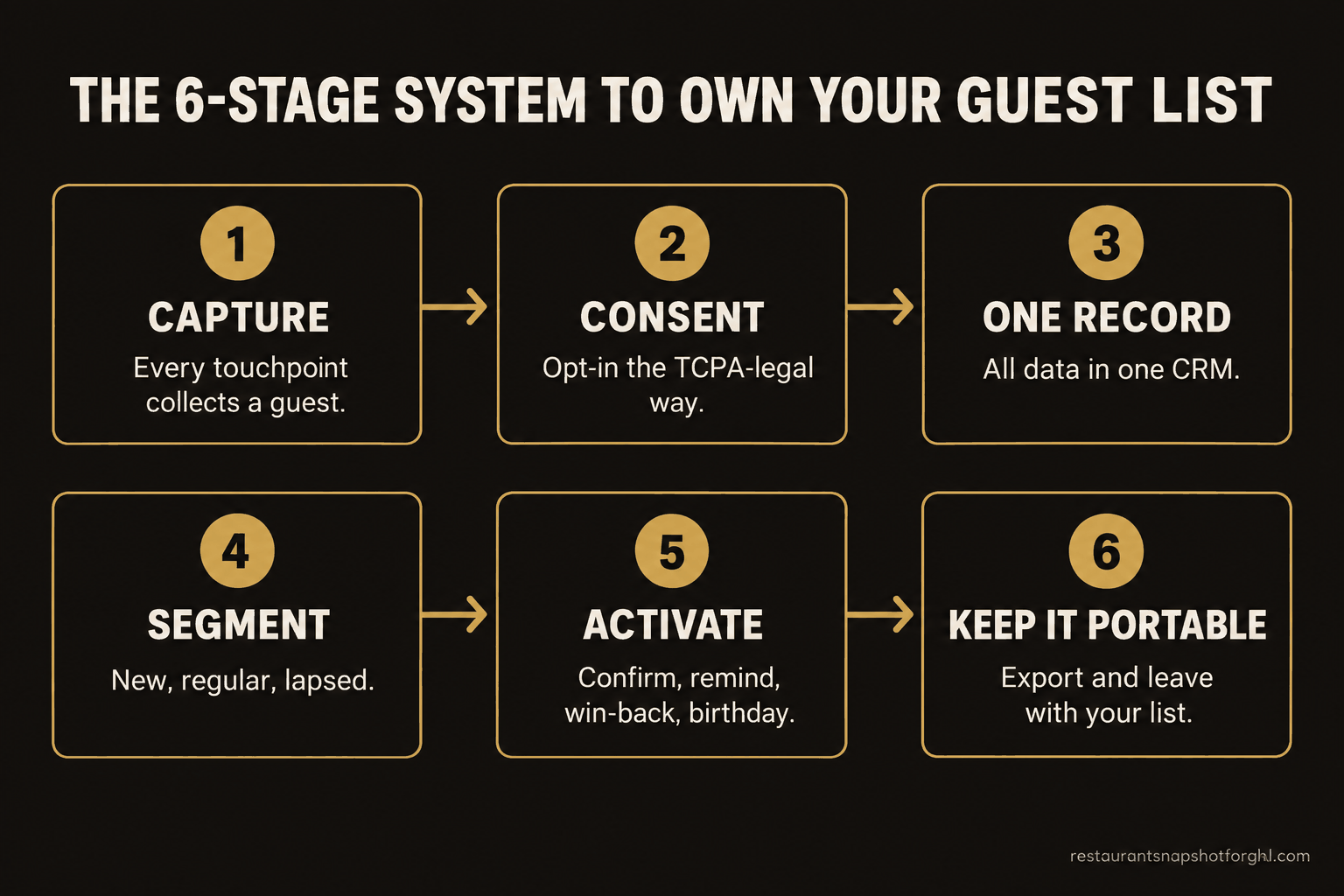
Stage 1: Turn every touchpoint into a capture point
You already touch every guest several times, and most of those moments collect nothing. Your capture points are the reservation form on your own site, the Wi-Fi splash page, the QR on the table tent and the check, the online-ordering checkout, the review request, and the host stand for walk-ins. Each should ask for a name, a mobile number or email, and permission to message.
The highest-value capture is a booking on your own website, because that diner’s data starts and stays with you. 65% of diners now go straight to a restaurant’s own website rather than a third-party app (Toast, 2025).
Where it breaks: five disconnected tools each collect a different fragment, and none of them talk. The fix: pick capture points that all feed one place (Stage 3), and turn on no more than two new ones at a time.
Stage 2: Collect consent the legal way
This is the stage operators skip, and the one that bites. A phone number is not permission. To send marketing texts you need prior express written consent: a clear, affirmative opt-in that names your restaurant and says what the guest is signing up for. The rules come from the Telephone Consumer Protection Act (TCPA), and violations run $500 to $1,500 per message (FCC). A reservation confirmation is transactional; a “half-price wine on Tuesday” blast is marketing and needs its own opt-in and an easy STOP.
Where it breaks: a manager collects 400 numbers at the host stand, then fires a promo to all of them. That is the classic violation. The fix: a single opt-in checkbox on every capture form, consent logged with a timestamp, and a hard rule that no number enters the list without it. Our TCPA and A2P 10DLC guide walks the registration step by step.
Stage 3: Put it all in one guest record
This is the spine of the whole thing. Every fragment from Stage 1 lands in one place, tied to one guest, so you see a person, not a row in five spreadsheets. That place is a customer relationship manager, a CRM, which is one organized guest database: one record per diner with name, mobile, email, birthday, visit count, last visit, average spend, and consent status.
Now you can answer questions you never could before. Who has not been in for 60 days? Who has a birthday next week? Each is a campaign.
Where it breaks: duplicate records. The same guest is “Mike” on a reservation and “Michael” on an online order, and now you have two half-profiles. The fix: match on mobile number as the unique key and let the system merge duplicates.
Stage 4: Segment so the list is worth something
A list of 4,000 names you blast identically is barely better than no list. The value is in the slices. At a minimum, cut your list into first-timers, regulars, lapsed guests (no visit in 60 days), big-party bookers, and takeout-only diners. Each group needs a different nudge, and you cannot segment a diner OpenTable is holding for you.
Where it breaks: over-segmenting on day one into twenty tiny groups you never maintain. The fix: start with three segments (new, regular, lapsed), prove they work, then add more.
Stage 5: Activate the list
Activation is the point, and the core plays all run on autopilot once built: a booking confirmation, a 24-hour reminder, a review request the day after a visit, a 60-day win-back, a birthday offer, and a weekly specials note to the segment most likely to come on a slow night.
Text is the workhorse because it gets seen. SMS open rates are commonly cited around 98%, against roughly 20% for email, though that reflects lock-screen visibility rather than pixel-tracked reads, so treat it as a benchmark, not a law (Sender, 2026). Email still earns its place for longer notes and its unmatched return.
Where it breaks: you over-text and guests opt out in a wave. The fix: cap promos at one a week, lead with real value, and let transactional messages carry the load. For the deeper sequences, see the 60-day silent win-back trigger and our restaurant email marketing playbook.
Stage 6: Keep it portable
Owning the list means you can leave with it, so build for the exit from day one. Export your guest data on a schedule (monthly is plenty) so a copy always lives somewhere you control. Keep your booking flow on your own domain so your Google “Reserve” link points at a system you own. And keep your Google Business Profile, reviews, and website in your own hands, because that is where your discovery lives.
Where it breaks: you never test the export until you are mid-switch, and find the platform hands back a thin slice. The fix: pull a full export this month while nothing is on fire, so you know what you get before you need to move.
Steal This: The Exact Capture and Consent Copy
You do not need a copywriter. Copy these, swap in your name and hours, and you have the whole front end of an owned list, all on the right side of the phone laws.
The booking-form consent line (next to the opt-in checkbox):
“Text me reservation updates and occasional offers from [Restaurant]. Msg & data rates may apply. Msg frequency varies. Reply STOP to cancel, HELP for help. Consent is not a condition of booking.”
The table-tent / receipt QR capture (the landing page):
“Want first dibs on [Restaurant] specials and a treat on your birthday? Drop your number. We text a few times a month, never more, and STOP works anytime.”
The post-visit review request (next day):
“Thanks for joining us last night, [First name]. If we got it right, a quick Google review means the world to a small spot like ours: [link]. If we didn’t, reply here and tell me so I can fix it.”
The 60-day win-back (for the lapsed segment):
“We miss you at [Restaurant], [First name]. Your table’s ready whenever you are, and this week [server or chef] is running [dish or offer]. Book direct: [link]. Reply STOP to opt out.”
The birthday offer (fires 10 days before, from the birthday field):
“Happy early birthday, [First name]. Celebrate at [Restaurant] this month and dessert is on us for the table. Book here: [link].”
All of it fires from data you own. Log consent, honor every STOP automatically, and keep the cadence honest.
Three Ways to Run It: Solo, Busy Independent, Small Group
The system is the same. What changes is how much you automate and who runs it.
The solo operator (one location, you wear every hat). Start with three capture points: your website booking form, a table QR, and the review request. Put everything in one low-cost CRM, run three segments (new, regular, lapsed), and turn on four automations: confirmation, reminder, review ask, and a monthly specials text. The win: a slow Tuesday becomes a two-minute text instead of a discount you eat all night. For the math, see restaurant customer lifetime value.
The busy independent (one location, a real team, high volume). Now the risk is fragmentation, because more staff means more tools and duplicate records. Consolidate onto one guest database, make mobile number the unique key, and add the birthday and win-back sequences on top of the basics. This is also where a direct-booking flow starts saving four figures a year in per-cover fees. Compare the platforms in our OpenTable vs Resy vs Tock vs SevenRooms cost breakdown.
The small group (two or three locations). The list is your biggest untapped asset, and your biggest liability if it is scattered. Build one shared database with a location tag on every guest, so a diner is known at all three rooms but marketed to by their home location. Standardize consent and opt-out handling across every venue, because one location’s sloppy list becomes the whole group’s exposure. At group volume, marketplace per-cover fees run into tens of thousands a year an owned list does not cost.
Across all three, the acquisition math is the same, and it is the quiet argument for the whole system. A new guest costs roughly 5 to 25 times more to win than an existing one costs to keep, and lifting retention just 5% can raise profit 25% to 95% (Harvard Business Review, 2014).
Objections, Answered Straight
“OpenTable brings me diners I would never get on my own.” Sometimes true, and worth paying for when it is. The test: of last month’s network covers, how many were new faces versus regulars on the app? You pay the same fee for both. Keep the marketplace for real discovery if the math clears, and stop paying to re-seat regulars who already love you.
“I already pay for a reservation platform, so this is doubling up.” It is the opposite. The platform runs your book; the owned list turns those bookings into repeat visits without another per-cover fee.
“I am not technical, this sounds like a second job.” The capture forms, consent logging, database, and automations get set up once and left to run. You collect data by living your normal service. If setup is the wall, a done-for-you install handles it.
“Won’t guests be annoyed by the texts?” Only if you abuse it. Guests opt in because they want the birthday treat and the specials. Cap promos at about one a week, make every one worth opening, and let confirmations and reminders carry the relationship. The few who opt out were never coming back anyway.
“What if I switch platforms later?” That is the whole point of Stage 6. When you own the list and keep it portable, switching is a Tuesday, not a crisis: export your guests, move your booking link, and keep marketing to the same people.
Frequently Asked Questions
What does it mean to own your restaurant's guest list?
Every diner's name, mobile number, email, birthday, and visit history lives in a database you control, with their consent, and it comes with you if you cancel every platform tomorrow. If the only way to reach a guest runs through OpenTable or a delivery app, you are renting the relationship, not owning it.
Can I get my guest data out of OpenTable?
OpenTable says restaurants own their data and you can request an export, but the diner's app, booking history, and the next 'book again' prompt live in the marketplace, so the export is a snapshot, not the ongoing relationship. The durable fix is to capture guests into your own CRM in parallel, starting now.
Is it legal to text my restaurant's guest list?
Yes, with prior express written consent. A number collected at the host stand with no opt-in is not permission to market. You need a clear opt-in naming your restaurant, an easy STOP you honor instantly, and A2P 10DLC registration. TCPA penalties run $500 to $1,500 per message.
How is an owned list cheaper than OpenTable?
OpenTable charges a monthly fee plus up to $1.50 per network cover, so the bill grows every busy month. Reaching a guest on a list you own costs a fraction of a cent by email or a cent by text, with no per-cover fee. Email alone returns $36 per $1 spent.
Do I have to quit OpenTable to own my guest list?
No. Owning your list is a layer you add, not a platform you drop. Many operators keep a reservation platform for genuine discovery while building their own guest database underneath it, then cut marketplace spend as their direct channel proves it can fill seats.
Related reading
- OpenTable vs Resy vs Tock vs SevenRooms: what a reservation system really costs in 2026
- Take direct bookings and cut per-cover fees with your own reservation system
- Win back lapsed diners with a 60-day silent trigger
- Why your regulars stop coming in, and never say why
- Get the Restaurant Snapshot installed in 24 hours
Sources
- TableLink, OpenTable fees explained (2026)
- National Restaurant Association, 2026 State of the Restaurant Industry
- Litmus, The ROI of email marketing (2024)
- McKinsey & Company, The value of getting personalization right (2021)
- Harvard Business Review, The value of keeping the right customers (2014)
- Toast, Restaurant wait times and reservations data (2025)
- Rezku, Third-party delivery fees in 2026
- FCC, Stop unwanted robocalls and texts