
It’s a Tuesday in Deep Ellum and your dining room is two-thirds full. Down the block, a spot that opened four months ago has a wait — again. The food isn’t better than yours. The room isn’t nicer. But their Instagram is alive: a sizzling brisket reel every few days, a TikTok of the bartender torching a crème brûlée, replies to every comment within the hour. Yours? Three weeks since the last post. A hungry local scrolling for dinner sees their feed, not yours, and picks the wait.
That’s the quiet math of restaurant marketing in Dallas right now: the plate on the table matters less than the plate on the phone. This is the honest, operator’s-eye look at restaurant social media management in Dallas — why short-form video and Reels now decide where diners go, what it actually costs to keep up in-house, and how a done-for-you engine fills your tables while you stay on the line.
Table of Contents
- The 30-second answer
- Why Dallas diners choose with their thumbs
- Why Reels fill tables — the reach gap explained
- The four reasons Dallas owners fall behind
- What DIY social really costs
- DIY vs done-for-you social media management
- How our done-for-you engine works
- Frequently asked questions
The 30-Second Answer
Restaurant social media management in Dallas means consistently publishing food-first content — especially short-form video and Reels — across the channels your diners actually scroll, then answering every comment and DM fast enough to turn attention into a booked table. The problem isn’t that Dallas operators don’t know this; it’s that the dinner rush eats the time it takes to do it, so feeds go cold and louder competitors win the walk-in. The fix is either hiring a content team (expensive) or handing it to a done-for-you service that posts 5 days a week across 9 channels, ships a weekly reel, and books reservations for you — for a fraction of one salary.
Why Dallas Diners Choose With Their Thumbs
Dallas–Fort Worth is one of the most competitive dining markets in the country, inside the biggest restaurant state in the country: Texas restaurants employ more than 1.4 million people (National Restaurant Association, 2024). In a market that crowded — thousands of concepts fighting for the same Friday night — the deciding factor is rarely the menu. It’s who showed up in the feed this week.
And the feed is now the front door. Look at how diners actually pick a place, broken down by the generations filling your seats:
Share of diners who use social media to research a restaurant before visiting. Source: TouchBistro, 2024 American Diner Trends Report.
The younger the guest, the more this is true. Among Gen Z diners, 55% use Instagram for restaurant reviews and 44% use TikTok, and 52% have tried a new restaurant based on positive social feedback (TouchBistro, 2024). This isn’t a vanity metric — it’s discovery. BrightLocal’s 2024 survey found 34% of consumers use Instagram and 23% use TikTok to find and evaluate local businesses, and for the 18–24 crowd, Instagram and TikTok have overtaken Google Maps as the go-to (BrightLocal, 2024). A Google executive said the quiet part out loud back in 2022: roughly 40% of young people now open TikTok or Instagram — not Google Search or Maps — when they’re looking for a place to eat lunch (via TechCrunch, 2022).
Why Reels Fill Tables — the Reach Gap Explained
Here’s the part most Dallas owners underestimate: on today’s algorithms, format decides who sees you as much as frequency. Short-form vertical video is the content the platforms push hardest to people who don’t follow you yet — which is exactly the local diner you’re trying to reach.
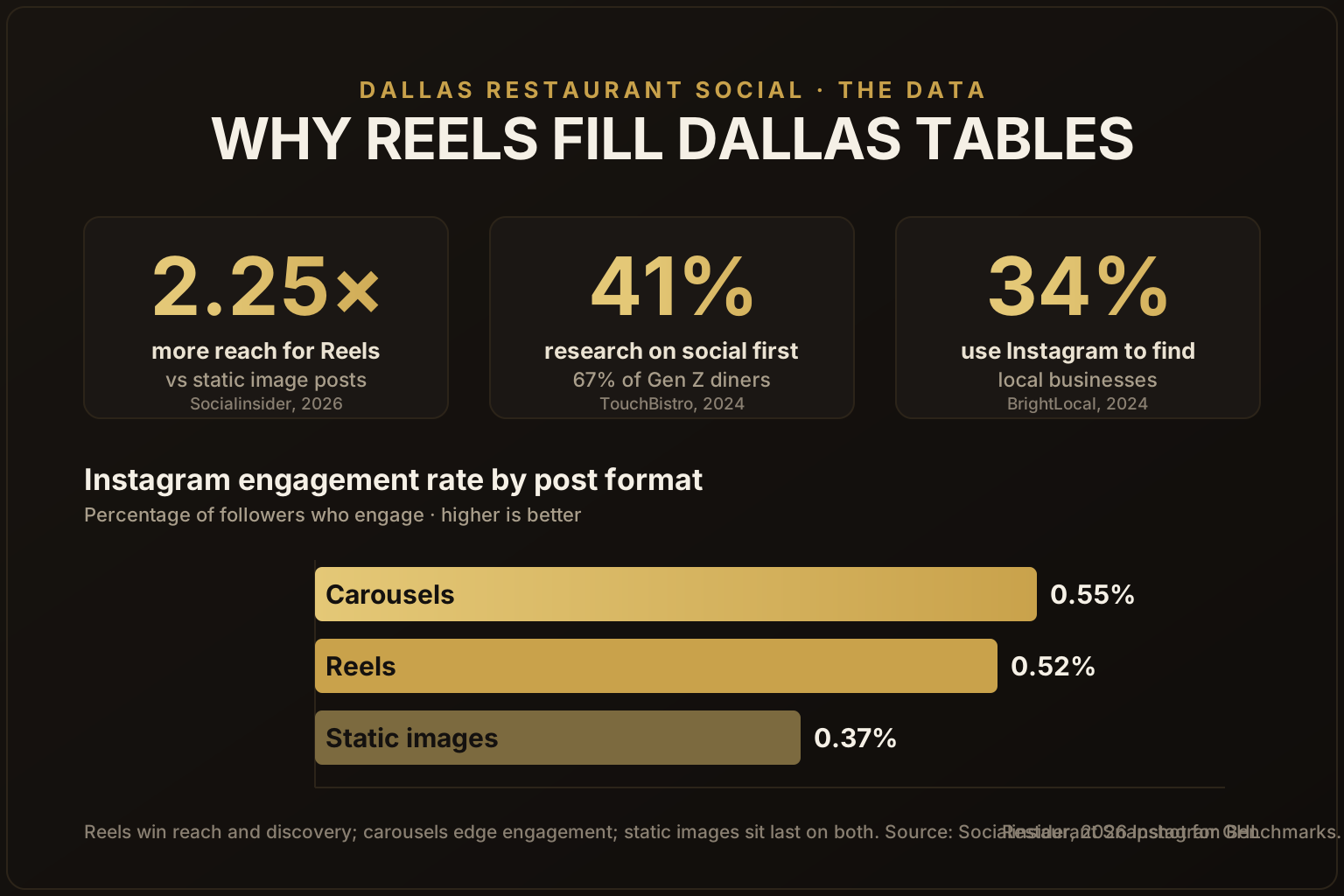
Instagram Reels reach roughly 2.25× more accounts than static image posts (and about 1.36× more than carousels), according to Socialinsider’s 2026 benchmark of tens of millions of posts (Socialinsider, 2026). A single reel of your brisket coming out of the smoker can put you in front of thousands of DFW diners who’ve never heard your name. A static photo of the same brisket mostly reaches the followers you already have.
Engagement rates by format tell the flip side of the story — the format that reaches the most new people isn’t always the one existing followers tap on:
Average Instagram engagement rate by post format (% of followers). Source: Socialinsider, 2026 Instagram Benchmarks.
The takeaway for a restaurant isn’t “only post Reels.” It’s run a mix on purpose: Reels to reach new diners, carousels to convert the ones already watching, static posts for the anchor. Static images sit at the bottom on both reach and engagement — so a feed that’s nothing but plated photos is fighting the algorithm with one hand tied behind its back.
The Four Reasons Dallas Owners Fall Behind
If the case for social is this clear, why do so many good Dallas restaurants have a graveyard for a feed? Because posting well is genuinely hard to sustain from behind the line. Here are the four failure points we see over and over.
1. The dinner rush eats your posting time
“Post to Instagram today” never beats “the walk-in at table 12 needs to be sat” or “we’re 86 on the halibut.” So it slips. A week becomes a month, the feed goes cold, and to a scrolling diner a cold feed reads as closed or coasting. Consistency is the whole game, and consistency is exactly what a slammed operator can’t promise.
2. Nine platforms, nine formats, one you
Facebook, Instagram, TikTok, YouTube, Google Business Profile, LinkedIn, Pinterest, Threads, Bluesky — every channel wants a different aspect ratio, caption style, and posting rhythm. Doing all nine by hand is a full-time job no GM has room for, so most restaurants pick one, do it sporadically, and leave the rest dark.
3. Reels feel out of reach
Owners know video wins, but shooting, editing, captioning, and scoring a 30-second reel every week is a real skill. Without a system, “we should do Reels” stays a someday item — while the new place down the street ships one every Thursday.
4. Comments and DMs die on the vine
Every “Are you open Sunday?” or “Do you do private events?” that sits unanswered until close is a table that booked somewhere else. Speed-to-reply is what turns a scroller into a cover, and no one’s watching the inbox during service. (It’s the same lesson as missed-call text-back, applied to social.)
What DIY Social Really Costs
Let’s put real numbers on “just hire someone.” A dedicated social media manager averages about $71,000 a year in current U.S. job-market data (Sprout Social, 2026). Step up to a marketing manager and the median jumps to $161,030; even a public-relations specialist runs a $69,780 median (U.S. Bureau of Labor Statistics, 2024). And one hire is rarely enough — great restaurant content usually needs a photographer, a video editor, a writer, and someone watching the inbox.
The DIY-it-yourself route isn’t free either; it’s just paid in owner-hours. Small-business owners who handle their own social report spending around 6 hours a week on it (VerticalResponse) — 300+ hours a year of your attention pulled off the floor, off the books, off the plan. Here’s how the three paths stack up:
Three ways to run your Dallas restaurant's social
| Plan | Done-For-You recommended | Hire In-House | Do It Yourself |
|---|---|---|---|
| Price | From $397/mo | $71k–$161k/yr | ~6 hrs/week of you |
| Feature 1 | 9 channels posted 5 days a week | One salary, one person's bandwidth | No cash cost — paid in owner-hours |
| Feature 2 | 1 reel + 1 image + 2 carousels + 1 Q&A weekly | Still need a photographer & video editor | Goes cold the first busy week |
| Feature 3 | 3 AI agents answer comments, DMs & web chat | Payroll, benefits, PTO, turnover risk | Usually 1–2 channels, rarely video |
| Feature 4 | Books reservations straight to your CRM | Coverage gaps when they're out | DMs answered after close (or never) |
| Feature 5 | Monthly report from every channel | Ramp-up time before results | No reporting, no real strategy |
| Feature 6 | White-label, cancel with 15 days notice | Hard to justify for one location | 300+ hours/year off the floor |
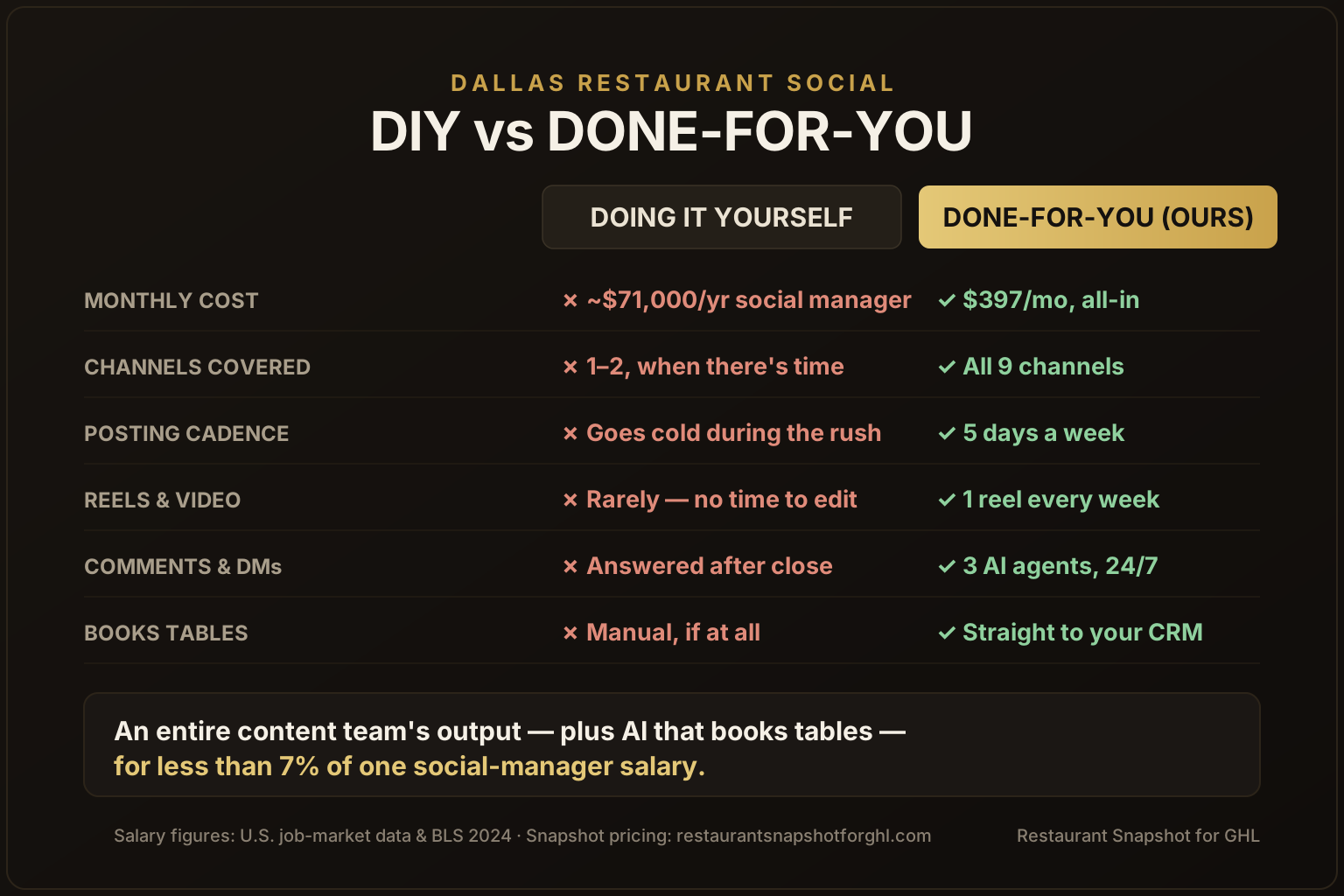
For a single independent restaurant, the done-for-you path is usually the only one that pencils out: you get an entire content team’s output — including the weekly reel and the AI agents that book tables — for less than 7% of one social-manager salary.
DIY vs Done-For-You Social Media Management
The difference isn’t just who clicks “post.” It’s whether the whole loop — create, publish, engage, book — runs every single day without you. A done-for-you engine turns social from a chore you lose to the rush into a channel that quietly fills tables.
- Content that’s actually food-first. Per brand, every week: 1 text (Q&A) post, 1 branded image, 2 carousels, and 1 short reel — written in your restaurant’s voice, cropped and captioned per platform. No stock-quote filler.
- Every channel your diners scroll. All 9 — Facebook, Instagram, Google Business Profile, LinkedIn, TikTok, YouTube, Pinterest, Threads, Bluesky — one brand voice, published for you.
- AI that answers and books. A comment agent replies on TikTok, Instagram, and Facebook; a DM agent answers messages, collects party size, and books the table; a web-chat agent turns menu-browsers into confirmed covers — 24/7, in your voice.
- It all lands in your CRM. Every reservation and lead the AI books shows on your calendar with the guest’s name, phone, party size, and full conversation — so your host can confirm or upsell a private event. It’s the same guest-data flywheel behind customer lifetime value and win-back campaigns.
None of this replaces your team’s judgment or your chef’s photos — it removes the bottleneck so the work actually ships, five days a week, without stealing your evenings.
How Our Done-For-You Engine Works
Getting started is deliberately low-lift for the operator, because the whole point is to give you time, not take it:
- Onboarding call. We capture your voice, your best dishes, your specials rhythm, and your booking flow. You connect your own social accounts to our planner — we never need your passwords, and you stay in full control.
- Content engine goes live. Within your first cycle, food-first posts and your weekly reel start publishing across all 9 channels, and the comment, DM, and web-chat AI agents deploy.
- Reach compounds. Organic growth builds over roughly 3–5 months as the algorithms start surfacing your reels to new local diners — and because you get a fresh reel every week, you get dozens of shots at the one that goes viral and packs a slow Tuesday.
- You watch the tables fill. Reservations and leads land in your CRM; a monthly report from every channel shows reach, engagement, top posts, and covers booked.
Anyone promising overnight virality isn’t being straight with you. But in a market where 45% of diners have tried a restaurant for the first time because of its social post (MGH, 2019), showing up consistently — with video — is the closest thing to a sure bet in restaurant marketing.
The Bottom Line
Your Dallas restaurant’s hardest work is already done — the food is good and the room is ready. What’s leaking is attention: the high-intent local diner who picks their Tuesday spot from a phone, and never sees you because the feed went quiet three weeks ago. Consistent, food-first content — anchored by a weekly reel — plus fast replies that book the table is how you win that diner back. Do it yourself and it costs your evenings; hire it out and it costs a salary; hand it to a done-for-you engine and it costs less than 7% of one. In a city this crowded and this hungry, showing up in the feed every week isn’t marketing fluff. It’s how the tables fill.
Frequently Asked Questions
Restaurant social media management in Dallas — common questions
Why do Dallas restaurants need social media management?
Because diners choose with their phones. 41% of U.S. diners research a restaurant on social media before visiting — 57% of Millennials and 67% of Gen Z (TouchBistro, 2024) — and 34% use Instagram to find local businesses (BrightLocal, 2024). In a market as crowded as Dallas–Fort Worth, a consistent, video-first feed is often the deciding factor between a full Friday and a soft one.
Why do Reels matter so much for restaurants?
Short-form vertical video is what the algorithms push hardest to people who don't follow you yet — your future diners. Instagram Reels reach about 2.25× more accounts than static image posts (Socialinsider, 2026), so a single reel of a dish can put you in front of thousands of local diners who've never heard your name. Static photos mostly reach the followers you already have.
How much does restaurant social media management cost in Dallas?
Hiring in-house runs roughly $71,000/year for a social media manager, and up to $161,030 median for a marketing manager (BLS, 2024) — plus a photographer and editor. A done-for-you service like ours starts at $397/mo for one brand (or $997/mo for up to 4 brands), which includes content for all 9 channels, a weekly reel, and 3 AI agents — a fraction of one salary.
What's included in done-for-you restaurant social media?
Per brand, every week: 1 text (Q&A) post, 1 branded image, 2 carousels, and 1 short reel, published 5 days a week across 9 channels (Facebook, Instagram, Google Business Profile, LinkedIn, TikTok, YouTube, Pinterest, Threads, Bluesky). Plus 3 AI agents that answer comments and DMs and a website web-chat agent that books reservations into your CRM, with a monthly report from every channel.
Do I have to hand over my social media passwords?
No. During onboarding you connect your own accounts (or ones you already have) to our social planner — that connection is all we need to publish for you. You keep full control of every account and can disconnect anytime. Everything is 100% white-label.
How soon will I see results from social media?
Organic growth compounds — expect meaningful reach and inbound in roughly 3–5 months as the algorithms surface your food content to new local audiences. Because you get a fresh reel every week across 9 channels, a single post can go viral and fill tables much sooner. Anyone promising overnight results isn't being honest.
Gina is a hospitality marketing writer who came up through catering and event sales before falling in love with diner data. She translates dense automation concepts into plain English for owner-operators who’d rather be in the kitchen than in a CRM. When she’s not writing about win-back campaigns and weekly-specials blasts, she’s testing local restaurants’ loyalty texts and reels to see who’s doing it right.
Related reading
- Restaurant Instagram marketing: from grid to booked tables
- Turn Instagram DMs into booked tables
- Restaurant local SEO & the Google map pack
- Facebook & Instagram ads for restaurants
- Restaurant reputation management: reviews on autopilot
Sources
- TouchBistro — 2024 American Diner Trends Report (41% research on social; 67% Gen Z / 57% Millennials; 55% Gen Z use Instagram)
- Socialinsider — 2026 Instagram Benchmarks (Reels ≈ 2.25× reach vs static; engagement by format)
- BrightLocal — Local Consumer Review Survey 2024 (34% Instagram / 23% TikTok for local discovery)
- DataReportal — Digital 2025: Brand Discovery (search 32.8%; social fastest-growing; #1 for 16–24)
- TechCrunch — Google exec on TikTok/Instagram vs Search & Maps (~40% of young people)
- U.S. Bureau of Labor Statistics — Advertising, Promotions & Marketing Managers (median $161,030)
- U.S. Bureau of Labor Statistics — Public Relations Specialists (median $69,780)
- Sprout Social — How much do social media managers make? (≈ $71,000/yr)
- VerticalResponse — Time small businesses spend on social (≈ 6 hrs/week)
- National Restaurant Association — State Statistics (Texas restaurants employ 1.4M+)
- MGH — Social Media Influences Nearly Half of US Diners (45% tried a new restaurant from a social post)