
It is 8:15 on a Saturday. Table 12, a party of ten booked three weeks ago for a birthday, is still empty. You held it. You turned away two walk-in four-tops and a couple who wanted the window. The phone has not rung. At 8:40 you finally break the reservation and try to fill it, but the rush is cresting and the best you do is seat a two-top at a table set for ten. That single ghosted booking just cost you more than most operators lose in a slow week, and nobody called to say sorry.
Large parties are where no-shows hurt worst. A solo diner who ghosts costs you one cover. A party of ten costs you the table, the covers you turned away to hold it, and the prep you fired for a group that never walked in. The fix is not begging guests to be nice. It is a written restaurant no-show policy for large parties with a real mechanism behind it, worded so guests accept it instead of booking somewhere else. This is that policy, the exact copy to steal, and how to run it without breaking the phone laws.
Table of Contents
- The 30-second answer
- What a no-show on a large party actually costs
- Why a policy without a mechanism is just a wish
- The 7-part no-show policy framework
- Card-on-file vs deposit vs prepayment
- Steal this: the exact policy copy
- Run it three ways: solo, small group, high-demand
- The compliance part nobody reads until it bites
- Objections guests and staff will throw
- Frequently asked questions
The 30-Second Answer
A no-show policy for large parties is a written rule that ties a big booking to a card on file or a deposit, gives the guest a clear window to cancel for free, reminds them by text, and charges a fee only when they ghost past that window. It works because it changes the guest’s incentive without insulting them. Nobody has ever cared enough about a free reservation to protect it. Give them a card hold and a two-day cancellation window and suddenly the booking has weight.
The policy is five decisions: which bookings it covers (party size), what mechanism backs it (hold, deposit, or prepay), how long the cancellation window is, how you get consent, and how you remind. Get those five right and you turn your worst-hurting no-shows into a rounding error, while the guest walks away feeling the restaurant is simply well run. Everything below is how to make each decision, the copy to use word for word, and the ways it breaks so you can dodge them.
What a No-Show on a Large Party Actually Costs
Operators underprice their own no-shows because they only count the empty seats. The real bill is bigger. When a party of ten ghosts, you lose the ten covers, plus the walk-ins you refused to hold the table, plus the food you prepped, plus the server scheduled for a section that never filled. On a peak Saturday, that one table can be the difference between a good night and a flat one.
The numbers back the gut feel. Industry estimates put restaurant no-show rates at roughly 10 to 20% with no mitigation, which can quietly erase 5 to 20% of monthly revenue (Eat App). And margins are thin: the National Restaurant Association projects the industry will reach $1.55 trillion in sales in 2026 across 15.8 million jobs, so a handful of ghosted large parties a month is real money off the bottom line (National Restaurant Association, 2026).
Put a large-party number to it. A group of eight at a $70 average check is a $560 table before drinks. Turn away one four-top to hold it and the ghost has cost you closer to $800 in a single service. Do that four times a month and you are down more than $3,000 on ghosted groups alone, which is why this policy pays for itself faster than almost anything else you can set up.
Why a Policy Without a Mechanism Is Just a Wish
Here is the mistake most operators make. They add a line to the reservation page that reads “please give 24 hours notice for cancellations,” feel covered, and change nothing. A guest who was going to ghost still ghosts, because the sentence has no teeth. There is no card, no consequence, no reason to open the confirmation text.
A policy is only as strong as the mechanism behind it. The mechanism is what moves the number. Look at the gap between the same restaurants running a real hold versus running nothing:
Average no-show rate by policy mechanism. Card-hold, deposit and prepayment figures from Tock customer data (Dec 2023 to Mar 2024); the “no policy” figure is the midpoint of the widely cited 10 to 20% industry estimate.
That is the whole argument for doing this properly. A card-on-file hold takes the ghost rate from a double-digit disaster to around 3%. OpenTable’s own reporting says guests who book with a credit-card hold are up to 16% less likely to no-show and 15% less likely to cancel late than guests booked with no policy (OpenTable). The sentence on your website did none of that. The card did all of it.
The 7-Part No-Show Policy Framework
A large-party no-show policy is seven small decisions. Make each one on purpose and the whole thing holds together. Skip one and it leaks.
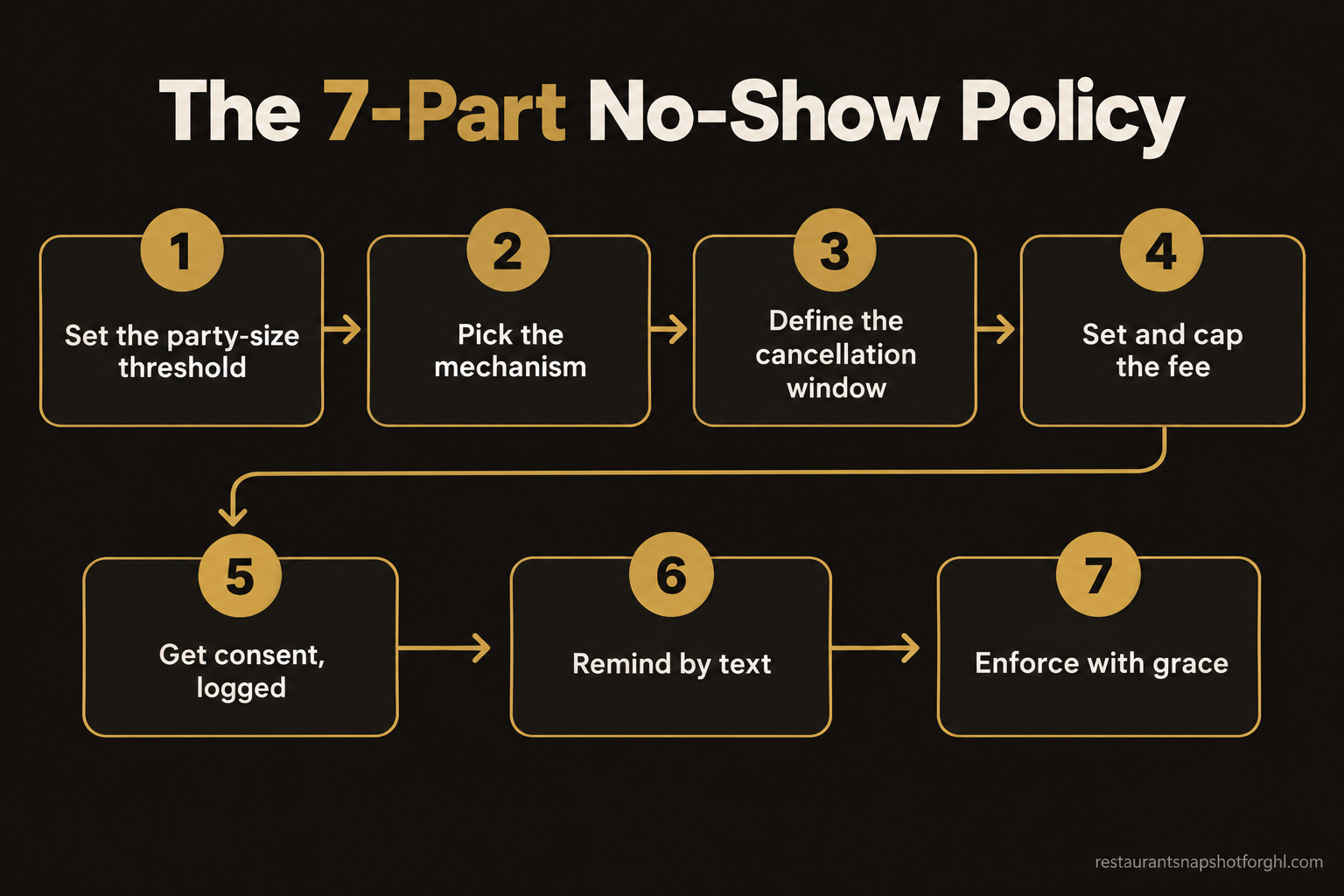
1. Set the threshold: which parties it covers
Do not apply this to everyone. Apply it to the bookings that hurt when they ghost. For most independents that means parties of 6 or 8 and up, plus any booking for a peak window like a holiday or a private area. A two-top on a Tuesday should still book in twelve seconds with no card.
How it breaks: you set the threshold too low, a family of four hits a card-hold wall for a random weeknight, and they book down the street instead. Fix: keep the no-friction path wide, gate only the big or high-demand slots.
2. Pick the mechanism
Three real options: a card-on-file authorization hold, a per-head deposit, or full prepayment. The next section breaks down which to use. For most independent dining rooms, a card-on-file hold on parties of 6+ is the sweet spot: it moves the number almost as much as a deposit while feeling far lighter.
How it breaks: you jump straight to prepayment on a neighborhood bistro and regulars feel like they are buying a ticket to dinner. Fix: match the mechanism to your demand.
3. Define the cancellation window
The window is the promise. Common and fair is 48 hours for large parties, dropping to 24 for smaller gated bookings. Long enough that a guest can cancel like an adult, short enough that you can refill. State it in hours, not vague “advance notice.”
How it breaks: the window is fuzzy, a guest cancels at 5pm for a 7pm booking, and now you are arguing over what “reasonable notice” meant. Fix: put the exact hours in the policy, the confirmation, and the reminder.
4. Set the fee and cap it
The fee should sting a little, not feel like a fine. A per-head no-show fee of $10 to $25, or forfeiting the deposit, is plenty. Cap it so a party of twelve does not get a shocking bill. The point is behavior change, not revenue from angry people.
How it breaks: you charge the full check average per head, the guest disputes it, and you lose the chargeback plus the goodwill. Fix: keep the fee modest, disclosed, and tied to the window they agreed to.
5. Get consent the legal way
At booking, the guest has to actively agree to the policy and, if you take a card, to the hold. That means a checkbox they tick, not fine print they never see. Store the timestamp. The compliance section covers the texting side, which is a separate consent entirely.
How it breaks: you tuck the policy in a footer, charge a no-show, and cannot prove the guest agreed. Fix: an explicit, logged opt-in at the moment of booking.
6. Remind relentlessly, by text
Most no-shows are not malice. They are forgetting. A texted reminder at 48 hours and again on the day, each with a one-tap confirm or cancel, catches the honest cancellations early enough to refill. Text is the channel because it actually gets opened, a widely cited 98% against roughly 20% for email (Mailchimp).
How it breaks: you only email the reminder, it sits unread under 40 other emails, and the table ghosts anyway. Fix: text-first reminders with an easy cancel path.
7. Enforce with a spine and a smile
When a party ghosts past the window, charge the fee, then send a warm, non-accusatory message. Give regulars grace if you want; just do it as a deliberate choice, not because you are scared to run the card. Consistency is what makes the policy real.
How it breaks: you never actually charge, word gets around that the policy is theater, and it stops working. Fix: enforce every time on the gated bookings, and let the warm message repair the relationship.
Card-on-File vs Deposit vs Prepayment
The mechanism is the single biggest lever, so choose it on purpose. Here is the honest trade-off.
| Mechanism | What the guest feels | Typical no-show rate | Best for |
|---|---|---|---|
| No policy | Nothing | 10 to 20% | Nothing. This is the leak. |
| Card-on-file hold | Light. Card is stored, not charged, unless they ghost | About 3% | Most independents, parties of 6+ |
| Per-head deposit | Moderate. Real money down, credited to the bill | About 1.7% | High-demand nights, holidays, private rooms |
| Full prepayment | Heavy. Feels like a ticket | Under 1% | Tasting menus, chef’s table, impossible tables |
No-show rates for holds, deposits and prepayment are from Tock customer data, Dec 2023 to Mar 2024; the no-policy range is the industry estimate.
For a normal dining room, the card-on-file hold wins. It captures nearly all the benefit of a deposit while feeling far lighter, because you are not asking for money up front. The deposit is your move for nights that are genuinely hard to give away, where a guest on a prime holiday eight-top should have some skin in the game. Full prepayment is a different animal: right for a tasting menu where food cost is committed days out, wrong for a neighborhood spot that would look greedy asking for it.
One note on where this lives. You can run holds and deposits through a reservation platform like OpenTable, Resy, Tock or SevenRooms and pay a monthly fee plus, in some cases, a per-cover charge. Or you can run the same hold-and-remind flow on your own online reservation system and keep the fees and the guest data. The policy logic is identical either way. What changes is who owns the phone number afterward.
Steal This: The Exact Policy Copy
This is the utility part. Copy these, swap in your numbers, and you have a working policy today. All of it is written to be firm and warm at the same time, because a policy that reads like a parking ticket gets guests booking elsewhere.
The website / booking-page policy (parties of 6+):
Large-party reservations (6 or more) hold a table we cannot easily resell, so we ask for a card to reserve. Your card is not charged now. If you need to change or cancel, just let us know at least 48 hours before your reservation and there is no charge at all. For groups that do not arrive and have not canceled within that window, we charge a $15-per-guest no-show fee (capped at $150). Life happens, so reach out and we will always try to work with you.
The booking confirmation text (sent right after they book):
Great, [Name], you’re booked at [Restaurant] for [party size] on [date] at [time]. Heads up: for groups this size we hold a card and ask for 48 hours notice to cancel free. Need to change it? Reply here anytime. See you soon!
The 48-hour reminder text (one-tap confirm or cancel):
Hi [Name], we’re looking forward to your table for [party size] at [Restaurant] on [date], [time]. Please reply YES to confirm or CANCEL if plans changed, so we can plan the floor. Free cancellation ends [date/time].
The no-show fee notice (sent after you charge, never before a human eyes it):
Hi [Name], we held your table for [party size] last night and missed you. Per the policy you agreed to at booking, a $[amount] no-show fee was applied to your card. We’d genuinely love to have you back, so reply here and we’ll get you re-booked with a clean slate.
The waiver / grace message (for a regular or a real emergency):
Hi [Name], we saw the missed reservation. We know you, and we’ve waived the no-show fee this time, no questions. Whenever you’re ready, we’ve got a table for you.
Run It Three Ways: Solo, Small Group, High-Demand
The framework is the same, but the right settings depend on the shop. Here is how the same policy flexes across three kinds of operator.
The solo independent (one dining room, mixed crowd). Keep it gentle. Threshold at parties of 8+. Mechanism: card-on-file hold, no deposit. Window: 48 hours. Fee: $10 to $15 per head, capped low. Let the reminder do most of the work and the card sit as a quiet backstop, and lead with grace on first offenses. You are protecting the handful of big tables that actually hurt, without making a normal booking feel transactional.
The small local group (two or three locations). Now consistency matters more than warmth, because guests move between your rooms and staff turns over. Threshold at 6+. Mechanism: card-on-file hold standard, per-head deposit on weekend prime time and holidays. Window: 48 hours. Fee: $15 to $20 per head. Write the policy once and enforce it identically everywhere, so a manager at store two is not freelancing a different rule than store one. This is where automation earns its keep, because you cannot personally watch every reminder across three floors.
The high-demand room (hard-to-get tables, tasting menu, private events). Here you have the upper hand, so use it. Threshold can drop to 4+ on peak nights, or cover every tasting-menu booking. Mechanism: deposit by default, full prepayment for the tasting menu and private buyouts. Window: 72 hours, because these tables are genuinely hard to refill last minute. Fee: forfeit the deposit. Guests booking an impossible table expect this and respect it. The risk here is not scaring people off, it is looking disorganized, so the confirmation and reminder flow has to be flawless.
The Compliance Part Nobody Reads Until It Bites
Two bodies of rules touch this policy: how you charge, and how you text. Neither is optional, and both are boring right up until they cost you.
Charging the fee. No-show fees are a legitimate, widely used practice, and some in-demand restaurants now charge as much as $100 a head to hold a hard table (CBS News). The catch is disclosure. You have to make the fee clear before the guest agrees, get an active opt-in, and keep the record. There is a real difference between an authorization hold (a pending charge you can capture if they ghost) and actually charging the card, and card-network rules and some state surcharge laws, notably in states like California and New York, shape how you present it (TouchBistro). Disclose plainly, cap the fee, and you stay on the right side of a chargeback dispute.
Texting the reminders. This is where operators get burned. Under the TCPA and A2P 10DLC rules, a reservation reminder is a transactional message that rests on the guest’s prior express consent, which they give by booking and handing over a number for that purpose. A promotional text (your weekly specials, a win-back, a birthday offer) needs separate express written consent. You cannot assume a guest who agreed to reminders also agreed to marketing. Opt-outs have gotten stricter too: guests can revoke consent through any reasonable method, and you have to honor it fast. Register your number properly, keep the two message types separate, and log everything. Our TCPA guide for restaurant SMS and the deeper compliance walkthrough break down the consent language line by line.
Objections Guests and Staff Will Throw
“Won’t a card requirement scare guests off?” Only if you apply it to everyone. Scoped to parties of 6 or 8 and up, the guests hitting it are booking exactly the tables that are painful to lose, and those guests overwhelmingly expect some form of hold for a big group. The data is clear that the policy moves the no-show number without tanking bookings; the restaurants running holds are not empty, they are protected. Keep the small-party path frictionless and the objection mostly disappears.
“My regulars will be insulted.” Your regulars are the easiest part. Tell them directly: the policy is for the big weekend groups you do not know, and you will always waive it for the people who keep the lights on. Better still, use the grace message when a known regular slips. One waived fee buys more loyalty than the fee ever would have earned.
“I already pay OpenTable, isn’t this handled?” Partly. The platforms can run holds and deposits, and if you use one, turn that on today. But the policy logic, the thresholds, the window, the reminder copy, the enforcement, is yours to set regardless of the tool. And if you would rather not pay per-cover fees forever, the same flow runs on your own booking system where you keep the guest data.
“I don’t have time to chase reminders and charge cards.” That is the honest one, and it is why this should be automated, not manual. The card hold, the two texts, the confirm-or-cancel handling, and the fee notice can all fire on their own once set up. Your only manual job is the human call on whether to grant grace. If it stays a to-do on your list, it will not happen during a rush, which is exactly when it matters.
The Table You Held, Filled
Back to that birthday party of ten. Run this policy and the night looks different. When they booked three weeks out, they ticked a box agreeing to a card hold and a 48-hour window. Two days before, a text went out and one guest replied to move it to nine people, handled in seconds. On the day, a reminder confirmed it, and they showed. On the rare Saturday a big group still ghosts past the window, you charge a fair, disclosed fee, send a warm note, and refill faster because the reminder flagged the risk early.
None of it takes a new POS or a reservation platform you rebuild around. It takes a clear policy, the right mechanism on the right bookings, and reminders that actually get read. Set it once and it runs every service, quietly saving the tables that used to vanish.
What party size should trigger a no-show policy?
For most independents, apply it to parties of 6 or 8 and up, plus any booking for peak windows like holidays or a private area. Keep smaller bookings frictionless so a Tuesday two-top still reserves in seconds. Gate only the tables that genuinely hurt when they ghost.
How much should a restaurant no-show fee be?
Enough to change behavior, not to punish. A per-head fee of $10 to $25, or forfeiting a 10% deposit, is typical, and you should cap the total so a large party does not get a shocking bill. In-demand rooms charge more, sometimes up to $100 a head, but a modest, clearly disclosed fee is what holds up if a guest disputes it.
Is it legal to charge a no-show fee in the US?
Yes, no-show fees are a legitimate and common practice, but you have to disclose the fee clearly before the guest agrees, capture an active opt-in, and keep the record. There is a difference between an authorization hold and an actual charge, and some states have surcharge rules, so disclose plainly and keep the fee reasonable.
Does a card-on-file hold really reduce no-shows?
Sharply. OpenTable reports guests with a credit-card hold are up to 16% less likely to no-show and 15% less likely to cancel late. Restaurants running holds on Tock saw an average no-show rate near 3%, versus the 10 to 20% common with no policy at all. The hold, not the sentence on your website, is what moves the number.
Can I text reservation reminders without breaking TCPA rules?
A reservation reminder is a transactional message that rests on the guest's prior express consent, given when they booked and shared a number for that purpose. A promotional text needs separate written consent. Keep the two apart, register your number under A2P 10DLC, and honor opt-outs promptly.
What if a loyal regular no-shows?
Grant grace on purpose. Waive the fee, send a warm message letting them know, and re-book them with a clean slate. Doing it as a deliberate choice, rather than because you are afraid to run the card, keeps the policy real for strangers while protecting the relationships that keep you open.