
It’s a Friday night on Glenwood South. Two people just walked out of a packed spot with a 45-minute wait, and they’re standing on the sidewalk with a phone out, thumbs moving, deciding where to actually eat. They tap your restaurant’s link. If your menu, your room, and a “book a table” button are on the screen in about a second, you may have just filled a two-top. If there’s a spinner, a cookie banner, and a hero video still buffering, they’re already back in Google tapping the next result — and you never knew they existed.
Raleigh’s dining scene has never been more competitive. Wake County restaurants and hotels rang up a record year in 2024, with prepared food and beverage tax collections hitting $44.6 million, up 4% over 2023 (Visit Raleigh, 2025), and the city just landed four James Beard Award semifinalist nominations for 2025 (Visit Raleigh, 2025). In a market that hot, the platform your website runs on isn’t a back-office detail — it’s the front window. This is the honest, numbers-first comparison of the two ways most Raleigh operators build that window in 2026: a done-for-you custom Astro site vs a DIY Squarespace site. And I’ll do something the usual “custom is always better” posts won’t — give Squarespace real credit where it’s earned, then show you exactly where it costs you covers.
Table of Contents
- The 30-second answer
- Your website is your busiest host in Raleigh
- The honest part: Squarespace is a good product
- So where does a custom Astro site actually win?
- The side-by-side comparison
- Speed is money: what a faster site is worth
- Core Web Vitals: passing is a floor, not a ceiling
- Reservations, schema, and getting found in Raleigh
- The real 3-year cost
- Where Squarespace still makes sense
- Switching without losing your rankings
- Frequently asked questions
The 30-Second Answer
For most Raleigh restaurants in 2026, a done-for-you custom Astro website beats a DIY Squarespace site on the metric that matters — covers booked per dollar. Squarespace is easy to start and looks good out of the box, but it’s a template you rent: you build and maintain it yourself, booking is a paid add-on, and you have limited control over the code, schema, and files that decide how you rank in Google and in AI answers.
A custom Astro site ships as static HTML with near-zero JavaScript, so it’s built to hit 90–100 on Google PageSpeed even loaded with food photography and a reservation flow. A professional builds and maintains it for you, booking and review collection are included, and you own the code — clean URLs, full schema, and an llms.txt file so you show up when a diner searches “best patio dinner in Raleigh” and when they ask ChatGPT the same thing. Below is the honest head-to-head, with the 2026 numbers.
Your Website Is Your Busiest Host in Raleigh
Before a single guest walks in, your website has already worked the door for them. 85% of diners look at the menu online before deciding on a new restaurant (TouchBistro, 2024), and 80% say they check the restaurant’s website before choosing where to eat (TouchBistro, 2024). For a Raleigh operator, that research moment is happening constantly — from hotel rooms downtown, from apartments in Cary and Durham, from a phone at a bar in Glenwood South while someone decides where to go next.
And Raleigh’s demand is real money. Wake County drew 19 million visitors who generated $3.4 billion in direct spending in 2024, with combined hotel and prepared-food-and-beverage tax collections hitting a record $87.45 million (Visit Raleigh, 2025). Those visitors don’t have your Instagram bookmarked. They Google “dinner near me,” land on your site, and decide in seconds. If the page is slow or the menu is two seasons out of date, that’s a table lost to the place down the block that loaded first.
The Honest Part: Squarespace Is a Good Product
Let’s be fair, because most “custom vs. Squarespace” posts aren’t. Squarespace makes a genuinely strong product. Its templates are tasteful, the editor is approachable, and it has closed most of the old speed gap — HTTP Archive’s field data shows roughly 70% of Squarespace sites passed Google’s Core Web Vitals on mobile in 2025, up from about 60% a year earlier, ahead of WordPress (~46%) and comparable to Wix (~74%) (HTTP Archive Web Almanac, 2025; Search Engine Journal, 2025). If a competitor tells you Squarespace is slow and broken, they’re working from 2019 data.
For a brand-new spot testing whether it’ll even make rent, Squarespace is a reasonable place to start. You can stand up a decent-looking page in a weekend for the price of a couple of covers. The catch — and it’s the whole point of this comparison — is that “passing Core Web Vitals” is a floor, not a ceiling, and the parts of a website that quietly cost a busy Raleigh restaurant tables live above that floor.
So Where Does a Custom Astro Site Actually Win?
Three places, and none of them is a marketing slogan:
- The performance ceiling. Squarespace ships a heavy JavaScript runtime to every visitor because it has to power a general-purpose editor. A custom Astro site ships static HTML with almost no JavaScript, so it stays fast even after you add galleries, a reservation widget, and a chat bubble — exactly the things that drag a real restaurant Squarespace site down from “passing” to “middling.”
- Control over how you get found. On Astro we set every URL, every meta tag, precise JSON-LD schema (menu, hours,
Restaurantmarkup, FAQ), a clean sitemap, and anllms.txtfile. On Squarespace, custom schema is only possible through code injection and often collides with the platform’s own markup (Squarespace Forum), and you don’t get root-level file access to add things likellms.txt. In 2026, that control is how you rank in both the Google map pack and AI answers. - Ownership and done-for-you upkeep. You own an Astro build — it’s portable and there’s no editor to learn. And you never touch it: menu prices, holiday hours, a new special all get handled for you. On Squarespace, every edit is your job, on your time, during a dinner rush.
The Side-by-Side Comparison
Custom Astro (done-for-you) vs Squarespace (DIY) for a Raleigh restaurant website
| Plan | Custom Astro (done-for-you) recommended | Squarespace (DIY) |
|---|---|---|
| Price | Fills tables | Passes, rarely peaks |
| Feature 1 | Static HTML, near-zero JavaScript — built for 90+ PageSpeed (often 100) | Passes Core Web Vitals (~70%) but real restaurant sites rarely hit 90+ |
| Feature 2 | Performance ceiling stays high even with photos, menu & booking | Speed drops as you add reservation embeds, galleries, pop-ups & chat |
| Feature 3 | Full control of every URL, meta tag & JSON-LD schema for SEO/AEO | Custom schema only via code injection; can conflict with defaults |
| Feature 4 | Clean sitemap, robots.txt and llms.txt built in for Google + AI search | No root file access — you can't add a custom llms.txt for AI search |
| Feature 5 | Online reservations, review collection & AI chat widget included | Reservations = paid Acuity add-on (from ~$16/mo) on top of your plan |
| Feature 6 | You own the build — portable, future-proof, no lock-in | You rent the template inside Squarespace; leaving means a rebuild |
| Feature 7 | Menu, prices & hours updated for you, done in 2–5 working days | Every menu & price edit is your job, on your time |
| Feature 8 | Flat $117/mo + $597 one-time — hosting, SSL & updates included | $16–$99/mo plan (annual) + add-ons + your hours building it |
| Get a custom site → | The DIY route |
The pattern is clear: Squarespace wins on do-it-yourself immediacy and a low sticker price. A custom Astro site wins on the ceiling, the control, the ownership, and the fact that a professional builds and maintains it for you. For an operator whose real job is service — not site-building — that trade is usually a landslide.
Speed Is Money: What a Faster Site Is Worth
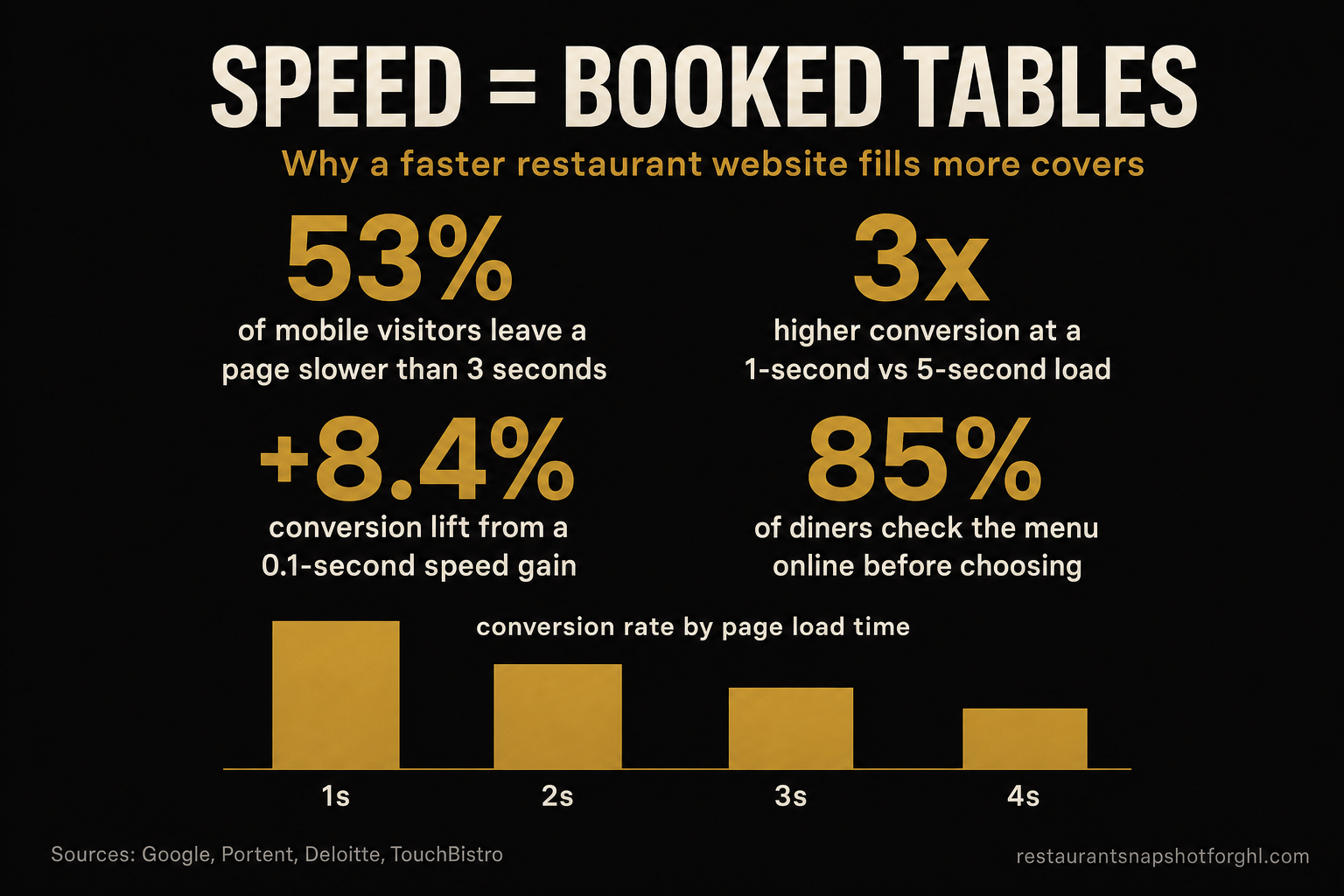
The reason the ceiling matters — not just the pass — is that conversion keeps climbing as pages get faster. Portent’s analysis of over 100 million page views found a site loading in one second converts roughly three times better than one loading in five seconds (Portent, 2022). And Deloitte’s Milliseconds Make Millions study, run with Google across 37 brands and 30 million-plus sessions, found that improving mobile load time by just 0.1 seconds lifted retail conversions 8.4% and average order value 9.2% (Deloitte / Google, 2020).
Notice these gains live above the Core Web Vitals pass line. A Squarespace site sitting at a mid-range mobile score is “passing” and still leaving conversions on the table versus a 95+ Astro page. Apply it to a Saturday: if a few hundred people reach your reservations page and a handful more book because the page opened instantly, that’s several covers a night you’d otherwise lose — compounding every service. Speed isn’t vanity; it’s the cheapest table-filler you’ll ever install, which is exactly how we build our online reservation flow.
Core Web Vitals: Passing Is a Floor, Not a Ceiling
Here’s the chart that reframes the whole debate. Squarespace, Wix, and WordPress are all “passing or close” on mobile — but a passing grade is a C, and a custom static build is built to hit an A. Because an Astro site ships almost no JavaScript, it targets 90–100 on Google PageSpeed regardless of how much food photography you load onto it.
I’ve kept the Astro bar as a dashed annotation on purpose: PageSpeed’s 0–100 score and the Core Web Vitals pass rate are different measurements, and I won’t pretend otherwise. The point stands — the platforms cluster around “passing,” while a hand-built static site is engineered for the top of the scale, and every tenth of a second up there is more booked covers.
Reservations, Schema, and Getting Found in Raleigh
This is where the sticker price gets misleading. A restaurant website has to do three things Squarespace charges extra for or can’t do cleanly:
- Take reservations. Squarespace has no native reservations product. Booking runs through Acuity Scheduling — a separate paid add-on that starts around $16/mo and climbs to $49/mo (Squarespace Help Center) — or an embedded third-party tool like OpenTable or Resy, which is its own subscription. A done-for-you Astro build includes the booking flow and reminders in the base price.
- Speak schema fluently. Google’s map pack and rich results run on structured data —
Restaurant, menu, hours, reviews, FAQ. On Astro we ship precise JSON-LD by default. On Squarespace, custom JSON-LD is a code-injection workaround that can conflict with the platform’s own markup (Squarespace Forum). If you want to win the Raleigh map pack, that control is the game. - Be readable by AI. The way diners find restaurants is splitting between Google and AI assistants. An
llms.txtfile and clean, answer-shaped pages help you get quoted in ChatGPT and Google AI Overviews — and Squarespace doesn’t give you the root file access to add one. Local intent still rules the day, too: 76% of people who search for something nearby on a phone visit a related business within a day (Think with Google).
The Real 3-Year Cost
Squarespace looks cheaper on day one. Add up three years the way an operator actually experiences it, and the picture changes — because the real cost of a DIY site is the hours you spend building and editing it during service, plus the add-ons the sticker price hides.
3-year cost, the way a Raleigh operator actually experiences it
| Plan | Custom Astro (done-for-you) recommended | Squarespace (DIY) |
|---|---|---|
| Price | ~$4,800 / 3 yrs | $$ + your hours |
| Feature 1 | $597 one-time build fee (charged only after the site is live) | $16–$99/mo plan (annual billing), higher month-to-month |
| Feature 2 | $117/mo — hosting, SSL, menu updates & revisions included | + Acuity Scheduling from ~$16/mo for real reservations |
| Feature 3 | Reservations, review collection & AI chat widget included | + review tool, chat tool & extra plugins as you need them |
| Feature 4 | Menu/price/hours edits done for you in 2–5 working days | + your time: every menu, price & hours edit is on you |
| Feature 5 | ≈ $4,809 over three years, all-in, zero of your hours | Lower sticker price, but you are the web team |
| See website pricing → | Compare our pricing |
The honest read: Squarespace can be cheaper in raw dollars if you value your own time at zero and never add booking. The moment you need real reservations, review collection, and a page that stays fast under load — and you’d rather run your kitchen than your CMS — a done-for-you Astro build is the better deal and the faster site.
Where Squarespace Still Makes Sense
No hard sell. Squarespace is the right call in a few real situations:
- You’re pre-launch and testing an idea. If you’re not sure the concept will make rent, a $16/mo template you build yourself is a sensible way to get something live.
- You genuinely enjoy building it and have the time. Some owners like the editor and have slow afternoons to spend in it. If that’s you, Squarespace is capable.
- You don’t need reservations or heavy local SEO. A coffee cart or a spot that lives entirely on walk-ins and Instagram may never feel the ceiling.
If, on the other hand, you’re an established Raleigh restaurant fighting for the map pack, taking reservations, and losing edits to the dinner rush — the ceiling and the done-for-you upkeep are worth far more than the sticker savings. That’s the same logic behind going beyond a stock website into a full automation stack.
Switching Without Losing Your Rankings
The number-one fear operators have is torching their Google rankings in a move. Done right, you won’t. A clean migration means we crawl your current Squarespace URLs, rebuild the important pages on Astro with matching or improved content, map 301 redirects from every old URL to its new home, port your schema and reviews, and submit a fresh sitemap. Rankings typically hold or improve within a few weeks because the new site is faster and better structured — Google rewards both. We handle the whole move; you keep serving dinner. See how the same speed-first approach plays out in our Fort Worth page-speed teardown and our Astro vs WordPress comparison.
Frequently Asked Questions
Custom Astro vs Squarespace for restaurant websites — FAQs
Is a Squarespace restaurant website actually slow in 2026?
Not inherently. Squarespace has closed most of the old speed gap — HTTP Archive field data shows roughly 70% of Squarespace sites passed Google's Core Web Vitals on mobile in 2025, up from about 60% the year before, ahead of WordPress (~46%) and near Wix (~74%). The catch is that 'passing' is a floor, not a ceiling: a real restaurant Squarespace site loaded with a reservation embed, photo galleries, pop-ups, and chat usually lands mid-range on Google's 0–100 PageSpeed score, while a static Astro build is engineered for 90–100. Since conversion keeps rising as pages get faster, that gap between 'passing' and 'peak' is real bookings.
Why choose a custom Astro site over Squarespace for a Raleigh restaurant specifically?
Three reasons beyond raw speed. First, the performance ceiling: Astro is built to hit 90+ PageSpeed even with heavy food photography and booking. Second, control: on Astro we ship precise schema, clean URLs, per-neighborhood location pages, and an llms.txt file so you rank in Raleigh's Google map pack and in AI answers — control that Squarespace's closed platform limits. Third, ownership and upkeep: you own the Astro build, it's portable, and we handle every menu and price edit for you, where a Squarespace site is a template you rent and maintain yourself during the rush.
Does Squarespace include restaurant reservations?
No. Squarespace has no native reservations product. Booking runs through Acuity Scheduling — a separate paid add-on that starts around $16/mo and goes up to $49/mo — or an embedded third-party tool like OpenTable, Resy, or Tock, each with its own subscription. A done-for-you Astro build includes the reservation flow, reminders, and review collection in the base price, so you're not stacking monthly tools to do the basics.
Will moving off Squarespace hurt my Google rankings?
Not with a proper migration. We map 301 redirects from every old Squarespace URL to its new Astro home, rebuild the important pages with matching or improved content, port your schema and reviews, and submit a new sitemap. Because the rebuilt site is faster and better structured, rankings typically hold steady or improve within a few weeks — Google rewards both speed and clean structure.
Does page speed really affect how many tables I book?
Yes, measurably. Google found 53% of mobile visitors abandon a page that takes longer than three seconds to load. Portent found a one-second page converts about three times better than a five-second one, and Deloitte's study with Google found a 0.1-second speed improvement lifted retail conversions 8.4% and average order value 9.2%. Since 85% of diners check a restaurant's menu online before choosing where to eat, a faster site literally converts more of that research traffic into booked covers.
How much does a done-for-you Astro restaurant website cost?
Our restaurant sites are $117/month plus a one-time $597 build fee — and the build fee is only charged after the site is live and you're happy with it. That flat price includes Cloudflare hosting, SSL, the reservation flow, review collection, an AI chat widget, and menu/price/hours updates handled for you within 2–5 working days. There are no separate hosting, plugin, or booking bills stacked on top.
Devon runs a small agency that builds and resells GoHighLevel systems and blazing-fast websites to hospitality clients, from food trucks to fine dining. A former line cook turned funnel nerd, he’s obsessed with the unsexy plumbing of restaurant marketing: page speed, schema, two-way SMS, and review pipelines that don’t annoy guests. His posts lean technical without losing the operator who has to live with the system.
Related reading
- Astro vs Wix for restaurant websites: speed, SEO & real cost (NYC)
- Astro vs WordPress for restaurant websites: page speed compared (Chicago)
- Fort Worth restaurant website page speed: the teardown
- Restaurant local SEO: how to win the Google map pack
- Get a blazing-fast restaurant website (Astro)
Sources
- HTTP Archive — 2025 Web Almanac: CMS chapter (platform CWV pass rates)
- Search Engine Journal — Core Web Vitals by CMS: WordPress, Wix, Squarespace (2025)
- Google / DoubleClick — Mobile page speed: new industry benchmarks (53% abandon >3s)
- Portent — Site speed is hurting everyone’s revenue (1s vs 5s conversion)
- Deloitte / Google — Milliseconds Make Millions (0.1s → +8.4% conversion, +9.2% AOV)
- TouchBistro — 2024 American Diner Trends Report (85% menu / 80% website)
- Squarespace Help Center — Acuity Scheduling pricing (separate add-on)
- Squarespace Forum — Schema markup / JSON-LD via code injection
- Think with Google — Mobile search / near-me trends (76% visit within a day)
- Visit Raleigh — Wake County 2024 Tourism Industry Report ($44.6M F&B tax; $3.4B spending)
- Visit Raleigh — Raleigh earns four James Beard semifinalist nominations for 2025