
It’s 7:40 on a Thursday in the West Village. Two people just left a sceney small-plates spot with a 90-minute wait, and they’re standing on Bleecker with a phone out, thumbs moving, deciding where to actually eat. They tap your restaurant’s link. If your menu, your vibe, and a “book a table” button are on the screen in about a second, you might have just filled a two-top. If there’s a spinner, a cookie banner, and a hero video still buffering — they’re already back in Google, tapping the next result. You never knew they existed.
In a market as deep as New York City — an industry the NYC Hospitality Alliance pegs at more than 25,000 restaurant and nightlife establishments — the platform your website runs on isn’t a back-office detail. It’s the front window. This is the honest, numbers-first comparison of the two ways most NYC operators build that window in 2026: a done-for-you Astro site vs a DIY Wix site. And I’m going to do something the usual “Astro is fast, everything else is slow” posts won’t: give Wix real credit where it’s earned it — then show you exactly where it costs you, and why.
Table of Contents
- The 30-second answer
- Your website is your busiest host in New York
- The honest part: Wix isn’t slow anymore
- So where does Astro actually win?
- The side-by-side comparison
- Speed is money: what a faster site is worth
- The Wix ceiling: apps, media, and the DIY tax
- Control, schema, and getting found in NYC
- The real 3-year cost
- Where Wix still makes sense
- Switching without losing your rankings
- Frequently asked questions
The 30-Second Answer
For a New York City restaurant, a done-for-you Astro site beats a DIY Wix site — not because Wix is slow, but because Astro guarantees the top of the performance range and hands you full control and ownership. Wix has genuinely closed the speed gap: most Wix sites now pass Core Web Vitals. But “passing” is a low bar, and a real restaurant Wix site — booking widget, photo galleries, a pop-up, a chat app, an animated hero — tends to drift down from there. Astro builds your pages into static HTML with almost no JavaScript, so it reliably scores 90–100 and stays there.
The deeper difference shows up after launch. On Wix, you rent a site inside Wix’s editor: you can’t touch the code, you’re limited on URL structure and schema, and if you ever outgrow it you rebuild from scratch. With a done-for-you Astro build you get a fast, fully-controlled, search- and AI-optimized site that someone else maintains — for a flat, predictable price. Everything below is the evidence, including the parts where Wix genuinely competes.
Your Website Is Your Busiest Host in New York
Before we compare platforms, be clear on the job the website is actually doing. In New York, the website is your busiest host — it greets more prospective guests than your maître d’ ever will, and it does it while you’re in the weeds on a Saturday.
Diners research before they commit. TouchBistro’s 2024 survey of U.S. diners found 85% look at a restaurant’s menu online and 80% check the website before choosing a new place to eat (TouchBistro, 2024). Almost all of that happens on a phone, on the sidewalk, under time pressure — the exact conditions where speed and clarity win or lose the table.
And they’re impatient. Google’s benchmark research found 53% of mobile visitors abandon a page that takes longer than three seconds to load (Google / DoubleClick, 2016). In a city with 25,000+ places to eat, three seconds is all the runway you get before that West Village couple books somebody else. Your food didn’t lose them. Your load time did.
The Honest Part: Wix Isn’t Slow Anymore
Here’s where most comparison posts lie to you, so let’s not. Wix has spent years rebuilding its performance stack, and the data shows it worked.
According to HTTP Archive’s Core Web Vitals data for 2025, roughly 71% of Wix sites pass all three Core Web Vitals on mobile — ahead of WordPress at about 46%, and well ahead of the web-wide average, where only about 48% of mobile sites pass (HTTP Archive / Search Engine Journal, 2025; Web Almanac, 2025). As a managed platform that controls its own hosting, CDN, and image pipeline, Wix can push performance improvements to every site at once — an advantage self-hosted WordPress, at the mercy of cheap shared hosting and plugin sprawl, simply doesn’t have.
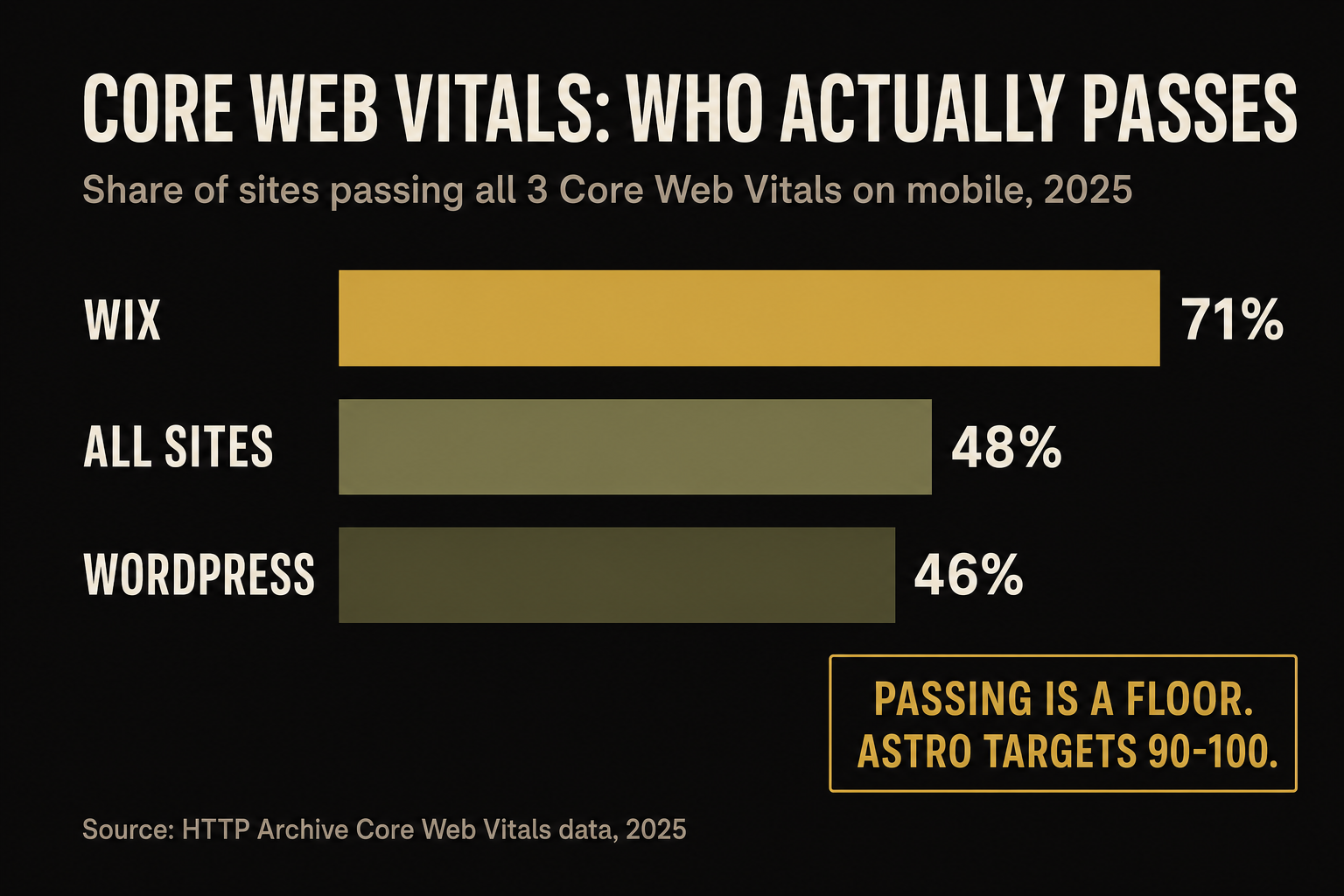
So if a salesperson tells you “your Wix site is slow, that’s why you’re not booking,” be skeptical. It might be true — but it’s not automatically true, and the honest question is different: not “does it pass?” but “how high is the ceiling, and who controls it?” That’s where Astro pulls ahead.
So Where Does Astro Actually Win?
Core Web Vitals is a pass/fail grade against three thresholds: Largest Contentful Paint under 2.5s, Interaction to Next Paint under 200ms, and Cumulative Layout Shift under 0.1 (web.dev, 2024). Passing means you cleared the bar. It says nothing about how fast you actually are, and Google’s overall PageSpeed score — the 0–100 number — rewards being genuinely fast, not just adequate.
That’s the gap. Astro builds ahead of time. It compiles your site into static HTML during the build, ships almost no JavaScript (“islands architecture”), and serves finished files straight from a global edge network. There’s no page-builder runtime assembling the page on the diner’s phone — just a done page arriving almost instantly. That’s why a well-built Astro restaurant site reliably scores 90–100 on Google PageSpeed, and why our prebuilt restaurant website ships with a guaranteed 90+ on mobile and desktop.
Wix, by design, does the opposite: it’s a visual editor that renders a fairly heavy, JavaScript-driven page so that anyone can drag boxes around. Great for a solo owner on a slow Tuesday afternoon. But it means your ceiling is Wix’s engine plus whatever apps you bolt on — and for a restaurant, you always bolt on apps.
The Side-by-Side Comparison
Here’s the honest scorecard on the factors that decide whether a New York restaurant website fills tables — including where Wix genuinely competes.
Astro (done-for-you) vs Wix (DIY) for a restaurant website
| Plan | Astro (done-for-you) recommended | Wix (DIY) |
|---|---|---|
| Price | Fills tables | Passes, rarely peaks |
| Feature 1 | Static HTML, near-zero JavaScript — guaranteed 90+ PageSpeed (often 100) | Passes Core Web Vitals (~71%) but real restaurant sites rarely hit 90+ |
| Feature 2 | Performance ceiling stays high even with photos, menus, and booking | Speed drops as you add booking apps, galleries, pop-ups & chat |
| Feature 3 | Full control of every URL, meta tag, and JSON-LD schema for SEO/AEO | Limited control of code, URL structure, and custom schema |
| Feature 4 | Clean sitemap, robots.txt and llms.txt built in for Google + AI search | SEO tools improving, but advanced/AEO control is constrained |
| Feature 5 | Per-neighborhood location pages that load instantly | Location pages possible but add app and template weight |
| Feature 6 | You own the build; portable and future-proof, no lock-in | You rent the site inside Wix; leaving means a full rebuild |
| Feature 7 | Menu edits handled for you via a support ticket | You do every edit yourself in the editor — it's on your time |
| Feature 8 | Flat $497 + $97/mo — domain, hosting & updates included | $17–$159/mo plan + paid apps + your hours building it |
| Get an Astro site → | The DIY route |
The pattern is clear: Wix wins on do-it-yourself immediacy and a low sticker price. Astro wins on the ceiling, the control, the ownership, and the fact that a professional builds and maintains it for you. For an operator whose real job is service, not site-building, that trade is usually a landslide.
Speed Is Money: What a Faster Site Is Worth
The reason the ceiling matters — not just the pass — is that conversion keeps climbing as pages get faster. Portent’s analysis found a site loading in one second converts roughly three times better than one loading in five seconds (Portent, 2022). And Deloitte’s Milliseconds Make Millions study, run with Google across dozens of brands, found that improving mobile load time by just 0.1 seconds lifted conversions 8.4% and average order value 9.2% (Deloitte / Google, 2020).
Notice these gains live above the Core Web Vitals pass line. A Wix site sitting at a mid-range mobile score is “passing” and still leaving conversions on the table versus a 95+ Astro page. Apply it to a Friday: if a couple hundred people reach your reservations page and a handful more book because the page opened instantly, that’s several covers a night you’d otherwise lose — compounding every service. Speed isn’t vanity; it’s the cheapest table-filler you’ll ever install, which is exactly how we build our online reservation flow.
The Wix Ceiling: Apps, Media, and the DIY Tax
The platform-wide 71% pass rate is measured across all Wix sites — including simple brochure pages. A restaurant site is not simple. To actually run your floor you’ll add a reservation/booking widget, high-resolution food photography, a menu with sections, maybe a pop-up for the mailing list, a chat app, an events calendar, and tracking pixels. Every one of those is more JavaScript and more media the diner’s phone has to download and run, and each is exactly what drags a real Wix restaurant site down from “passing” toward “why is this so slow on my phone.”
There’s a second, quieter cost: your time. Wix is DIY, which means you are the web team. You’re the one resizing images at 11pm, fighting the mobile editor because the desktop layout broke, and re-learning the interface every time you touch it after three months away. That’s the DIY tax — real hours that a restaurant owner does not have during a New York dinner rush. A done-for-you build moves that entire job off your plate.
Control, Schema, and Getting Found in NYC
Speed decides whether a diner who reaches your site stays. Structure decides whether they find you at all — in Google’s local map pack, and increasingly in AI answers when someone asks ChatGPT or Google’s AI Overviews “where should I eat near Union Square tonight?”
This is where renting a site inside a closed editor bites. On Astro, we control the raw HTML of every page, so we can ship precise, valid JSON-LD schema (Restaurant, Menu, FAQ, LocalBusiness, per-location markup), clean human-readable URLs, a correct sitemap, and an llms.txt file that tells AI crawlers exactly what your menu, hours, and neighborhoods are. That structural clarity is how a fast, well-built site climbs above the delivery apps — the same foundation we cover in the restaurant local SEO playbook.
Wix’s SEO tools have improved a lot, and for a basic site they’re fine. But you’re working within the platform’s guardrails: constrained URL structures, auto-generated schema you can’t fully shape, and limited control when you want to do something advanced for AEO. For a single-location café that may never matter. For a group trying to rank across multiple NYC neighborhoods and show up in AI search, full control is the difference between competing and being invisible. It’s the same reason we recommend GoHighLevel for the marketing engine but a dedicated Astro site for the public front door — each tool doing the job it’s actually built for.
The Real 3-Year Cost
Wix’s sticker price looks lower, and month one, it is. But price a restaurant site over the three years you’ll actually run it, and the picture changes. A restaurant-grade Wix plan runs roughly $29–$159/month, and the features you need — removing Wix ads, connecting a domain, accepting bookings, and premium apps — push most operators into the higher tiers, on top of paid third-party apps. Then add the hours you spend being your own webmaster.
A done-for-you Astro build from our Get a Website service is a flat $497 one-time plus $97/month — and you pay the one-time fee only after the site is live and you’re happy, typically within 10 working days. That $97 covers managed Cloudflare hosting, your domain, SSL, and updates (open a ticket, we make the change — no “$150 to update tonight’s specials”). Multi-location NYC operators can rebrand up to five sites for a flat bulk rate.
The honest framing: Wix is cheaper if your own time is free and you never need the top of the performance range or advanced SEO. For most New York operators, neither is true — your time is the scarcest thing you own, and the market is too competitive to leave conversions or rankings on the table.
Where Wix Still Makes Sense
An honest comparison names the exceptions. Wix is a reasonable call when you’re a brand-new, single-location spot on the tightest possible budget, you genuinely enjoy building and tweaking the site yourself, and you don’t yet need multi-neighborhood SEO or the last mile of performance. Its editor is friendly, its templates are attractive, and — as the data shows — it will very likely pass Core Web Vitals out of the box. For a pop-up, a soft launch, or a placeholder while you find your footing, that can be exactly enough.
The moment any of these becomes true, though, you’ve outgrown it: you’re competing for bookings across several NYC neighborhoods, you want to show up in AI search, your site is bloating as you add apps, you’re tired of being your own webmaster, or you’re opening a second location. That’s when a fast, controlled, done-for-you build stops being a nice-to-have and starts paying for itself in covers.
Switching Without Losing Your Rankings
Moving off Wix is lower-risk than most operators fear. Here’s the sequence we use.
- Benchmark first. Run your current site through Google PageSpeed Insights on mobile and write down the score and your Largest Contentful Paint. This is your before-photo — and usually the moment operators decide to move.
- Inventory what earns its keep. Your menu, hours, locations, reservation link, photos, and any pages that rank. Most Wix sites carry apps and sections nobody uses; those don’t migrate.
- Rebuild static, keep your URLs. The site is rebuilt in Astro with your key URLs preserved (or proper 301 redirects), so you keep your existing Google rankings — plus new per-neighborhood location pages and clean schema.
- Point the domain and go live. Hosting moves to Cloudflare’s edge. You keep your domain; there’s no gap in being found.
- Re-benchmark. Run PageSpeed again. Going from a mid-range mobile score to a guaranteed 90+ is the norm — and that’s the difference the West Village couple feels.
If you’d rather not run any of that yourself, that’s the whole point of a done-for-you build — see what’s included and the pricing, or book a walkthrough and we’ll benchmark your current Wix site live on the call. Prefer to compare against the other common option? Here’s the honest Astro vs WordPress breakdown too.
Frequently Asked Questions
Astro vs Wix for restaurant websites — FAQs
Is a Wix restaurant website actually slow in 2026?
Not inherently. Wix has closed most of the speed gap — HTTP Archive data for 2025 shows about 71% of Wix sites pass Google's Core Web Vitals on mobile, ahead of WordPress (~46%) and the ~48% web-wide average. The catch is that 'passing' is a floor, not a ceiling: a real restaurant Wix site loaded with a booking app, photo galleries, pop-ups, and chat usually lands in the mid-range on Google's 0–100 PageSpeed score, while a static Astro build reliably hits 90–100. Since conversion keeps rising as pages get faster, that difference between 'passing' and 'peak' is real bookings.
Why choose Astro over Wix for a New York City restaurant specifically?
Three reasons beyond raw speed. First, the performance ceiling: Astro guarantees 90+ PageSpeed even with heavy food photography and booking. Second, control: on Astro we can ship precise schema, clean URLs, per-neighborhood location pages, and an llms.txt file so you rank in Google's map pack and in AI answers across competitive NYC neighborhoods — control Wix's closed editor limits. Third, ownership: you own an Astro build and it's portable, where a Wix site is rented inside Wix and leaving means a full rebuild.
Does page speed really affect how many tables I book?
Yes, measurably. Google found 53% of mobile visitors abandon a page that takes longer than three seconds to load. Portent found a one-second page converts about three times better than a five-second one, and Deloitte's study with Google found a 0.1-second speed improvement lifted conversions 8.4%. Since 80% of diners check a restaurant's website before choosing where to eat, a faster site literally converts more of that research traffic into booked covers.
Can I still edit my menu easily if I move off Wix to Astro?
Yes. With a done-for-you Astro build you submit a change — a new menu, seasonal hours, a photo swap — via a support ticket and it's handled for you, usually within a day for small edits, with no surprise fee. The trade-off versus Wix's log-in-and-drag model is real, but for most operators, not having to be your own webmaster during a dinner rush is a feature, not a limitation. You get the speed and SEO without touching the code.
Will moving from Wix to Astro hurt my Google rankings?
Not if the migration is done correctly. You preserve your key URLs (or set proper 301 redirects), carry over your content and add clean schema and sitemaps. Because Core Web Vitals are a Google ranking signal and Astro pages pass them by default while scoring higher on PageSpeed, most restaurants see their technical SEO improve after migrating, not decline — typically going from a mid-range mobile score to a guaranteed 90+.
How much does a fast Astro restaurant website cost versus Wix in NYC?
Our Get a Website service is $497 one-time plus $97/month for a single restaurant, and you pay the one-time build fee only after the site is live and you're satisfied — usually within 10 working days. The $97/month covers managed Cloudflare hosting, your domain, SSL, and updates, with no per-page or per-edit fees. A restaurant-grade Wix plan often runs $29–$159/month before paid apps and the hours you spend building it yourself. Multi-location NYC operators can rebrand up to five sites for a flat bulk rate.
Devon runs a small agency that builds and resells GoHighLevel systems and blazing-fast websites to hospitality clients, from food trucks to fine dining. A former line cook turned funnel nerd, he’s obsessed with the unsexy plumbing of restaurant marketing: page speed, schema, two-way SMS, and review pipelines that don’t annoy guests. His posts lean technical without losing the operator who has to live with the system.
Related reading
- Astro vs WordPress for restaurant websites: page speed compared
- Restaurant local SEO: how to win the Google map pack
- Building a restaurant online reservation system that fills tables
- Get a blazing-fast restaurant website (Astro)
Sources
- HTTP Archive / Search Engine Journal — 2025 Core Web Vitals CMS rankings (Wix vs WordPress pass rates)
- HTTP Archive — 2025 Web Almanac: Performance (overall CWV pass rate)
- Google / DoubleClick — Mobile page speed: new industry benchmarks (53% abandon >3s)
- Portent — Site speed is hurting everyone’s revenue (1s vs 5s conversion)
- Deloitte / Google — Milliseconds Make Millions (0.1s → +8.4% conversion)
- web.dev — Defining the Core Web Vitals thresholds
- TouchBistro — 2024 American Diner Trends Report (85% menu / 80% website)
- NYC Hospitality Alliance — Our Mission (25,000+ NYC establishments)