
It is the last day of the month and you are reconciling the OpenTable invoice at the bar. The subscription line you expected. It is the cover fees underneath that make you stop: a dollar here, a dollar fifty there, line after line, for diners who were coming to your room anyway. You booked them a table; OpenTable booked you a bill. And the guest whose birthday and usual order you could be building a relationship around belongs to the app, not to you.
You are not stuck. There are real OpenTable alternatives in 2026 that charge a flat monthly rate with no per-cover fee, and a route that cuts the middleman out entirely. This is the honest rundown for a one-to-three location independent: what each really costs, the Resy and Tock merger that reshaped the market this year, and which is right for your room.
Table of Contents
- The 30-second answer
- Why independents are leaving OpenTable
- How to judge an alternative: eight criteria
- The alternatives, priced side by side
- Resy (and Tock, now folded in)
- Yelp Guest Manager
- Toast Tables
- SevenRooms
- The real answer: own your own bookings
- Three budgets: solo, busy, small group
- Steal this: the switch-over scripts
- Where the switch breaks
- Objections, answered straight
- Frequently asked questions
The 30-Second Answer
If you want off OpenTable to stop the per-cover bleed, the shortlist is short. Pick Resy for a flat-fee marketplace with a real diner network. Pick Yelp Guest Manager if most of your discovery already happens on Yelp. Pick Toast Tables if you already run Toast POS, because for you it is close to free. Consider SevenRooms only if you are a multi-unit group with a marketing person and the budget for a quote-gated contract. But the honest answer underneath all of them is to take bookings directly on your own website, so no third party sits between you and the diner.
Why Independents Are Leaving OpenTable
OpenTable is not a bad product. It is the oldest and largest reservation network in the US, and for a brand-new room with no audience the discovery can be worth paying for. The problem is the pricing model, and it gets worse the better you do. It sells three monthly tiers, reported at roughly $149/mo (Basic), $299/mo (Core), and $499/mo (Pro) (EatApp, 2026). The part that stings sits on top: a per-cover fee of about $1.50 for each “network” cover on Basic and $1.00 on Core and Pro, a network cover being a diner it routed to you. On Basic, even covers from your own website cost $0.25 each unless you pay a $49/month fee to waive them, and early in 2026 OpenTable added a 2% service fee on deposits and no-show penalties too. You are paying a premium that scales with your success.
The National Restaurant Association projects $1.55 trillion in 2026 sales but notes 45% of operators were not profitable in 2025 (NRA, 2026). On a net margin that typically runs just 3% to 5% (Level CFO, 2026), a few thousand dollars a year in avoidable cover fees is the difference between a flat year and a good one.
How to Judge an OpenTable Alternative: Eight Criteria
A tool that wins a feature checklist can still be wrong for your room. Score every option against eight things, the rows of the table below: monthly base price, per-cover fee (the biggest reason to switch), deposit fees, setup and contract length, marketplace discovery, who owns the guest data, POS fit, and who it is built for. That last one is the tiebreaker: most of these tools are fine and simply built for an operation that is not your size.
The Alternatives, Priced Out Side by Side
Here is the whole field on one screen. Treat SevenRooms and Toast Tables Plus figures as reported or estimated, because neither publishes a public rate.
| Criteria | OpenTable | Resy | Yelp Guest Manager | Toast Tables | SevenRooms |
|---|---|---|---|---|---|
| Entry monthly price | $149/mo (Basic) | ~$289/mo (Platform) | ~$159/mo (Basic) | Near-free w/ Toast POS | ~$300+/mo (est.) |
| Top tier | $499/mo (Pro) | ~$459/mo (360) | ~$349/mo (Plus) | Plus (quote only) | Custom |
| Per-cover fee | $1.00 to $1.50 | None | None | None | None |
| Deposit / prepay fee | ~2% | ~2 to 3% | None stated | Via Toast | Custom |
| Setup / contract | 12-mo term | Low | Low | Included | ~$5K to $25K, annual |
| Marketplace discovery | Largest US network | Amex + Resy network | Yelp traffic | Minimal | Minimal (CRM-led) |
| You own the guest data? | No, lives with OpenTable | Partial | Partial | Yes, via Toast | Partial |
| Best for | Brand-new room needing covers | Flat-fee marketplace fans | Yelp-driven shops | Existing Toast users | Multi-unit groups |
Resy (and Tock, Now Folded In)
Resy is the most direct like-for-like swap for OpenTable, and in 2026 it got bigger. American Express, which has owned Resy since 2019, announced in February 2026 that it would merge Resy with Tock, the platform it bought from Squarespace for $400 million in 2024. The standalone Tock consumer app and exploretock.com are being sunset, with diner-facing booking moving onto Resy and more than 25,000 Tock venues added to the combined network (Upgraded Points, 2026). The restaurant-side tools keep running under Resy branding. So signing with Tock today really means signing up for Resy.
Resy sells a Platform tier around $289/mo and Platform 360 around $459/mo, both flat, with no per-cover fee and a small percentage (roughly 2 to 3%) only on prepayments and deposits (PricingSaaS, 2026). Who it is right for: a busy independent that wants a real diner network and a flat bill and does not mind the Amex ecosystem. Where it falls short: discovery is thinner outside big metros, and the guest relationship still runs through Resy, not you.
Yelp Guest Manager
Worth a look if your discovery already happens on Yelp, since it ties bookings and waitlist to where people read your reviews. Third-party tracking in 2026 puts Basic around $159/mo (about $129/mo annually), capped at 500 covers a month, and Plus around $349/mo (about $279/mo annually) with unlimited covers, plus a custom Enterprise tier, with no cover fees (FrontDeskReview, 2026).
Who it is right for: a neighborhood independent whose discovery runs through Yelp. Where it falls short: the 500-cover cap on Basic is low for real volume, so a busy shop lands on Plus fast, and your diner relationship is still tethered to Yelp’s rules.
Toast Tables
The quiet value pick, with one condition: you must already run Toast POS, since Toast Tables is sold only to existing Toast merchants. The base plan includes an unlimited waitlist and up to 25 reservations a month, which for a small walk-in room can be effectively free. Toast Tables Plus adds unlimited reservations and Experiences for rooms taking bookings online or by phone; Toast does not publish a price, so it is a quote, but it is a flat monthly fee with no per-cover charge (Toast, 2026).
Its edge is living inside the POS you already use, so the booking, guest data, and check sit in one system you own. Who it is right for: an existing Toast restaurant that wants bookings and a waitlist without another subscription. Where it falls short: almost no marketplace discovery, and a non-starter on Square, Clover, or anything but Toast.
SevenRooms
The most powerful platform here, and the least appropriate for most independents. It is not really a reservation tool; it is a guest-data CRM with reservations attached, built for hotel groups and multi-unit operators, and it is fully demo-gated. Operator reports (unverified) cluster around $300 to $700 per location per month, climbing past $1,000 to $2,000 with the marketing and CRM modules, with setup fees reported from $5,000 to $25,000 and an annual contract (Software Advice, 2026). And since DoorDash bought SevenRooms for $1.2 billion in June 2025, your guest data now sits inside a delivery company (CNBC, 2025). See the full SevenRooms teardown.
Who it is right for: a multi-location group with a dedicated marketing hire. Where it falls short: for a one-to-three room independent, the setup cost and contract are out of all proportion to what you will use.
The Real Answer: Own Your Own Bookings
Every option above beats OpenTable’s per-cover model, but none changes the core problem: the diner still books through somebody else’s brand, and the relationship lives in somebody else’s database. The cheapest cover of all is the one a returning guest books directly with you, because you already have their name, number, birthday, and last order, and no platform takes a cut.
In Toast’s 2025 survey, 65% of diners said they go straight to a restaurant’s own website to book rather than opening a third-party app (Toast, 2025). The demand is already there; what is missing is the plumbing: a booking widget on your own site, confirmations and reminders by text, and a guest database you control. Run that and a marketplace becomes a channel you can dial down, not a landlord. We cover the setup in how to own your guest list instead of renting it from OpenTable.
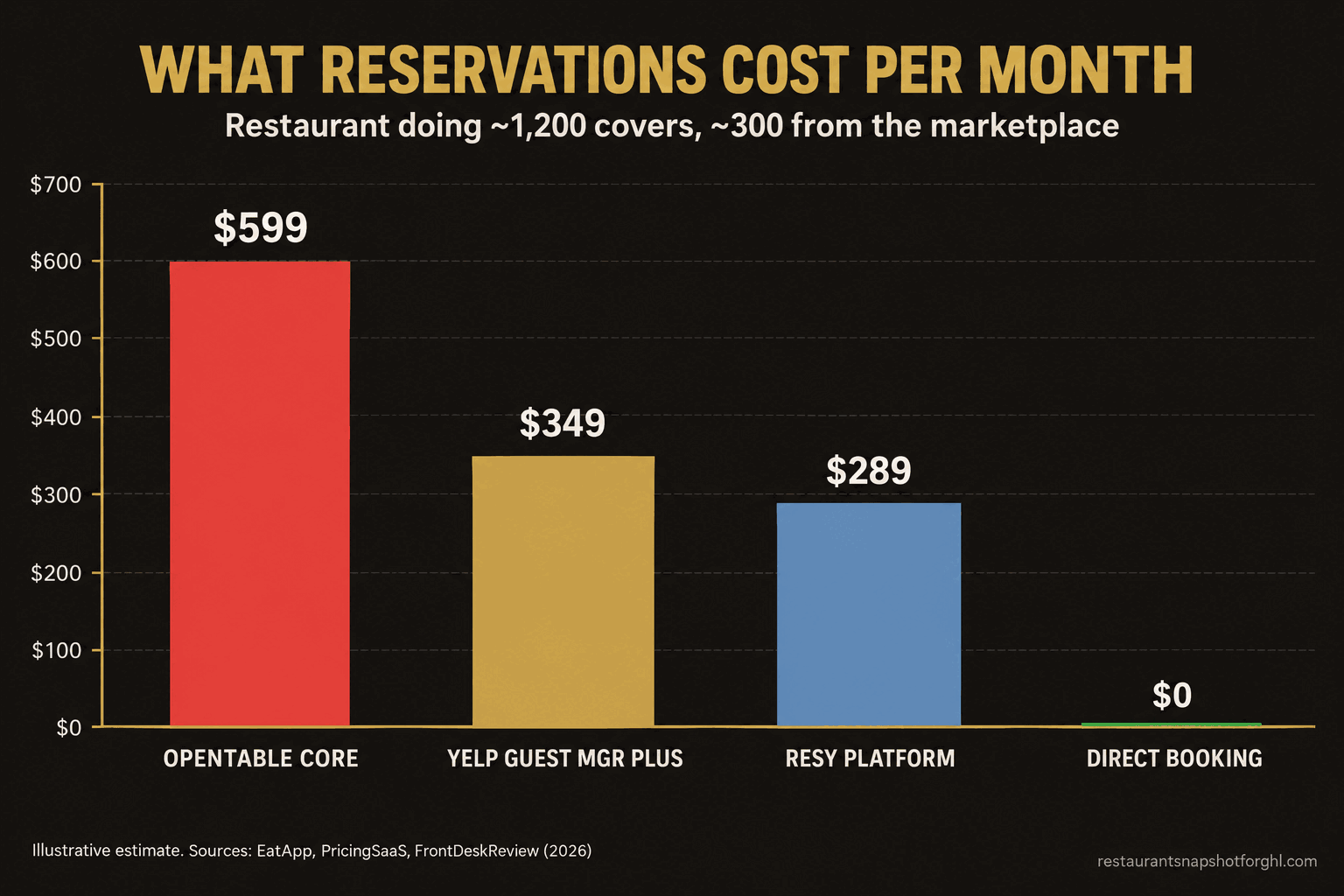
Here is the per-cover math, same 1,200-cover month and roughly 300 marketplace-sourced covers, priced across the options:
Estimated monthly reservation cost at ~1,200 covers with ~300 marketplace-sourced covers. OpenTable is base plan plus ~300 network covers at ~$1.00 each; flat-fee platforms are the published rate; direct booking has no per-cover fee. Illustrative estimates, not quotes. Sources: EatApp, PricingSaaS, FrontDeskReview (2026).
Three Budgets: Solo, Busy Independent, Small Group
The right answer changes with the room.
The solo bistro (one room, mostly walk-ins, under 500 covers a month). No marketplace subscription or per-cover fees needed. On Toast POS, the free Toast Tables base plan plus a booking link covers you; otherwise a direct booking widget plus SMS reminders is the whole system. Estimated monthly: $0 to $159.
The busy independent (one or two rooms, 1,000 to 2,500 covers a month). Per-cover fees hurt most here, so a flat-fee tool pays for itself immediately. Resy Platform or Yelp Guest Manager Plus gives you a flat bill and a network; pair it with direct booking to shift covers off the marketplace over time. Estimated monthly: $289 to $349, trending down.
The small group (two to three locations, a marketing person, events). Now CRM depth earns its keep. Resy Platform 360 across locations is the sane flat-fee choice; SevenRooms is worth a quote only if you will truly use the guest marketing. Either way, stand up one shared direct-booking database so the group owns one list, not three rented ones. Estimated monthly: $459 and up.
Steal This: the Switch-Over Scripts
Done right, the switch is boring. Here is the exact copy; swap in your name, hours, and link.
1. The migration announcement (email and SMS to your list, two weeks out).
“Good news from [Restaurant]: you can now book us directly at [yourlink]. Same tables, same team, and it is the fastest way to reach us. Save the link and skip the app. Reply STOP to opt out.”
2. The “book direct” nudge (on receipts, table tents, and your Google listing).
“Loved it? Book your next visit direct at [yourlink]. No app, no account, 30 seconds.”
3. The booking confirmation (fires the second they book on your site).
“You’re booked, [First name]. Table for [party size] at [Restaurant] on [date] at [time]. Reply C to confirm or R to reschedule. Parking + directions: [link]. Reply STOP to opt out.”
4. The reminder (24 hours before, the no-show killer).
“See you tomorrow at [time], [First name]. Need to change your party size or time? Reply here. If plans changed, reply CANCEL so we can offer the table to someone on the waitlist.”
5. The win-back (60 days after a guest’s last visit, pulled from your own database).
“We miss you at [Restaurant], [First name]. Your table is always ready. Book direct at [yourlink] and tell the kitchen it’s you.”
Before you send a single text, read what TCPA and A2P 10DLC require of restaurant SMS, because a promo blasted to a list collected at the host stand is the classic violation.
Where the Switch Breaks
Switching reservation platforms is where good intentions go to die. Here is where it goes wrong, and how to avoid it.
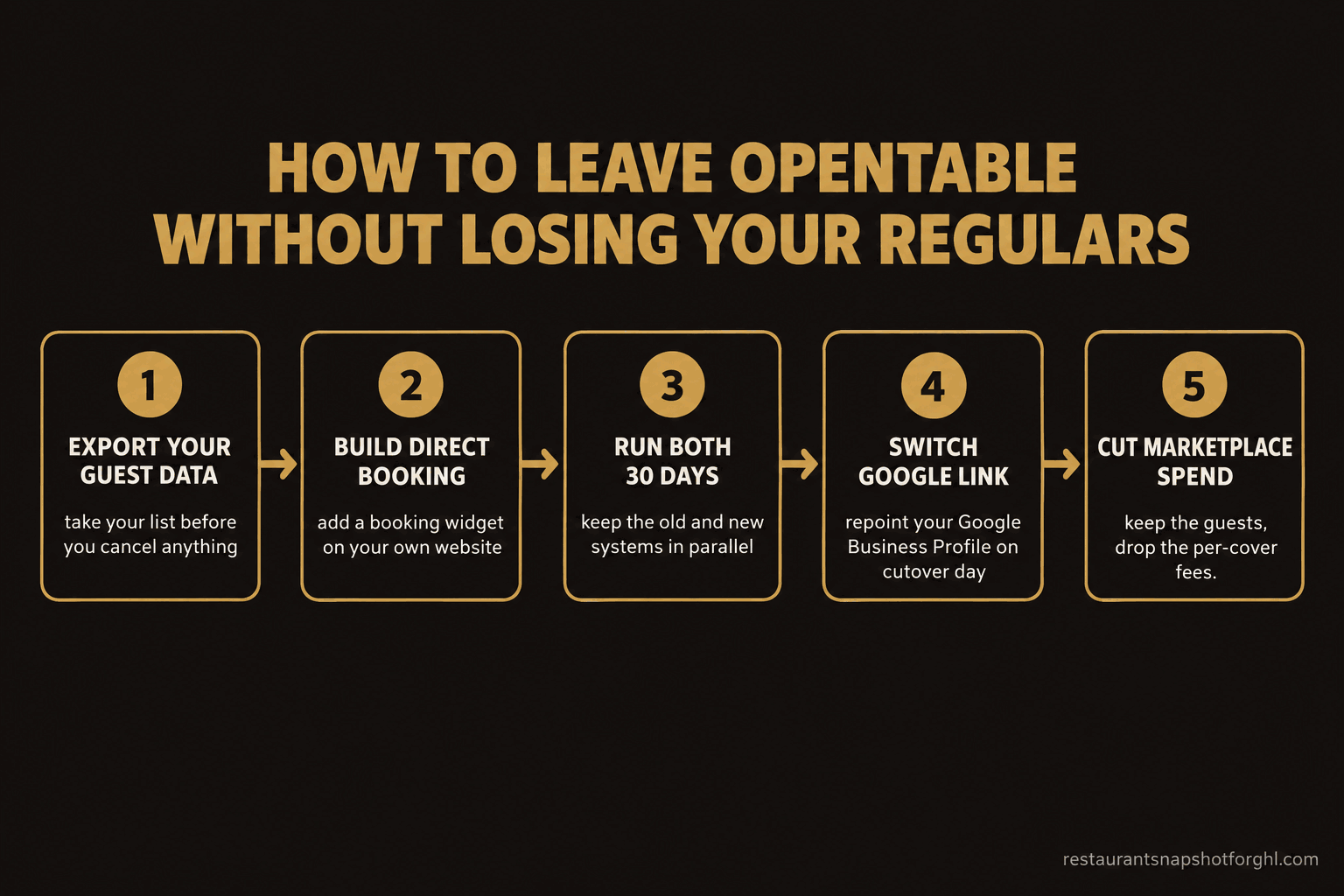
You drop the marketplace before the direct channel works. Fix: stand up and test direct booking first, run both in parallel for about 30 days, then cut marketplace spend.
You lose the guest list on the way out. Your reservation history is your bargaining power, and most operators forget to take it. Fix: export your full guest data before you cancel anything. If export is hard, that difficulty is itself the argument for owning your list next time.
Your Google booking link still points at the old platform. Diners hit the “Reserve a table” button on your Google Business Profile and land in a dead system. Fix: update that reservation link on cutover day and check it from a phone that is not logged in. The reviews you earned on OpenTable do not move with you either, so drive reviews to Google from day one, where they help every channel.
Nobody told the front-of-house team. The host grabs the old tablet out of habit. Fix: a printed cheat sheet at the host stand, a five-minute pre-shift walkthrough, and the old app deleted on cutover day.
Objections, Answered Straight
“Won’t I lose discovery if I leave OpenTable?” Some, if you are a brand-new room with no audience. But most established independents overestimate how many truly new diners the marketplace brings versus diners who already knew them and used the app out of habit. Run the per-cover report for one month and count how many “network” covers were genuinely first-time guests; the number is usually smaller than the invoice feels.
“I already paid for a year of OpenTable.” Then do not cancel today. Use the remaining term to build your direct channel in parallel, so that at renewal you no longer need them. A 12-month contract is a reason to start now, not to re-sign.
“Do I need to be technical to run my own bookings?” No. A booking widget, confirmations, and reminder texts are setup-once systems. The point of a done-for-you install is that someone builds the plumbing and you just run your floor.
“What about no-shows if I leave the big platform?” No-shows are a policy and reminder problem, not a platform problem. Toast’s data put no-shows around 2% of booked reservations, and a good confirm-and-remind flow cuts them further. See our no-show recovery playbook.
Frequently Asked Questions
What is the best OpenTable alternative for a small independent restaurant in 2026?
It depends on your setup. On Toast POS, Toast Tables is nearly free and the easiest swap. For a flat-fee marketplace, Resy (about $289/mo) or Yelp Guest Manager (about $159 to $349/mo) both charge no per-cover fee. But the cheapest option overall is taking bookings directly on your own website, which has no per-cover fee and keeps the guest data with you.
Is Tock still a separate reservation platform?
No. American Express, which owns both, merged Tock into Resy in 2026. The standalone Tock consumer app and exploretock.com are being sunset and bookings now run through Resy, though restaurant-side tools continue under Resy branding. If you were considering Tock as a standalone choice, you are really choosing Resy.
Can I use Toast Tables without Toast POS?
No. Toast Tables is sold only to existing Toast merchant accounts. On Square, Clover, or another POS, look at Resy, Yelp Guest Manager, or direct booking on your own site instead.
Do any reservation platforms let me keep my guest data?
Partially. Toast Tables keeps the data inside your Toast account. Resy, Yelp, and SevenRooms hold the relationship on their platforms, so you can usually export a list but the ongoing relationship runs through them. The only way to fully own it is to take bookings on your own site into your own database.
How do I switch reservation systems without losing my regulars?
Export your guest data first, stand up and test direct booking on your own website, run both systems in parallel for about 30 days, update your Google Business Profile reservation link on cutover day, and send your list your new booking link before dropping the old platform. Build the direct channel first, then reduce marketplace spend.
Related reading
- OpenTable vs Resy vs Tock vs SevenRooms: the real cost per cover
- How to own your restaurant’s guest list instead of renting it from OpenTable
- What SevenRooms actually costs in 2026 now that DoorDash owns it
- Online reservation system for restaurants: take direct bookings and cut per-cover fees
- The real cost of every cover booked through a marketplace
- Restaurant customer lifetime value: the number that changes every decision
- Get the Restaurant Snapshot installed in 24 hours
Sources
- EatApp, OpenTable pricing explained (2026)
- PricingSaaS, Resy pricing plans and history (2026)
- FrontDeskReview, Yelp Guest Manager pricing (2026)
- Toast, Toast Tables vs Toast Tables Plus (2026)
- Software Advice, SevenRooms profile and pricing (2026)
- Upgraded Points, Resy merges with Tock, adds 25K venues (2026)
- CNBC, DoorDash announces $1.2 billion SevenRooms deal (2025)
- Toast, 2025 reservation data: 65% of diners book direct on the website
- National Restaurant Association, 2026 State of the Restaurant Industry (Feb 2026)
- Level CFO, Restaurant profit margins by type (2026)