
You wanted a number. You filled out the form, sat through the demo, watched the rep walk through the guest profiles and automated marketing and reservation widget, then asked the only question that matters: what does this cost per month? And you got a version of “it depends on your needs, let’s build you a custom plan.” That’s not an accident. SevenRooms is one of the most capable guest platforms in the business, and one of the only ones in this teardown that won’t put a price on its website.
So let’s put one on it. This is a straight, numbers-first look at what SevenRooms actually costs an independent restaurant in 2026: the monthly figure operators report, the setup fee and annual contract nobody mentions on the call, and what changed in June 2025 when DoorDash bought the company for $1.2 billion. By the end you’ll know whether it’s worth the quote, or whether you’re about to pay enterprise money for a tool a small shop touches twice a year.
Table of Contents
- The 30-second answer
- Why you can’t find a SevenRooms price
- What SevenRooms actually costs in 2026
- The DoorDash question: who owns your guest list now?
- SevenRooms vs the alternatives, priced out
- Three real budgets: solo, busy independent, small group
- The hidden costs nobody quotes you (and where it breaks)
- Steal this: how to force a real quote
- Objections, answered straight
- Frequently asked questions
The 30-Second Answer
SevenRooms doesn’t publish a price because it flexes with how much they think you’ll pay, and for most independents the honest answer is “more than you need to spend.” Plan on roughly $500 per location per month for a lean single-venue setup, climbing to $1,000 to $2,000+ per location with the marketing, CRM, and ordering modules, plus a setup fee and an annual contract (Software Advice, 2026).
Its genuine edge is no per-cover fee, so a busy room isn’t punished for being busy the way it is on OpenTable. But the platform was built for hotel groups and multi-unit operators with a marketing team, and the pricing assumes you have one. If you run one to three rooms and mostly want reservations, reminders, and reviews, it’s the wrong tool. The real question isn’t “SevenRooms or OpenTable.” It’s how much of your guest relationship you’ll rent, and from whom.
Why You Can’t Find a SevenRooms Price
Go to the pricing page and you’ll find tiers with names (Starter, Growth, Premium) and a “request a demo” button where the numbers should be. Gated pricing isn’t about the product being too complex to price; a quote-only model lets the vendor read the room and quote each operator differently. The “custom plan” is custom to your willingness to pay.
That matters because the margin to absorb a bad software decision is thin. The National Restaurant Association projects $1.55 trillion in industry sales for 2026 and 15.8 million jobs (NRA, 2026). But the same report notes 42% of operators said their restaurant was not profitable the prior year, on a net margin that typically runs just 3% to 5% (Level CFO, 2026). At those margins, an enterprise contract you half-use is the difference between a flat year and a good one.
What SevenRooms Actually Costs in 2026
Since SevenRooms won’t say, here’s what the trackers and operator reports converge on. Treat every figure as reported.
- Entry / single venue, core platform: trackers peg this near $499/mo, about $5,988/year (Software Advice, 2026).
- Typical real deployments: $300 to $700+ per location per month at the low end, scaling to $1,000 to $2,000+ per location with CRM, marketing, and ordering modules (Software Advice, 2026).
- Setup / implementation: reported from a few hundred dollars up to $5,000 to $25,000 depending on size, with weeks of guided onboarding (Capterra, 2026).
- Contract: annual terms are the norm.
- Per-cover fee: none. The one place SevenRooms genuinely beats OpenTable.
Estimated SevenRooms monthly subscription by deployment size, single location, before setup fees. SevenRooms does not publish rates; these are reported third-party estimates, not official quotes. Sources: Software Advice, Capterra (2026).
Here’s what the pricing page won’t frame. SevenRooms isn’t a reservation tool with extras; it’s a guest-data CRM with a reservation tool bolted on, and you pay for the whole CRM whether or not you use it. Deep guest profiles, automated win-back and birthday marketing, review capture: a good pitch if you have the volume and the staff to run it. A single bistro that wants a booking widget and a reminder text is buying a commercial kitchen to make toast.
The DoorDash Question: Who Owns Your Guest List Now?
In May 2025 DoorDash announced it was buying SevenRooms for $1.2 billion in cash, and the deal closed June 13, 2025 (CNBC, 2025). DoorDash said the deal would help merchants “build and grow direct relationships with their customers” and grow their first-party presence (Business Wire, 2025).
Here’s the tension. The whole reason to run a guest CRM instead of renting reservations from a marketplace is to own the relationship with your diner: their name, email, visit history, birthday. That data is the asset. When the CRM holding it becomes a division of the largest food-delivery company in the country, “who benefits from my guest data” gets a second answer you didn’t choose. None of this makes SevenRooms a bad product, but it changes the calculus on a multi-year contract: you’re handing your most valuable list to a company whose core business is intermediating the restaurant-to-diner relationship. That’s a judgment call, and it belongs in the decision, not just the pricing table.
SevenRooms vs the Alternatives, Priced Out
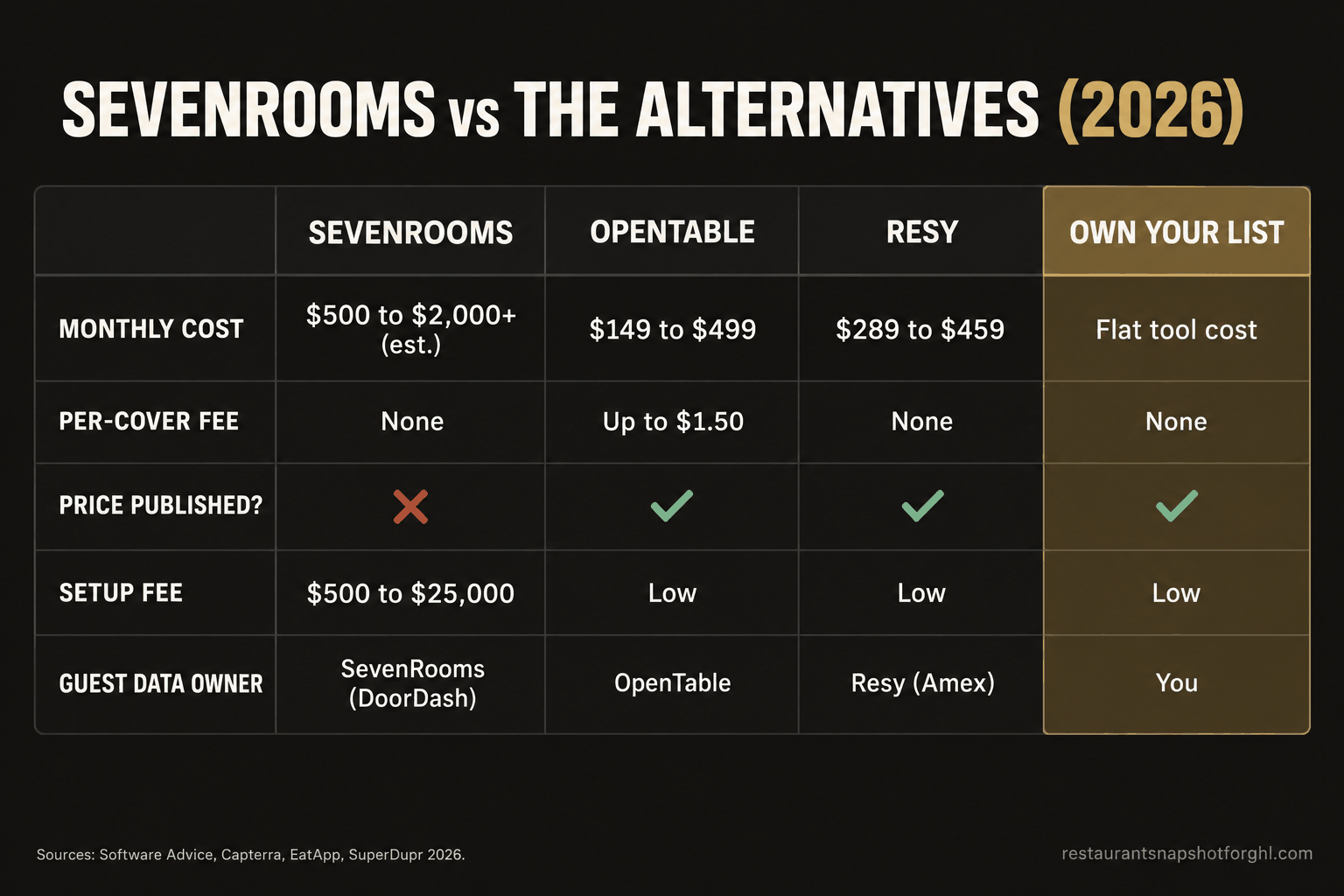
Operators don’t shop SevenRooms in a vacuum. Here’s how it lines up against the platforms you’re choosing between in 2026, plus the option most owners forget: running the relationship yourself. SevenRooms figures are estimated; the rest reflect published 2026 rates.
| What matters | SevenRooms | OpenTable | Resy | Own your list |
|---|---|---|---|---|
| Monthly cost | ~$500–$2,000+/loc (est.) | $149–$499/mo | $289–$459/mo | Flat tool cost |
| Per-cover fee | None | Up to ~$1.50/cover | None | None |
| Setup fee | Reported $500–$25,000 | Low | Low | Low |
| Contract | Annual | Varies | Varies | Month-to-month typical |
| Price published? | No | Yes | Yes | Yes |
| Guest data owner | SevenRooms (DoorDash) | OpenTable | Resy (Amex) | You |
| Best fit | Hotel groups, multi-unit | Discovery-dependent rooms | Flat-rate single sites | Owner who wants the list |
Sources: Software Advice and Capterra for SevenRooms; EatApp for OpenTable; SuperDupr for Resy. Confirm current rates with each vendor. For the full four-way breakdown, see our OpenTable vs Resy vs Tock vs SevenRooms cost teardown.
Among the paid platforms, SevenRooms is the most capable, the most expensive, and the only one that both hides its price and hands your data to a delivery company. The quiet fourth column, owning the list through a system you control, is the one that gets cheaper as you grow instead of more expensive.
Three Real Budgets: Solo, Busy Independent, Small Group
The right answer changes dramatically with your size. Every figure below is illustrative, built from the pricing above, excluding setup fees unless noted.
Scenario 1: the solo operator. One room, 800 to 1,000 covers a month, wants bookings, reminders, and reviews.
- SevenRooms lean single venue (
$499/mo) plus a setup fee and annual commitment = **$6,000/yr before setup**, for a CRM you’ll use maybe a third of. - The honest read: the clearest “don’t.” A flat-rate tool at $289/mo, or a system you own, does the job for half the money and none of the contract.
Scenario 2: the busy independent. One high-volume room or two locations, a real marketing calendar, someone who can run campaigns.
- SevenRooms mid-feature (~$850/loc) across the marketing and CRM modules, plus setup, lands near $10,000 to $20,000/yr.
- The honest read: a real debate. If you’ll genuinely run the win-backs, birthday marketing, and review capture, no-per-cover pricing can beat OpenTable at volume. Price it against owning the workflows yourself.
Scenario 3: the small group. Three to ten locations, shared guest data, a marketing lead.
- SevenRooms full enterprise (~$1,200 to $1,500/loc) plus implementation runs well into five or six figures a year.
- The honest read: this is who it was built for, and at scale the CRM depth earns its keep. Even here, get the per-location price in writing.
Estimated annual SevenRooms subscription spend by operator size, before setup and implementation fees. Illustrative, built from the 2026 reported per-location pricing cited above.
The Hidden Costs Nobody Quotes You (and Where It Breaks)
The monthly number is only the start. Four costs surface after you sign.
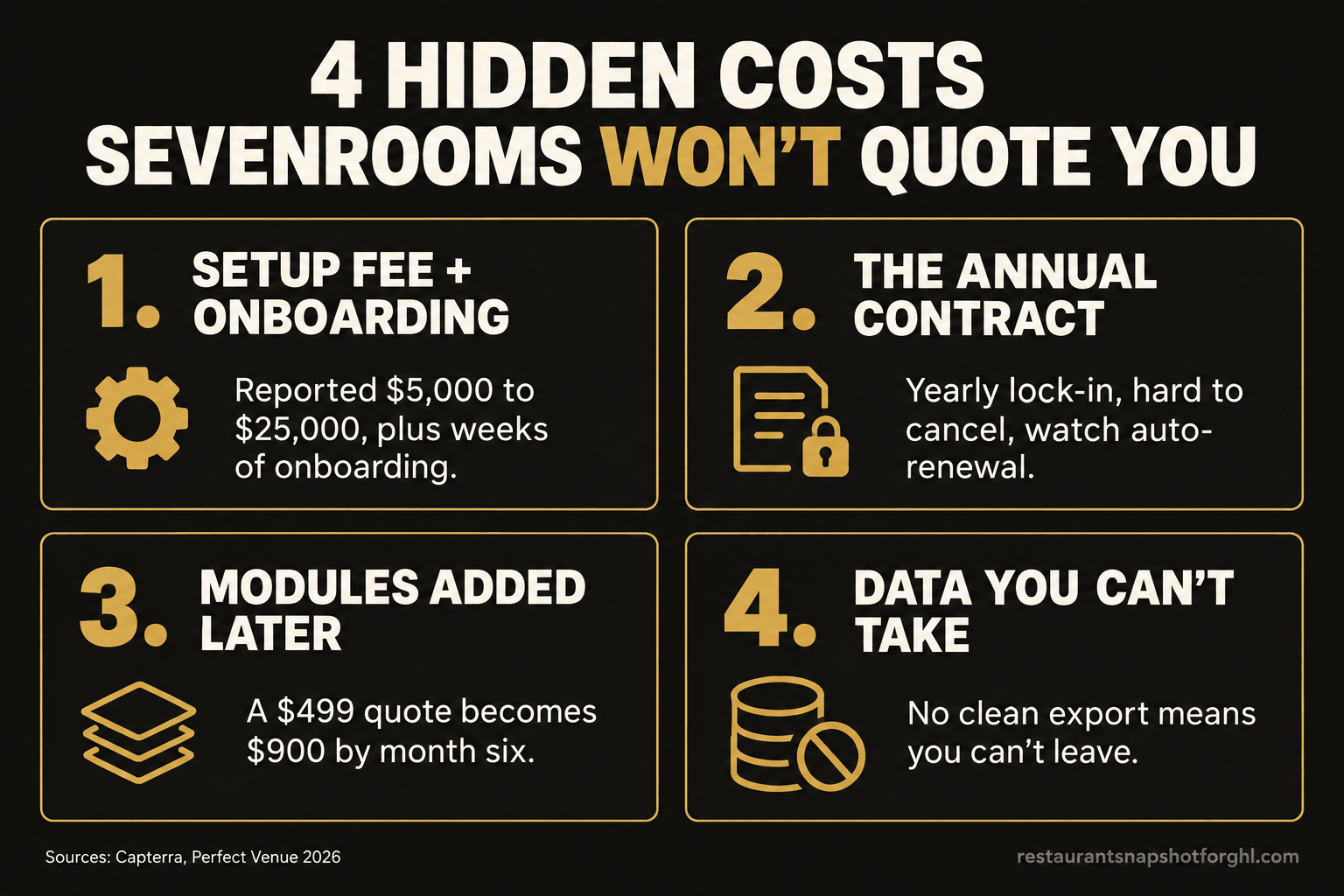
1. The setup fee and onboarding weeks. Operators report implementations running weeks with a dedicated onboarding team, and setup fees that climb with the module count (Capterra, 2026). Where it breaks: the setup cost rarely appears in the demo, and the onboarding is staff time pulled off the floor during the weeks you’re trying to run service.
2. The annual contract and the exit. One operator reported being pressured into a contract they regretted and finding it difficult to cancel (Perfect Venue, 2026). Where it breaks: remorse on a monthly tool costs a month. On an annual contract it costs a year. Read the termination and auto-renewal terms first.
3. The modules you’ll add later. The quote is for what you demoed; the marketing suite, extra location, and ordering add-on get layered on once you’re inside. Where it breaks: your “$499 a month” tool is $900 by month six, and because the pricing was never public you have nothing to measure the creep against.
4. The data you can’t easily take with you. This compounds after the DoorDash acquisition. Where it breaks: if the export terms aren’t clean, the guest list you spent a year building becomes the reason you can’t leave. The asset you paid to build becomes the lock on the door.
Steal This: How to Force a Real Quote
If you’re taking the demo anyway, make the rep answer these in writing before you sign. Copy this list into your notes:
- “What’s the all-in monthly price, per location, with every module I need?” Reservations, CRM, marketing, review capture, ordering. Not the stripped demo config.
- “What’s the one-time setup fee, and what does it include?” Get the dollar figure and the staff hours it assumes.
- “What’s the contract length, auto-renewal terms, and early-termination fee?” Point to the exact clause.
- “Can I export my full guest data (emails, phone numbers, visit history) for free, any time, including the day I cancel?” Anything but a clean yes is your answer.
- “After the DoorDash acquisition, how is my guest data used or shared, and can I opt out?” Make them put the data-use terms in front of you.
- “Show me the real number on one screen, per location, for year one including setup.” If they can’t, that’s your transparency answer.
And if you run the guest relationship yourself, you can’t skip compliant texting. The moment you message a list collected at the host stand, you’re bound by the Telephone Consumer Protection Act (TCPA) and A2P 10DLC rules, with penalties of $500 to $1,500 per message (FCC). Here’s consent language for your booking or Wi-Fi form. Steal it:
“Text me reservation updates and occasional offers from [Restaurant]. Msg & data rates may apply. Msg frequency varies. Reply STOP to cancel, HELP for help. Consent isn’t a condition of dining with us.”
Keep the transactional confirmation and the marketing opt-in separate, log every consent with a timestamp, and honor STOP automatically. Our full TCPA and A2P 10DLC guide covers registration and templates.
Objections, Answered Straight
“No per-cover fee, so isn’t it cheaper than OpenTable?” At high volume, it can be: 2,000 network covers a month at OpenTable’s up-to-$1.50 fee is $3,000 on top of the plan (EatApp, 2026). But that compares SevenRooms to the wrong alternative. Resy is also flat with no per-cover fee at a published $289 to $459/mo (SuperDupr, 2026). The real comparison is SevenRooms vs a flat tool that doesn’t hide its price.
“Isn’t DoorDash owning it a good thing? More reach.” Maybe, if your strategy is to lean into the DoorDash ecosystem. But if you want a CRM to own the guest relationship and keep the marketplace out of it, handing that list to a delivery company on a multi-year contract cuts against your goal.
“We’re fine dining, don’t we need enterprise CRM?” You need the guest data and the automated follow-up, not necessarily an enterprise platform with an enterprise contract. A single fine-dining room can run deep guest profiles and personalized win-backs from a system it owns, at a fraction of the cost. See owning your restaurant guest list.
“I’m not technical enough to run my own system.” You don’t have to be. The choice isn’t “enterprise bundle” or “wire it up yourself at midnight.” A done-for-you setup installs the booking flow, reminders, review requests, loyalty, and compliant texting, so you own the data without becoming a systems admin. See a done-for-you GoHighLevel system.
The One Line That Changes the Math
The more of your guest relationship you own, the less you pay to rent it, and the less power anyone holds over you at renewal. A per-cover fee, a gated contract, a guest list you can’t easily export: each charges you to reach a diner through someone else’s platform, and each is expensive precisely because winning a new customer costs about five times more than keeping one you have (Bain & Company). So the highest-return line in your budget isn’t the most powerful CRM. It’s the one that leaves the list in your name: a reminder that stops the no-show, a birthday text, a win-back at 45 days, and lifetime value you control.
SevenRooms is a genuinely strong platform for the operator it was built for. For most independents, the better move is to keep the number, the contract, and the guest list on your side of the table.
Frequently Asked Questions
How much does SevenRooms cost per month in 2026?
SevenRooms doesn't publish prices; every plan is quote-only behind a demo. Third-party trackers put a lean single venue near $499 a month (about $5,988 a year), with real deployments running roughly $300 to $2,000 or more per location once you add CRM, marketing, and ordering modules. Expect a setup fee and an annual contract on top. Treat these as reported estimates and get your own number in writing.
Does SevenRooms charge a per-cover fee like OpenTable?
No. SevenRooms charges no per-cover fee or reservation commission, its clearest advantage over OpenTable, where network covers can cost up to about $1.50 each. But Resy is also flat-rate with no per-cover fee at a published $289 to $459 a month, so that advantage isn't unique to SevenRooms.
Why won't SevenRooms show its price?
It uses custom, quote-only pricing gated behind a demo, so the number flexes with your size, location count, and modules. That removes any public anchor you could compare against. The only real number is your written quote, so ask for the all-in per-location total, the setup fee, and the contract length before you sign.
What did DoorDash buying SevenRooms change for restaurants?
DoorDash acquired SevenRooms for $1.2 billion in cash, closing June 13, 2025. The tools are unchanged, but ownership isn't: your guest data now sits inside the largest food-delivery company in the US. That raises a fair question about who benefits from your first-party list over a multi-year contract, so read the data-use and export terms carefully.
Is SevenRooms worth it for a small independent restaurant?
Usually not. It was built for hotel groups and multi-unit operators with a marketing team, and the pricing, setup fee, and annual contract assume that scale. A one-to-three location shop that mainly wants reservations, reminders, and reviews uses a fraction of the platform and pays enterprise money for it.
What are the best SevenRooms alternatives for independents?
For flat-rate reservations, Resy ($289 to $459 a month, no per-cover fee) is the straightforward pick. If you need discovery you can't create yourself, OpenTable still leads, though you pay per cover. If your goal is to own the guest relationship end to end, running it from a system you control avoids the gated pricing and the contract entirely.
Related reading
- OpenTable vs Resy vs Tock vs SevenRooms: what a reservation system really costs in 2026
- What restaurant marketing software actually costs in 2026
- Own your restaurant guest list instead of renting it
- What DoorDash, Uber Eats, and Grubhub really cost your restaurant
- TCPA & A2P 10DLC: what restaurants need to know before sending one SMS
- Get the done-for-you system installed in 24 hours
Sources
- DoorDash acquisition: CNBC (2025); Business Wire (2025)
- SevenRooms pricing: Software Advice; Capterra; Perfect Venue review
- Competitor pricing: EatApp, OpenTable; SuperDupr, Resy vs OpenTable
- Industry: NRA 2026 State of the Industry; Level CFO margins; FCC TCPA; Bain on retention