
A diner in the Heights opens ChatGPT on a Thursday night and types, “best patio for tacos and margaritas near me in Houston, open now.” They don’t scroll ten blue links. They read one paragraph, get three restaurants by name, tap the first, and book. If your restaurant isn’t one of the three, you were never in the running — and you’ll never see the search that skipped you.
That is AI search, and in a city with more than 8,000 restaurants it is quietly becoming the shortlist that decides where Houston eats. This guide explains, in plain English, how ChatGPT, Google AI Overviews, and Perplexity choose which restaurants to recommend — and exactly what a Houston operator has to fix on their website and listings to get named instead of skipped.
Table of Contents
- The 30-second answer
- What “AI search” actually means for a restaurant
- Why this matters for Houston right now
- How AI decides which restaurant to recommend
- The 6 things that get your restaurant named by AI
- Invisible vs. AI-visible: the same restaurant, two outcomes
- Why most restaurant websites fail the AI test
- How to check if AI can see your restaurant
- Frequently asked questions
The 30-Second Answer
Houston restaurants get found in AI search the same way they earn a word-of-mouth referral: by being the option AI can clearly understand, trust, and verify. In practice that means four things working together — machine-readable structured data on your website (schema for your menu, hours, location, and reviews), a complete and consistent Google Business Profile, a steady flow of recent four- and five-star reviews, and a fast website an AI crawler can actually read. Do those, and when a diner asks ChatGPT or Google for “the best birria in Montrose,” your restaurant is in the answer. Skip them, and the AI recommends a competitor who did them — no matter how good your food is.
The rest of this piece is the why behind each of those, and how to get them in place without a computer-science degree.
What “AI Search” Actually Means for a Restaurant
“AI search” isn’t one product. For a Houston operator, it’s four overlapping surfaces that increasingly sit in front of the old list of links:
- Google AI Overviews — the AI-written summary that now appears at the very top of many Google results, often naming specific businesses before a single traditional listing.
- ChatGPT — where diners increasingly type conversational, planning-style questions (“date-night spot in Houston, quiet, under $60 a head”).
- Perplexity — an answer engine that cites its sources, popular with people who want a fast, referenced shortlist.
- Google Gemini and Apple/Siri AI — the assistant layer answering “near me” questions on phones.
The common thread: instead of returning ten links for the diner to sort through, these tools read the web for the diner and hand back a short, named answer. Optimizing to be in that answer is called AEO (Answer Engine Optimization) or GEO (Generative Engine Optimization). It’s the natural next chapter after traditional local SEO and the Google map pack — same goal, new gatekeeper.
Why This Matters for Houston Right Now
Two curves are crossing. AI answers are exploding in reach, and diners are already using them to choose where to eat.
Start with reach. Google AI Overviews appeared on roughly 6.5% of tracked search queries in January 2025, climbed past 13% by March, and peaked near 24.6% by mid-summer before settling into the mid-teens-to-twenties depending on the query set (Semrush, 2025; SEOProfy, 2026). Restaurant and “near me” queries — exactly what Houston diners type — are among the most AI-summarized of all.
Share of tracked Google searches showing an AI Overview, 2025 (%). Prevalence varies by query set and spikes on informational and local queries. Source: Semrush, 2025, via SEOProfy, 2026.
Now the behavior. The share of restaurant website visits referred by AI chatbots rose from 0.3% in 2024 to 2.5% in 2025 — an eight-fold jump in twelve months (Yext, 2025). ChatGPT surpassed 800 million weekly active users in late 2025 and pushed past 900 million by early 2026 (TechCrunch, 2026), and it’s the most-used generative AI tool by a wide margin (Attest, 2025). Diner comfort is rising to match: PAR Technology’s 2026 survey of 1,000 U.S. consumers found discomfort with restaurant AI fell from 41% to 27% year over year, with nearly three in four diners now open to it (PAR Technology, 2026).
Put that against Houston’s market. Depending on the source, the city counts 8,000 to 12,000+ restaurants, one of the highest per-capita restaurant densities in the country, with Mexican concepts alone numbering more than 1,400 (Oysterlink, 2025). When a diner asks an AI for “the best tacos near me,” the model has to choose from thousands. The restaurants it can read and trust make the shortlist. The rest are noise it skips.
How AI Decides Which Restaurant to Recommend
Here’s the mental model that makes everything else click: an AI answer engine is not browsing your website like a hungry customer. It’s assembling a fact sheet about your restaurant from every source it can verify, then deciding if you’re a safe, relevant thing to recommend.
It pulls from your website’s structured data, your Google Business Profile, your reviews across platforms, directory listings, and any menu or press it can find — and it cross-checks them against each other. Two rules follow directly from that:
- It rewards what it can read and verify. Machine-readable facts (schema markup, clean listings, consistent name/address/phone) beat pretty-but-unreadable design every time. As Yext puts it, AI systems reward structured information they can verify (Yext, 2025).
- It won’t recommend what it can’t trust. Contradictory hours, a three-star average, a stale profile, or a site it can’t crawl are all reasons to leave you out — the AI has thousands of safer options a click away.
That’s why the fix is never “write better copy.” It’s making your restaurant legible and trustworthy to a machine. Six things do that.
The 6 Things That Get Your Restaurant Named by AI
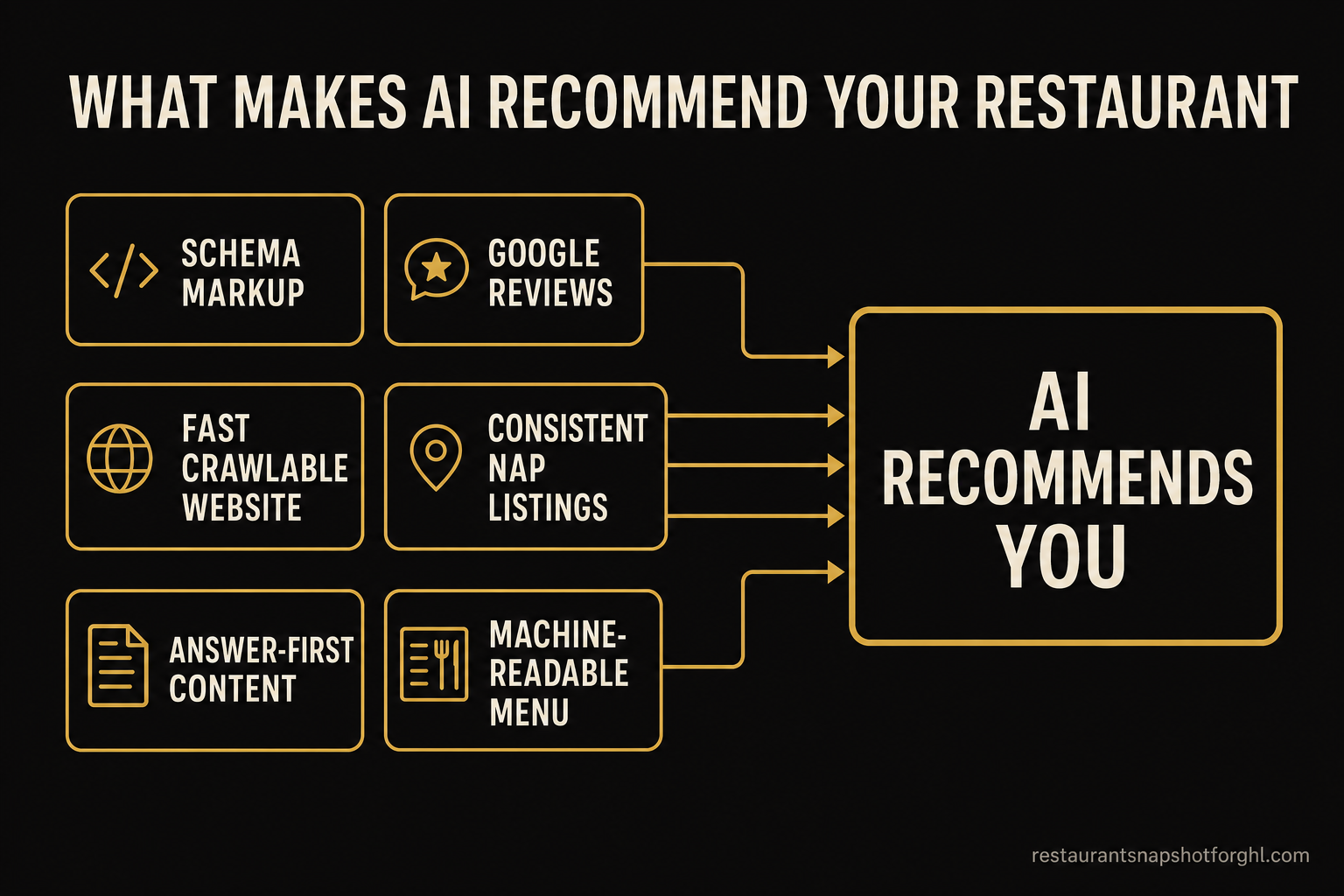
1. Structured data (schema markup). Schema is code that spells out your facts in a language AI reads directly: Restaurant type, address, hours, price range, cuisine, menu, and AggregateRating from your reviews. Without it, an AI has to guess what your site says; with it, you’re handing over a verified fact sheet. Sites that emit rich, valid schema are dramatically easier for AI to cite.
2. A complete, consistent Google Business Profile. This is still the single biggest local signal, and AI Overviews lean on it heavily. Fill every field — hours, menu link, attributes (patio, reservations, late-night), photos — and keep it current. Traditional local wins compound here too: businesses in the Google Local Pack pull 126% more traffic than those that aren’t (Malou, 2025).
3. Fresh, strong reviews. Reviews are the trust layer AI uses to break ties. Some 96% of diners read online reviews, 91% avoid restaurants under four stars, and a one-star rating increase can lift revenue by up to 10% (review-statistics roundup, 2025). An automated, well-timed review-harvesting flow keeps the stream fresh without your staff nagging every table — the same engine covered in our reputation-management playbook.
How diners screen restaurants before choosing (% of diners; Local Pack figure is the traffic lift vs. non-pack listings). Sources: review-statistics roundup, 2025; Restroworks, 2025; Malou, 2025.
4. A fast, crawlable website. If an AI crawler hits a slow, JavaScript-heavy page it can’t render, your facts never make the fact sheet. A lightweight, statically-rendered site — the kind we build on Astro — loads fast, exposes clean HTML, and can serve an llms.txt file that literally hands AI models a plain-text summary of your restaurant. Most drag-and-drop builders can’t do either.
5. Answer-first content that matches how diners ask. AI engines quote self-contained passages that directly answer a question. A page that opens with “Yes — [Restaurant] takes walk-ins and has a covered patio in the Heights, open until midnight Friday and Saturday” is quotable. A slideshow of food photos with no readable text is not. Write your hours, neighborhood, cuisine, and standout dishes in plain sentences, not just images.
6. Machine-readable menu, hours, and attributes. “Near me” and hyperlocal searches have surged roughly 900% over two years, and they’re getting hyper-specific — “kid-friendly sushi near me,” “late-night vegan tacos” (Malou, 2025). AI can only match those queries if your menu, dietary options, and hours exist as real text and data, not baked into a PDF or an image it can’t parse.
Invisible vs. AI-Visible: The Same Restaurant, Two Outcomes
None of this changes the food. It changes whether the machine can see it. Two Houston taquerias, identical quality, very different results:
A Houston taqueria, before and after AI-readiness
Menu lives in a slow PDF. Hours only shown as an image. No schema markup. Google profile half-filled, last review 4 months ago. AI can't parse the menu or verify the hours — so when a diner asks ChatGPT for 'birria near me, open late,' the model skips it and names three competitors.
Menu and hours are real text with Restaurant + Menu schema. Google profile complete with fresh weekly reviews and a 4.7 average. Fast site serves clean HTML and an llms.txt summary. Now the AI can confirm cuisine, hours, and rating in one pass — and names the taqueria first for 'birria near me, open late.'
Same tacos. One is in the answer; one isn’t. The gap is entirely in what the website and listings expose to a machine.
Why Most Restaurant Websites Fail the AI Test
Here’s the uncomfortable part. The typical Houston restaurant site — a Wix, Squarespace, or all-in-one page-builder template — was designed for humans in 2019, not AI crawlers in 2026. The recurring failures:
- No clean schema. Templated builders bolt on generic markup, if any, and rarely emit valid
Restaurant,Menu, orAggregateRatingdata an AI can trust. - Slow, heavy pages. Bloated builder sites are exactly the pages crawlers struggle to render — and a page that doesn’t render doesn’t get cited.
- Menus trapped in PDFs or images. The most-queried content on your site is the one thing AI can’t read.
- No
llms.txt. Almost no builder lets you publish the plain-text AI summary file that’s fast becoming table stakes for AI visibility. - Inconsistent facts. Hours on the site, the Google profile, and a delivery app all disagree — and contradiction is a reason for AI to leave you out.
This is the same “disconnected stack” tax we broke down in the hidden cost of a restaurant tech stack — it just now costs you AI visibility on top of everything else. A restaurant site built for 2026 fixes it at the foundation: fast, statically rendered, schema-rich, and AI-readable by default.
How to Check If AI Can See Your Restaurant
You can run a rough audit tonight in ten minutes:
- Ask the engines directly. Open ChatGPT, Perplexity, and Google, and search the questions your diners ask — “best [your cuisine] in [your Houston neighborhood],” “[your restaurant name] hours,” “[cuisine] near me open now.” Are you named? Are the facts right?
- Check your schema. Paste your homepage and menu URL into Google’s Rich Results Test. If it finds no
RestaurantorMenudata, AI is guessing about you. - Test your speed. Run your site through PageSpeed Insights. A slow score is a crawlability warning.
- Audit your facts. Confirm your name, address, phone, and hours match exactly across your website, Google Business Profile, Yelp, and any delivery apps.
- Look for
llms.txt. Visityourdomain.com/llms.txt. If it 404s, you have no AI-readable summary — most restaurants don’t.
If you fail two or more of those, you’re likely invisible to the diners now asking AI where to eat — and every one of them is a booked table going to a competitor.
The Bottom Line
Houston’s dining scene is one of the most crowded in America, and the shortlist that decides who eats where is increasingly written by AI. The restaurants that get named in ChatGPT, Google AI Overviews, and Perplexity aren’t the ones with the flashiest websites — they’re the ones a machine can read, verify, and trust: structured schema, a complete Google profile, fresh reviews, a fast crawlable site, and answer-first content. The food gets you the repeat visit. Being readable to AI is what gets you the first one. In 2026, that legibility is no longer optional — it’s the new front door.
Frequently Asked Questions
Houston restaurants & AI search — common questions
How do restaurants show up in ChatGPT and Google AI Overviews?
AI answer engines assemble a fact sheet about your restaurant from your website's structured data (schema), your Google Business Profile, your reviews, and directory listings, then recommend the options they can read, verify, and trust. To show up, you need valid Restaurant and Menu schema, a complete and consistent Google profile, fresh four- and five-star reviews, a fast crawlable website, and answer-first content that plainly states your cuisine, hours, neighborhood, and standout dishes.
Is AI search really affecting Houston restaurants yet?
Yes. The share of restaurant website visits referred by AI chatbots rose from 0.3% to 2.5% in a single year, Google AI Overviews appear on up to roughly a quarter of searches, and ChatGPT passed 800 million weekly users in late 2025. In a market of 8,000-plus restaurants, being the option AI can read and recommend is already the difference between making the shortlist and being skipped.
What is AEO / GEO, and how is it different from SEO?
AEO (Answer Engine Optimization) and GEO (Generative Engine Optimization) are about getting named inside an AI-generated answer, rather than ranking as a blue link. It builds on traditional local SEO — a strong Google Business Profile, reviews, and consistent listings still matter — but adds structured data, fast machine-readable pages, an llms.txt summary, and self-contained, quotable content so AI engines can confidently recommend you.
What is an llms.txt file and does my restaurant need one?
An llms.txt file is a plain-text summary of your business placed at yourdomain.com/llms.txt that hands AI models a clean, structured overview of your restaurant — name, location, cuisine, hours, menu highlights, and key pages. It's becoming table stakes for AI visibility, but most website builders can't publish one. A purpose-built site can generate it automatically.
Do reviews affect whether AI recommends my restaurant?
Heavily. Reviews are the trust layer AI uses to break ties between similar options. With 96% of diners reading reviews, 91% avoiding anywhere under four stars, and a one-star rating bump worth up to a 10% revenue lift, a steady flow of recent, positive reviews — ideally through an automated review-harvesting flow — is one of the highest-leverage AI-search moves a restaurant can make.
Can I fix this on my Wix or Squarespace site, or do I need a new one?
Some fixes — completing your Google profile, gathering reviews, unifying your hours — you can do on any platform today. But the deeper wins (valid restaurant schema, fast crawlable pages, an llms.txt summary, answer-first structure) are hard or impossible on most template builders. That's why we build restaurant sites on Astro from the ground up for AI search. Book a walkthrough and we'll audit your current site first.
Gina came up through catering and event sales before falling in love with diner data. She translates dense automation and search concepts into plain English for owner-operators who’d rather be in the kitchen than in a dashboard. When she’s not writing about win-back campaigns and AI search, she’s testing how local restaurants show up when she asks ChatGPT where to eat.
Related reading
- Restaurant local SEO: how to win the Google map pack
- Astro vs WordPress restaurant websites: page speed compared
- Restaurant reputation management: how to respond to Google reviews
- Custom GoHighLevel development for restaurants (2026)
- Get a website built for restaurants
Sources
- Semrush — Google search & AI Overviews statistics (prevalence by month, 2025)
- SEOProfy — Google AI Overviews: statistics and trends (2026)
- Yext — 15 AI search stats every marketer needs to know going into 2026 (chatbot referral share; structured data)
- TechCrunch — ChatGPT weekly active users (800M+ in 2025, 900M in early 2026)
- Attest — 2025 Consumer Adoption of AI report (ChatGPT most-used GenAI tool)
- PAR Technology / QSR Magazine — 2026 Industry Report: AI on the Diner’s Terms (discomfort 41%→27%; ~3 in 4 open to AI)
- Malou — Local SEO for restaurants: 2025 study (near-me +900%; Local Pack +126% traffic)
- Restroworks — Google restaurant search statistics (64% Google before visiting)
- Guaranteed Removals — Google review statistics for restaurants & hospitality (96% read reviews; 91% avoid under 4 stars; +1 star ≈ +10% revenue)
- Oysterlink — How many restaurants are in Houston (market size & density)