
A San Diego diner planning a Friday anniversary dinner does the same thing their parents did: they pick up the phone and call the restaurant. And in 2026, that call is more likely to decide where they eat than any app — 63% of Americans say calling is their preferred way to connect with a restaurant, and 69% say they’re likely to give up on a restaurant entirely if no one answers (The Harris Poll, 2025). During the 5-to-8 rush — exactly when that call comes in — your host is seating a four-top, running food, and watching the line grow. The phone rings out. The table goes to the place down the block that picked up.
Every San Diego operator eventually asks the same question: who — or what — should answer the phone when we can’t? The four real options are voicemail, a traditional phone answering service, a dedicated host paid to work the line, and an AI receptionist — a voice agent that answers every call, quotes the wait, and books the table straight into your calendar. This is the honest 2026 comparison on cost, coverage, and covers actually booked.
Table of Contents
- The 30-second answer
- Why the phone still decides who fills tables in San Diego
- The four ways to cover a restaurant phone line
- AI receptionist vs. answering service: the head-to-head
- What it actually costs to cover the phone in San Diego
- When an AI receptionist is the right call — and when it isn’t
- How San Diego restaurants deploy one
- Frequently asked questions
The 30-Second Answer
For most San Diego restaurants in 2026, an AI receptionist beats a traditional answering service, voicemail, and a dedicated phone host on the metric that matters — covers booked per dollar. A traditional answering service costs roughly $200–$800 a month for 24/7 coverage but can’t see your reservation book, doesn’t know your menu, and just takes a message. A dedicated host is fluent and warm but is off the floor during the rush and costs $17.75+ an hour under San Diego’s 2026 wage floor. Voicemail is free and loses the guest.
An AI receptionist — a voice agent trained on your concept — answers every call on the first ring, 24/7, quotes the wait or availability, books the reservation directly into your calendar, and texts the guest a confirmation. It never gets slammed, never calls in sick, and costs a flat monthly rate. The one thing it should not do is pretend to be human for complex, high-value moments — large-party events and buyouts should always route to a person. Below is how each option really stacks up, with the 2026 numbers.
Why the Phone Still Decides Who Fills Tables in San Diego
San Diego is one of the busiest dining markets in the country, and a huge share of the demand arrives from out of town. The region drew 32 million visitors who spent a record $14.6 billion locally in fiscal 2024, part of a $22 billion tourism economy that supports one in eight San Diego jobs (San Diego Tourism Authority). Those visitors don’t have your Instagram bookmarked or your app installed. They Google “best fish tacos near Gaslamp,” see your number, and call — often after hours, from a hotel room, planning tomorrow night.
That’s the moment the money is made or lost. Nationally, the pattern is stark: 63% of diners prefer to call, 69% will bail if no one answers, and 20% say their calls to restaurants are “always” or “often” ignored (Harris Poll, 2025). And the demand keeps rising while diners wait — most are willing to use technology to get through: 89% say they’d be open to an AI agent handling the interaction rather than get no answer at all.
Share of U.S. adults, % · Source: The Harris Poll, 2025 (survey of 2,065 U.S. adults, commissioned by Hostie).
The cost of ignoring the phone adds up fast. An industry analysis published in QSR Magazine estimates U.S. restaurants lose roughly $20 billion a year to unanswered calls — the average location misses about 150 calls a month, each worth $35–$85 in lost orders and reservations (QSR Magazine). Do the math on the low end: 150 missed calls at $35 is $5,250 a month walking out the door — and in a tourist-heavy market, many of those callers won’t call back. They’ll book the competitor.
This is the same problem we’ve written about from the SMS side in our missed-call text-back playbook — but a text-back only catches the call after it’s missed. An AI receptionist answers it in the first place.
The Four Ways to Cover a Restaurant Phone Line
Every operator is choosing among these four, whether they’ve named them or not:
-
Voicemail (do nothing). Free, and it feels like coverage. It isn’t. Most callers who reach voicemail hang up and dial the next restaurant. You never even know they called.
-
Traditional phone answering service. A remote call center answers in your restaurant’s name, takes a message or a basic order, and emails or texts it to you. It’s human and available after hours — but the operator doesn’t know your menu, can’t see tonight’s availability, and usually can’t book directly into your reservation system. You still have to call the guest back, and by then they may have moved on.
-
Dedicated host on the phone. The gold standard for guest experience — a warm, fluent person who knows the specials. The catch is cost and timing: under San Diego’s $17.75/hour minimum wage for 2026 (City of San Diego), staffing the line across all open hours is a five-figure annual expense, and during the 5-to-8 rush that host is needed on the floor, not on hold.
-
AI receptionist (voice AI). A voice agent trained on your concept answers instantly, 24/7. It quotes the wait, answers menu and hours questions, books the reservation into your calendar, captures the guest’s contact info, and texts a confirmation — then hands off large-party and events calls to a human. It’s a flat monthly cost with no scheduling, no turnover, and no rush-hour tradeoff.
The real decision, for most operators, comes down to options 2 and 4 — the two that promise to always answer. So let’s put them head to head.
AI Receptionist vs. Answering Service: The Head-to-Head
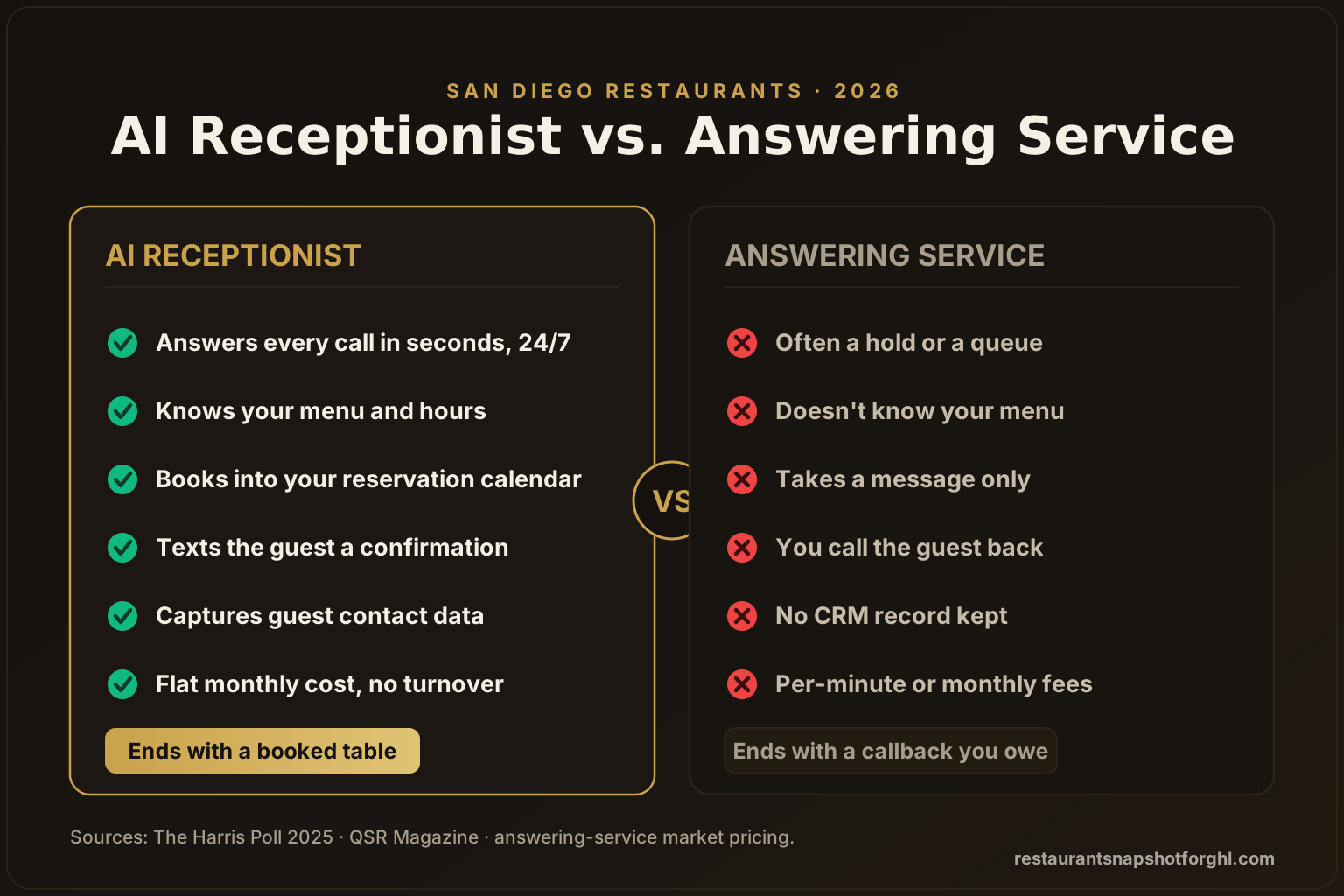
Here’s the same comparison as a decision table:
AI receptionist vs. traditional answering service for a San Diego restaurant
| Plan | AI receptionist (voice AI) recommended | Traditional answering service |
|---|---|---|
| Price | Books tables | Takes a message |
| Feature 1 | Answers every call in seconds — 24/7, no hold, no queue | Answers in your name, but often after a hold or queue |
| Feature 2 | Trained on your menu, hours, location, and policies | Operator doesn't know your menu or tonight's availability |
| Feature 3 | Books the reservation straight into your calendar | Usually can't book into your reservation system |
| Feature 4 | Texts the guest an instant confirmation + your booking link | Takes a message — you still call the guest back |
| Feature 5 | Captures name and number into your CRM on every call | Guest contact rarely lands in your CRM automatically |
| Feature 6 | Qualifies party size and occasion; routes large parties + events to a human | Basic triage only; no upsell or occasion capture |
| Feature 7 | Handles a rush of simultaneous calls without dropping one | Can bottleneck when several calls come in at once |
| Feature 8 | Flat monthly cost — no per-minute billing, no turnover | ~$200–$800/mo for 24/7, often billed per minute |
| See the AI receptionist → | The message-taking route |
The difference that matters isn’t “human vs. robot” — it’s booked vs. message taken. An answering service ends with a callback you still have to make during service. An AI receptionist ends with a confirmed cover on the book and a text in the guest’s pocket. For a deeper look at how the voice side works end-to-end, see our guide to AI phone answering for restaurants.
What It Actually Costs to Cover the Phone in San Diego
Cost is where the comparison gets decisive, because San Diego labor is expensive by design. The city minimum wage is $17.75 an hour effective January 1, 2026 — above California’s statewide $16.90 floor (California DIR). Here’s what each option realistically runs for a restaurant open roughly 12 hours a day, seven days a week:
- Voicemail: $0 — and it loses an estimated 150 calls a month, per the QSR figure above. The cheapest option is the most expensive one.
- Answering service: roughly $200–$800/month for 24/7 coverage, commonly billed per minute (based on published market pricing from providers like AnswerConnect and Housecall Pro). Human, always on — but message-taking only.
- Dedicated phone host: at $17.75/hour, covering just the 5-to-8 p.m. peak seven nights a week (21 hours) is about $373/week — roughly $1,600/month in wages alone, before payroll taxes and benefits, and that person is off the floor during service.
- AI receptionist: a flat monthly rate. In the Restaurant Snapshot, the AI caller ships as part of the one-time package; as standalone custom software, a dedicated AI reservation receptionist is a fixed monthly cost with no per-minute billing and no turnover.
Answering every call is still a genuine competitive edge, because most restaurants haven’t automated it. The 2026 National Restaurant Association State of the Industry report found 26% of operators now use some AI tools, but adoption is concentrated in back-office and marketing — 19% of full-service and 15% of limited-service operators use AI for marketing, while only 6% use AI for customer orders and calls (National Restaurant Association via Restaurant Dive).
Share of restaurant operators, % · Source: National Restaurant Association, 2026 State of the Restaurant Industry.
Translation: front-of-house voice AI is still the road less traveled. In a market where 32 million visitors a year are calling to book, the restaurant that answers every call — instantly, at any hour — has an edge most of its neighbors haven’t picked up yet.
When an AI Receptionist Is the Right Call — and When It Isn’t
Honest guidance beats hype, so here’s where the line sits.
An AI receptionist is the right call when the bulk of your phone volume is routine: “Are you open tonight?”, “Can I book a table for four at 7?”, “Do you have vegan options?”, “Where do I park?” These are the calls that get missed during the rush and lost to voicemail after hours — and they’re exactly what a well-trained voice agent handles flawlessly, every time, in seconds. The Harris Poll’s finding that 89% of diners are open to an AI agent (Harris Poll, 2025) is about exactly this: people would rather get a fast, correct answer from an AI than no answer from a human.
Keep a human in the loop when the call is high-value or complex — a 30-person rehearsal dinner, a buyout, a media inquiry, or a guest with a serious complaint. The best setups don’t force a choice: the AI receptionist answers first, handles the routine 80%, and warm-transfers the events-and-VIP calls to your team with the context already captured. That’s the design behind the AI reservation receptionist we build — it books the table itself, but routes large parties to the events line and texts you a summary of every call.
And a compliance note, because it’s San Diego and California: any follow-up texting the system does (confirmations, reminders, your booking link) has to respect consent. Collect SMS opt-in at the point of capture, honor STOP instantly, and stay inside TCPA and A2P 10DLC rules — the same discipline we cover in our TCPA compliance guide for restaurant SMS.
How San Diego Restaurants Deploy One
You don’t build an AI receptionist from scratch. Two paths get you there:
-
The Restaurant Snapshot. The done-for-you GoHighLevel snapshot ships with the AI caller plus reservation reminders, review harvesting, and win-back workflows — installed in about 24 hours, one price. It’s the fastest way for an independent or small group to get every call answered and every booking captured. See how the whole system fits together in our GoHighLevel for restaurants guide.
-
Custom voice AI. If you want a purpose-built AI reservation receptionist — natural voice, trained on your exact concept, booking into your specific stack, with warm-transfer rules for events — that’s a custom software build. It connects to your reservation calendar (and to POS platforms like Toast, OpenTable, or Resy), qualifies party size and occasion, and texts you a summary of every call.
Either way, the outcome is the same: the phone stops being a leak. Every San Diego diner who calls — at 2 p.m. or 11 p.m., during the rush or after close — gets an answer and a booked table instead of a ringing line.
Frequently Asked Questions
AI receptionists for restaurants — common questions
What is an AI receptionist for a restaurant?
It's a voice AI agent that answers your restaurant's phone automatically. Trained on your menu, hours, location, and policies, it handles routine calls — booking reservations, quoting the wait, answering questions — 24/7, books the table directly into your calendar, texts the guest a confirmation, and captures their contact details into your CRM. For complex or high-value calls like large parties and buyouts, it warm-transfers to a human on your team.
Is an AI receptionist better than a phone answering service?
For booking tables, yes — because it does more than take a message. A traditional answering service answers in your name but usually can't see tonight's availability or book into your reservation system, so it takes a message and you call the guest back later. An AI receptionist knows your menu and calendar, books the cover on the spot, and confirms it by text. Both are 'always on,' but only one ends the call with a table on the book.
How much does an AI receptionist cost compared with hiring a host in San Diego?
San Diego's 2026 minimum wage is $17.75/hour, so staffing even the 5-to-8 p.m. peak with a dedicated phone host runs roughly $1,600 a month in wages alone — and that person is off the floor during service. A traditional answering service is about $200–$800/month for 24/7 message-taking. An AI receptionist is a flat monthly rate that covers every hour with no turnover; in the Restaurant Snapshot the AI caller is included in the one-time package, and a custom build is a fixed monthly cost.
Will diners actually accept talking to an AI on the phone?
Most will, especially versus the alternative of no answer. A 2025 Harris Poll found 89% of Americans are open to using an AI agent to interact with a restaurant, and 69% will give up on a restaurant that doesn't answer at all. The key is a natural voice, fast and correct answers, and an easy path to a human for anything complex — which is exactly how a well-designed AI receptionist is set up.
Does the AI receptionist follow TCPA and SMS rules when it texts guests?
It should, and a properly built one does. Any confirmation or reminder texts require SMS consent captured at the point of booking, an instant STOP opt-out, and compliance with TCPA and A2P 10DLC. The Restaurant Snapshot ships with compliant templates and opt-out handling built in — see our TCPA compliance guide for restaurant SMS for the details.
Can it connect to my existing reservation or POS system?
Yes. A custom AI reservation receptionist can connect to your reservation calendar and to POS and booking platforms like Toast, Square, Clover, OpenTable, or Resy — no native GoHighLevel integration required — so new covers and guest records flow into one place automatically. That integration work is part of a custom software build; the stock snapshot books into GoHighLevel's own calendar out of the box.
About the author — Marisol Reyes. Marisol spent nine years running front-of-house and marketing for a three-location Tex-Mex group before going all-in on automation. She now designs GoHighLevel snapshots for independent restaurants and small multi-unit operators, with a soft spot for AI booking flows and review pipelines that actually fill slow weeknights. She writes the way she ran her floor: practical, fast, and allergic to fluff.
Related reading
- AI Phone Answering for Restaurants: Stop Losing Bookings to Missed Calls
- Missed-Call Text-Back for Restaurants: Turn Every Unanswered Call Into a Booked Table
- Restaurant Online Reservation System: Book More Covers on Autopilot
- GoHighLevel for Restaurants: The Complete 2026 Guide
- TCPA Compliance for Restaurant SMS