
It’s 7:10 on a Friday in Santana Row. Two engineers just off a long week are standing on the sidewalk, phone out, deciding where to drop $140 on dinner. They tap your San Jose restaurant’s link — and a spinner appears. One second. Two. Three. Before your hero shot of the wood-fired branzino even paints, they’ve swiped back to Google and booked the place across the street. You never knew they existed, and the reason wasn’t your food. It was your website’s page speed.
In a market as wired and as competitive as Silicon Valley, the platform your site is built on isn’t a back-office detail — it’s the front window. This is the honest, numbers-first comparison of two very different ways to put a restaurant online in 2026: a GoHighLevel-built website versus a purpose-built Astro site. We love GoHighLevel — we sell a whole restaurant snapshot on it — so this isn’t a hit piece. It’s about using the right tool for the right job, backed by real page-speed data.
Table of Contents
- The 30-second answer
- Why page speed decides whether a San Jose diner books you
- Astro vs GoHighLevel: what’s different under the hood
- The side-by-side comparison
- What GoHighLevel is genuinely great at
- Core Web Vitals and winning the San Jose map pack
- The setup that actually fills tables
- Frequently asked questions
The 30-Second Answer
For a restaurant’s public website, a purpose-built Astro site beats a GoHighLevel-built site on the thing that matters most on a phone — speed. Astro compiles your pages into static HTML and ships almost no JavaScript to the diner’s device, so pages open in a blink and reliably score 90+ on Google PageSpeed. GoHighLevel’s site and funnel builder is fantastic for landing pages inside a marketing funnel, but it renders through the GHL app runtime and a drag-and-drop layer, which is heavier — and that weight is exactly what makes a hungry, impatient mobile visitor bounce.
This isn’t “GoHighLevel is bad.” GoHighLevel is one of the best tools on the planet for the CRM side of a restaurant — the guest database, the AI booking, the SMS reminders, the review pipeline. That’s precisely what our snapshot uses it for. The mistake is asking that same funnel builder to also be your fast, SEO-driving public website. Use GHL for the engine; use Astro for the storefront. Everything below is the evidence, and where each tool genuinely fits.
Why Page Speed Decides Whether a San Jose Diner Books You
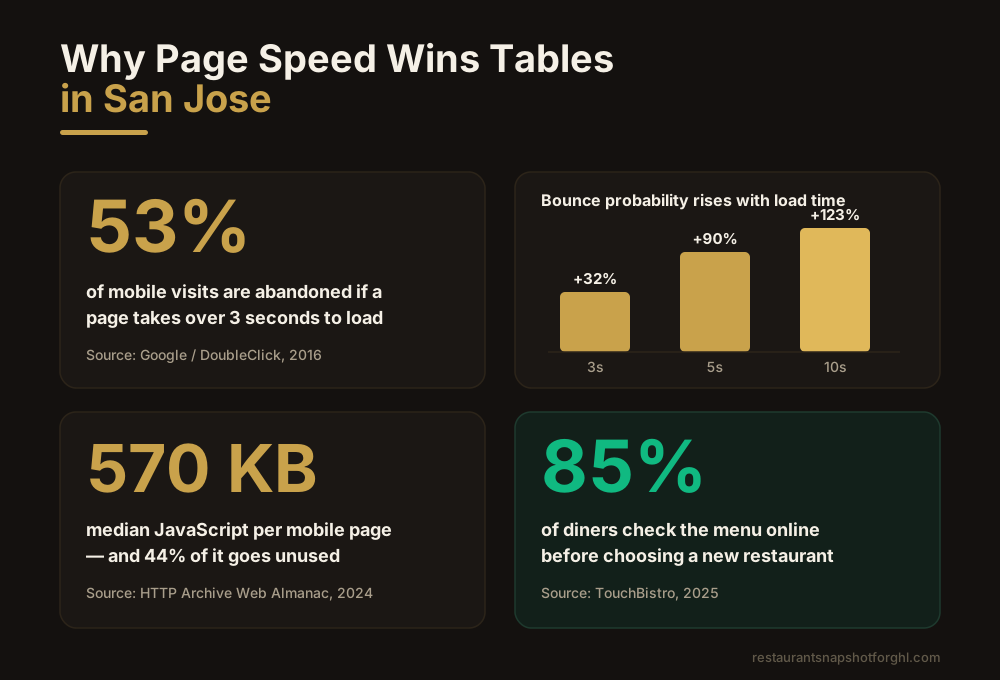
Restaurant traffic is overwhelmingly mobile and overwhelmingly impatient. A diner searching “dinner reservations near me” on a sidewalk in Willow Glen isn’t reading — they’re scanning, and they’ll give your site about three seconds before they quit. Google’s own research put a hard number on it: 53% of mobile visits are abandoned if a page takes longer than three seconds to load (Google / DoubleClick, 2016).
It gets steeper the slower you go. Using a model trained on real bounce data, Google and SOASTA found that as a page’s load time stretches from one second to three, the probability of a bounce jumps 32%. By five seconds it’s up 90%, and by ten seconds, 123% (Google / SOASTA, 2017). Every extra second is a measurable slice of your Friday rush choosing someone else.
Increase in the probability a mobile visitor bounces as load time grows, versus a 1-second load. Source: Google / SOASTA, 2017.
And this is the first thing a new guest sees. 85% of diners look at the menu online and 80% look at the restaurant’s website before deciding to visit a new place (TouchBistro, 2025). In San Jose — one of the most connected cities in America, inside a state with roughly 85,779 eating-and-drinking locations (National Restaurant Association, 2024) — that first impression is a race, and the fast site wins it.
Astro vs GoHighLevel: What’s Different Under the Hood
The gap comes down to when and how the page is built.
A GoHighLevel website is rendered by an app. GHL’s sites and funnels are built in a drag-and-drop editor and served through the GoHighLevel platform. That’s what makes them so quick to spin up inside a funnel — but the trade-off is weight: the page arrives with the builder’s JavaScript, layout runtime, and tracking, and a lot of it runs on the diner’s phone before your menu is usable. The broader web shows the cost of that approach. The median mobile page now ships about 570 KB of JavaScript, of which roughly 44% is never used (HTTP Archive Web Almanac, 2024), and the median mobile page has bloated to around 2.3 MB total (HTTP Archive, 2024). Page builders are a big reason why.
An Astro website is compiled ahead of time. Astro renders your pages to static HTML at build time and, in its own words, ships zero JavaScript by default — interactive bits are opt-in “islands” that hydrate only where you actually need them (Astro). The diner’s phone downloads a finished page instead of a program that has to assemble one. That’s the whole reason a well-built Astro restaurant site routinely scores 90–100 on PageSpeed while a heavier builder site struggles to pass Core Web Vitals.
Here’s the contrast that matters, in the one unit a phone cares about — JavaScript bytes it has to run before the page works:
The Side-by-Side Comparison
A GoHighLevel-built site vs a done-for-you Astro site — as your public restaurant website
| Plan | Astro (done-for-you) recommended | GoHighLevel website |
|---|---|---|
| Price | From $117/mo | In your GHL plan |
| Feature 1 | Static-first, ~0 KB JS by default | Rendered through the GHL app runtime |
| Feature 2 | 90+ PageSpeed guaranteed, mobile & desktop | Heavier JS payload from the builder |
| Feature 3 | Built for Core Web Vitals & local SEO | Great for funnels, harder to hit 90+ |
| Feature 4 | Menu, hours & prices updated for you weekly | You (or your VA) edit it in the builder |
| Feature 5 | Clean schema, llms.txt, AEO-ready | SEO controls are more limited |
| Feature 6 | Fully managed — you never log in | Best as a funnel, not a content site |
The point isn’t that one is “good” and one is “bad.” It’s that they’re built for different jobs. A GoHighLevel page shines as a single-purpose funnel — a gift-card promo, an event RSVP, a lead magnet — where you want it live in an hour and wired straight into the CRM. A restaurant’s main website is a different animal: it’s a photography-heavy, menu-driven, SEO-critical storefront that a stranger judges in three seconds on a phone. That’s Astro’s home turf. It’s the same conclusion we reached comparing Astro vs WordPress in Chicago and Astro vs Wix in New York City: for the public site, the lightest build wins the cover.
What GoHighLevel Is Genuinely Great At
Let’s be clear-eyed, because this matters for how you spend your money. GoHighLevel is one of the most capable small-business platforms in the world — it powers more than 60,000 agencies and well over a million businesses (GoHighLevel). For a restaurant, it’s the right home for everything behind the website:
- The guest CRM — every diner, tagged by visits and spend, in one database.
- AI booking and missed-call text-back — so no reservation inquiry goes unanswered, the core of our restaurant snapshot.
- SMS and email automation — reminders, win-backs, weekly-specials blasts, birthday club.
- Review harvesting — the 5-star pipeline that feeds your Google profile.
None of that changes in an Astro build. Your website’s booking widget, contact forms, and chat still flow straight into GoHighLevel — we just put a faster, better-ranking front door on it. If your operation has genuinely outgrown the stock setup, that’s a job for custom GoHighLevel development, not for stretching the site builder past what it’s for.
Core Web Vitals and Winning the San Jose Map Pack
Speed isn’t only about the diner’s patience — it’s a ranking signal. Google uses Core Web Vitals as part of how it ranks pages, and in March 2024 it replaced First Input Delay with INP (Interaction to Next Paint) as one of the three core metrics (Google Search Central, 2024). A page that loads fast, stays visually stable, and responds instantly to a tap is a page Google is more comfortable showing for “restaurants near me” in San Jose.
That local visibility is the whole game. When a diner in Japantown searches for dinner, you want to appear in the Google map pack — and the click-through from that pack lands on your website, where Core Web Vitals are graded. A heavy builder page can quietly cap your local reach; a fast Astro page compounds with the rest of your local SEO work and your AI-search visibility. Clean HTML, correct schema, and a bundled llms.txt also make you easier for AI answer engines to read and cite — a growing slice of how Bay Area diners discover where to eat.
The Setup That Actually Fills Tables
Here’s the architecture we recommend to every San Jose operator, and it’s the same one this very site runs on:
- Astro for the public website. Static-first, near-zero JavaScript, 90+ PageSpeed, built for Core Web Vitals and local SEO. This is your storefront — fast on a phone, easy for Google and AI engines to read.
- GoHighLevel for the engine. The guest CRM, AI booking, SMS and email automation, review harvesting — the restaurant snapshot, installed and running behind the site.
- One clean handoff. The booking widget, contact form, and chat on your Astro site pass straight into GHL, so every inquiry becomes a tagged guest record and an automated follow-up.
You don’t manage any of it. We build the Astro site, wire it to your GoHighLevel, and update your menu and content weekly — you run the kitchen. If you already have a slow site, book a walkthrough and we’ll benchmark it live on the call, then show you the same pages rebuilt on Astro. For the full breakdown of what’s included and every tier, see the website pricing or the get-a-website page.
Frequently Asked Questions
Astro vs GoHighLevel websites for restaurants — common questions
Is a GoHighLevel website bad for a restaurant?
No — it's just built for a different job. GoHighLevel's site and funnel builder is excellent for single-purpose funnels (a gift-card promo, an event RSVP) that you want live fast and wired into the CRM. The trade-off is weight: GHL pages render through its app runtime with a heavier JavaScript payload, so a photography-heavy, multi-page restaurant site is harder to get to a 90+ PageSpeed score. For the public marketing site, a static-first Astro build is faster. Keep GoHighLevel for the CRM, booking, and automations.
Why is Astro faster than a page builder?
Astro compiles your pages into static HTML at build time and ships zero JavaScript by default — interactive parts are opt-in 'islands' that load only where needed. A page builder assembles the page in the browser with a runtime and plugins, which is why the median mobile page now ships about 570 KB of JavaScript with roughly 44% unused (HTTP Archive, 2024). Less JavaScript on the phone means a faster first paint and a better Core Web Vitals score.
Do I have to leave GoHighLevel to get a fast website?
Not at all. You keep GoHighLevel for the guest CRM, AI booking, SMS and email automation, and review harvesting — the restaurant snapshot. We simply build your public website on Astro and wire its booking widget, forms, and chat straight into your GHL account. You get the speed of a static site and the automation of GoHighLevel, working as one system.
Does page speed actually affect my Google ranking in San Jose?
Yes. Google uses Core Web Vitals as part of its ranking systems, and in March 2024 it made INP (Interaction to Next Paint) one of the three core metrics. A fast, stable, responsive page is more likely to rank for 'restaurants near me' searches and to hold the map-pack click once it lands on your site. In a dense market like San Jose, that speed edge compounds with the rest of your local SEO.
How fast can a done-for-you Astro restaurant site be, and what does it cost?
We guarantee a 90+ Google PageSpeed score, often a perfect 100, on both mobile and desktop. Pricing starts at $117/mo plus a one-time $597 build, and includes hosting, weekly menu and content updates, clean schema, and a booking flow wired into your GoHighLevel. Book a free walkthrough and we'll benchmark your current site live on the call.
Devon runs a small agency that builds and resells GoHighLevel systems to hospitality clients, from food trucks to fine dining. A former line cook turned funnel nerd, he’s obsessed with the unsexy plumbing of restaurant marketing — POS integrations, two-way SMS, and now shipping restaurant sites that actually pass Core Web Vitals. His posts lean technical without losing the operator who has to live with the system.
Related reading
- Astro vs WordPress for restaurant websites: page speed compared (Chicago)
- Astro vs Wix for restaurant websites (New York City)
- The hidden cost of a disconnected restaurant tech stack (Atlanta)
- Custom GoHighLevel development for restaurants: beyond the stock snapshot
- Restaurant local SEO and the Google map pack
Sources
- Google / DoubleClick — The Need for Mobile Speed (53% abandon a page that takes >3s)
- Google / SOASTA — Mobile page-speed benchmarks (bounce probability +32% / +90% / +123%), 2017
- HTTP Archive — Web Almanac 2024: JavaScript (median ~570 KB/page, ~44% unused)
- HTTP Archive — Web Almanac 2024: Page Weight (median mobile page ~2.3 MB)
- Google Search Central — Understanding Core Web Vitals (INP replaced FID, March 2024)
- Astro — Why Astro: zero JavaScript by default, islands architecture
- TouchBistro — 2025 American Diner Trends Report (85% check menu online, 80% look at the website)
- National Restaurant Association — California State Fact Sheet (~85,779 eating-and-drinking locations)
- GoHighLevel — About Us (60,000+ agencies)