
It’s a Thursday at 6:15 in a Southtown dining room and the six-top by the window just messaged your Facebook page: “Do y’all have room for 8 tonight around 8? It’s my mom’s birthday.” Your host is running two menus to a table, the phone is lit, and nobody sees the notification until you close down at 11. By then the party has a booth at the place off the River Walk that answered in ninety seconds. You never lost that table on the food. You lost it on a message that sat unread through the rush.
That quiet leak has a fix, and it isn’t hiring someone to babysit your inbox. It’s Facebook Messenger automation — an AI agent that reads every message the moment it lands, answers in your restaurant’s voice, qualifies the guest, and books the table straight onto your calendar, 24/7. This is the step-by-step playbook for setting it up for a San Antonio restaurant, what it should and shouldn’t do, and how to keep it compliant.
Table of Contents
- The 30-second answer
- Why Facebook Messenger still books tables in San Antonio
- The real cost of a slow reply
- Why your Messenger goes unanswered
- How Facebook Messenger automation actually works
- Your 7-step San Antonio rollout playbook
- What the AI should — and shouldn’t — do
- Messenger automation vs. leaving it to staff
- Measuring what it’s worth
- Frequently asked questions
The 30-Second Answer
Facebook Messenger automation for restaurants is an AI agent connected to your Facebook page that instantly reads and replies to every Messenger conversation, answers the common questions, collects party size, date, and occasion, and books the reservation into your calendar — without a staff member touching it. It works during the 7 p.m. rush when nobody can look at a phone, after you’ve closed, and on the Mondays you’re dark. Instead of a notification that sits unread until midnight, the guest gets a real answer in seconds and a confirmed table, and you get their name and number saved as a contact you can market to later.
That’s the headline. The rest of this piece is why it matters in San Antonio specifically, and exactly how to stand one up.
Why Facebook Messenger Still Books Tables in San Antonio
San Antonio is a big, hungry, community-driven food town. Texas is the largest restaurant market outside of California — the Texas Restaurant Association represents roughly 58,000 foodservice establishments (Texas Restaurant Association, 2025), and the state’s eating-and-drinking places employ about 1.44 million people in a $138 billion industry (National Restaurant Association, 2025). On top of the locals, San Antonio pulls in enormous visitor demand: the city welcomed 37.65 million visitors who drove a $21.5 billion economic impact in 2023 (Visit San Antonio, 2024). That’s a lot of birthday dinners, bachelorette groups, and “are you open on Fiesta weekend?” questions — and a lot of them start on Facebook.
Facebook matters here for a simple reason: it’s where your actual guests are. 68% of U.S. adults use Facebook, and usage runs highest among the 30-to-64 crowd who fill weeknight tables and book the private-room celebrations — 78% of adults 30–49 and still 59% of adults 65 and older (Pew Research Center, 2024).
And they don’t just scroll — they message. Meta’s own numbers put business messaging at more than 1 billion active threads between people and businesses every day across Messenger, Instagram, and WhatsApp (Meta, 2026). For restaurants, social is now a genuine front door: in Toast’s 2024 diner study, 62% of diners said they check a restaurant’s social media before deciding to eat there, and 45% of 25-to-34-year-olds use Facebook specifically to discover new restaurants (Toast, 2024). A Messenger thread isn’t a customer-service chore — it’s a warm lead standing at your door with their hand up.
The Real Cost of a Slow Reply
Here’s the uncomfortable part: the message arriving is not the win. Answering it fast is. The classic study on this comes from Harvard Business Review, which audited 2,241 U.S. companies and found the average firm took 42 hours to respond to an inbound lead — and 23% never responded at all. The firms that reached a lead within an hour were nearly 7× more likely to have a qualifying conversation than those that waited even one hour longer, and 60× more likely than the ones who waited a day (Harvard Business Review, 2011).
Diners feel that clock even more sharply than a B2B buyer does, because dinner is a tonight decision. 90% of consumers say an immediate response is important when they contact a business, and most define “immediate” as ten minutes or less (HubSpot, 2024). If your Messenger reply lands at midnight, the birthday party has already booked, eaten, and posted the photos.
The math is brutal in one direction and beautiful in the other. A message you answer in three hours is usually a lost cover. The same message answered in three seconds — by an AI agent that never sleeps, never gets slammed, and never forgets to follow up — is a booked table and a new contact in your database. That’s the entire case for automating the channel.
Why Your Messenger Goes Unanswered
It’s not that operators don’t care about their inbox. It’s that the inbox competes with the floor, and the floor always wins. During the exact hours the good messages arrive — 5 to 9 p.m. — every set of hands is carrying plates. Staffing pressure makes it worse: even after a few years of recovery, 22% of restaurant operators still say they don’t have enough employees to meet demand, and 62% say recruiting and retaining staff is a significant challenge (National Restaurant Association, 2025). There is no spare person to sit and watch Facebook.
So messages pile up in three predictable ways:
- During the rush, when the guest is deciding where to eat right now and speed decides the sale.
- After hours and on dark days, when the page is technically “closed” but the birthday-planner is browsing at 10 p.m.
- On the repetitive stuff — hours, parking, patio, vegan options, “are you open on Fiesta weekend?” — that eats reply time without ever needing a human brain.
Every one of those is a job an AI agent does better than a stretched host, because it does it instantly and it does it every single time. This is the same leak we’ve written about on the phone line with missed-call text-back and in Instagram DMs — Messenger is just the version of it hiding on your Facebook page.
How Facebook Messenger Automation Actually Works
Under the hood it’s simpler than it sounds. You’re connecting your Facebook page to an AI agent that has been trained on your restaurant’s real answers, then giving it permission to reply and to write bookings into your calendar. Here’s the flow, start to finish:
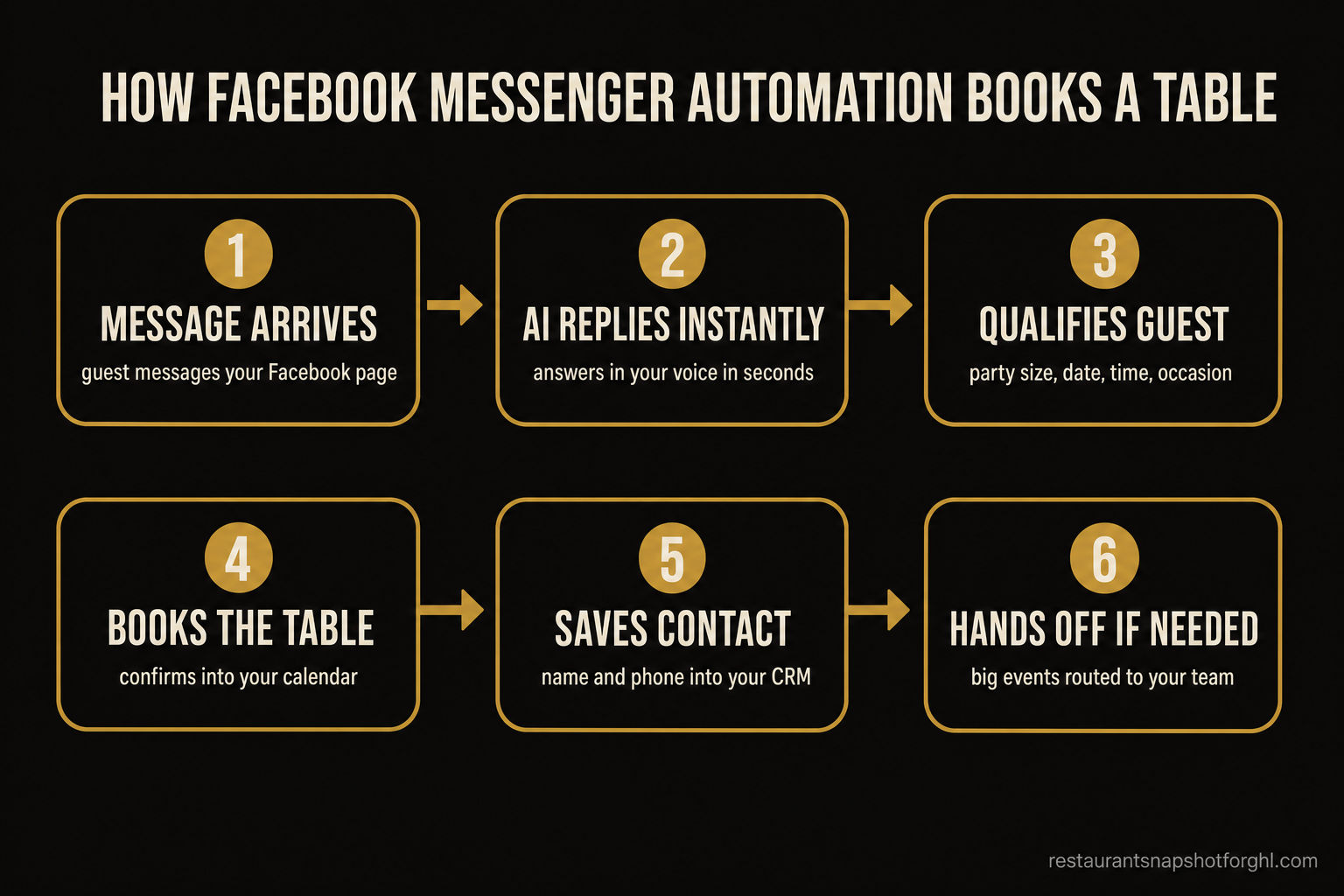
- A conversation starts. Someone messages your page — from your profile, a boosted post, a local event, or an ad. The agent sees it the instant it lands.
- The AI replies in your voice. It answers the actual question — hours, patio, private dining, “table for 8 tonight?” — in your restaurant’s tone, not a robotic script.
- It qualifies the guest. It gathers the details that decide whether it’s a table or a special event: party size, date, time, and occasion.
- It books the table. For a standard reservation, it checks availability and confirms straight into your calendar, then sends the guest a confirmation.
- It captures the contact. Name, phone, and the whole conversation are saved to your CRM as an owned guest record — the raw material for win-backs and specials later.
- It hands off when a human is actually needed. A 40-person rehearsal dinner or a food-allergy accommodation routes to your team with full context, so nobody re-asks what the guest already typed.
The AI DM agent that does this is part of our done-for-you social media management, and it shares one conversation engine with the Facebook Messenger, Instagram DM, and website chat widget agents — so a guest gets the same accurate answer no matter which door they knock on.
Your 7-Step San Antonio Rollout Playbook
You can stand this up in about a week without touching a line of code. Here’s the sequence we use.
- Audit your last 90 days of Messenger. Scroll back through your page’s inbox and list the ten questions people actually ask, plus how long each one sat unanswered. That list is your training script and your before-picture.
- Write your answer bank. For each common question, write the real answer in your restaurant’s voice — hours, parking near the River Walk or your neighborhood, patio and dog policy, private-dining minimums, vegan and gluten-free options, Fiesta and holiday hours. This is the single biggest driver of quality.
- Connect the Facebook page — no passwords required. You link your existing page to the social platform through Facebook’s official connection. You never hand over account passwords, and you can disconnect anytime.
- Set the qualifying questions. Decide what the agent must collect before booking: party size, date, time, occasion, and a phone number. Keep it to the essentials — every extra question loses a guest.
- Wire bookings into your calendar. Point confirmed reservations at your reservation calendar so the table is held automatically and the guest gets a confirmation. Sync it to the calendar your team already uses so hosts see every booking.
- Draw the handoff line. Define exactly when the AI steps back for a human — large parties, catering, media requests, complaints, allergy accommodations. These route to your team with the full thread attached.
- Turn it on, then tune weekly. Go live, then read the transcripts for the first two weeks and patch any answer the AI got thin or wrong. After that it mostly runs itself.
What the AI Should — and Shouldn’t — Do
Automation earns trust by knowing its lane. A good Messenger agent is not trying to be a human; it’s trying to get the guest a fast, correct answer and a booked table, and to get out of the way the moment the conversation needs a person.
It should: answer FAQs instantly, quote availability, book standard reservations, capture the contact, and confirm by text. It shouldn’t: improvise menu claims it wasn’t given, negotiate large-event pricing, handle a complaint, or pretend to be a named staff member. Those go to a human — fast, and with context.
There’s a compliance lane, too, and it’s not optional. Meta’s platform policies govern how businesses message people (including the standard messaging window after a user’s last contact), and once you move a guest to text for confirmations and specials, U.S. TCPA and A2P 10DLC rules apply — clear opt-in, clear sender identity, and an easy STOP. We keep a dedicated primer on this in our TCPA compliance guide for restaurant SMS; the short version is get consent, honor opt-outs instantly, and never buy a list. Done right, compliance is invisible to the guest and bulletproof for you.
Messenger Automation vs. Leaving It to Staff
The honest comparison isn’t “AI vs. a dedicated inbox person,” because almost no independent restaurant has one. It’s “AI vs. whoever happens to glance at the page between tables.” Here’s the scorecard.
AI Messenger automation vs. answering it manually
| Plan | AI Messenger automation recommended | Answering it manually |
|---|---|---|
| Price | Answers in seconds, 24/7 | When someone's free |
| Feature 1 | Replies instantly, every time — even mid-rush and after close | Replies land hours later — after the guest booked elsewhere |
| Feature 2 | Books standard reservations straight into your calendar | Bookings depend on a host who's also running the floor |
| Feature 3 | Captures name, phone & the full thread as an owned contact | Contact details get lost in the thread and never saved |
| Feature 4 | Handles repetitive FAQs so staff never see them | The same 10 questions eat staff time every shift |
| Feature 5 | Hands off big events & special requests with full context | Big-event leads slip through at 10 p.m. with no reply |
| Feature 6 | Consistent brand voice across Messenger, Instagram & web chat | Voice drifts with whoever grabbed the phone |
| Feature 7 | Runs on dark days and holidays without overtime | Nights, Mondays & holidays go completely dark |
| See how it works → | The status quo |
The point isn’t to remove people from hospitality — it’s to stop asking a slammed host to also be a 24/7 reservations desk, and to make sure the first reply, the one that decides the sale, always happens in seconds.
Measuring What It’s Worth
You don’t have to take the ROI on faith. Track four numbers for the first 60 days and the case makes itself: first-response time (target: seconds, not hours), reply rate (target: 100% of messages), tables booked from Messenger, and new contacts captured. That last one compounds — every conversation becomes a guest you own and can bring back, and repeat guests are where the profit actually lives. Bain’s foundational retention research found that a 5% lift in customer retention can raise profits by 25% to 95% (Bain & Company). A saved Messenger contact is the first brick in that.
Automating guest conversations is also still an edge, not table stakes. Only about 26% of restaurant operators report using AI tools, and marketing is the single most common use case (National Restaurant Association via Restaurant Dive, 2026). In a market as competitive as San Antonio, being the restaurant that answers every message in seconds is a real advantage while three out of four of your competitors still don’t.
Frequently Asked Questions
Facebook Messenger automation for San Antonio restaurants — FAQs
What is Facebook Messenger automation for a restaurant?
It's an AI agent connected to your restaurant's Facebook page that instantly reads and replies to every Messenger conversation. It answers common questions in your voice, collects party size, date, time, and occasion, books standard reservations into your calendar, and saves the guest's contact details to your CRM — all without a staff member touching it. When a conversation genuinely needs a human, like a large private event, it hands off to your team with the full thread attached.
Do I have to give up my Facebook password?
No. You connect your existing Facebook page through Facebook's official page-connection flow, which never requires handing over your personal or business passwords. You stay in full control of the account and can disconnect the integration at any time.
Will the replies sound robotic or off-brand?
Not if it's set up right. The agent is trained on your restaurant's real answers and tone during onboarding — your hours, your patio and parking, your private-dining details, your vegan options — so it reads like your host, not a generic bot. You review the first two weeks of transcripts and tune any answer that comes out thin.
Is automated messaging on Facebook compliant?
Yes, when it follows the rules. Meta's platform policies govern business messaging, including the standard window for messaging a user after their last contact. And once you move a guest to SMS for confirmations or specials, U.S. TCPA and A2P 10DLC rules apply: clear opt-in, clear sender identity, and an instant STOP opt-out. Our TCPA compliance guide for restaurant SMS covers the details — the short version is get consent, honor opt-outs immediately, and never buy a list.
How is this different from Instagram DM or comment automation?
It's the same idea on a different doorway. Facebook Messenger tends to carry your local, community, and older-skewing audience and a lot of event and private-dining questions, while Instagram DMs skew younger and more visual. The best setups run one shared conversation engine across Facebook Messenger, Instagram DMs, and your website chat so every guest gets the same accurate answer. We cover the Instagram side in our Instagram DMs-to-bookings and Instagram comment automation posts.
How fast can a San Antonio restaurant get this running?
About a week. Most of the work is on the front end: auditing your last 90 days of messages, writing your answer bank, and setting your qualifying questions and handoff rules. Once the page is connected and bookings are wired into your calendar, you go live and tune it over the first couple of weeks. After that it largely runs itself.
Gina is a hospitality marketing writer who came up through catering and event sales before falling in love with diner data. She translates dense automation concepts into plain English for owner-operators who’d rather be in the kitchen than in a CRM. When she’s not writing about win-back campaigns and Messenger-to-booking flows, she’s testing local restaurants’ reply speed to see who’s actually answering.
Related reading
- Restaurant social media management: done-for-you across 9 channels
- Instagram marketing: turning DMs into bookings
- Instagram comment automation for Seattle restaurants
- Restaurant social media management in Dallas: why Reels fill tables
- Missed-call text-back: catch the calls you can’t answer
- TCPA compliance for restaurant SMS
Sources
- Meta — More than 1 billion business message threads per day (Meta Business Agent)
- Pew Research Center — 5 facts about how Americans use Facebook
- Harvard Business Review — The Short Life of Online Sales Leads
- HubSpot — Social media response time expectations
- Toast — How diners are using social media (2024 Diner Study)
- National Restaurant Association — State of the Restaurant Industry
- Restaurant Dive — Over 25% of operators report using AI
- Texas Restaurant Association — About the TRA (industry size)
- Visit San Antonio — 37.65M visitors, $21.5B impact in 2023
- Bain & Company — Retaining customers is the real challenge