
Most restaurant owners think of YouTube as the place they watched a knife-skills video at 1 a.m., not a channel that fills tables. That instinct is a decade out of date. YouTube is now the single most-used online platform in the United States — 85% of U.S. adults say they use it, ahead of Facebook and well ahead of Instagram, according to the Pew Research Center (Pew Research, 2025). And the short vertical clips that look exactly like the Reels and TikToks you already scroll? On YouTube those are Shorts, and they pull more than 200 billion views every single day (YouTube Official Blog, 2025).
That is the reach. The problem is that almost no independent restaurant is set up to capture it. This is the playbook that fixes that — a straight, step-by-step system for turning a phone, a good-looking plate, and ten minutes a day into a YouTube channel that gets found by hungry locals and routes them to a booked table. No film crew, no viral-or-bust gambling, no jargon.
Table of Contents
- The 30-second answer
- Why YouTube belongs in a restaurant’s marketing
- How diners actually use video to choose where to eat
- Why short-form video wins the attention war
- The 6-step YouTube playbook for restaurants
- Turning views into reservations
- The mistakes that keep restaurant channels stuck
- Frequently asked questions
The 30-Second Answer
To market a restaurant on YouTube in 2026, treat it as a local discovery engine, not a TV network: post short, vertical, appetite-first videos of your food and room consistently, write titles and descriptions the way people search (“best tacos near me,” “date-night dinner in [your city]”), and make every video route viewers to a live booking link. YouTube gives you the largest audience of any U.S. platform; Shorts gives you a format that reaches people who have never heard of you; and a fast reservation flow plus quick replies to comments and DMs turns that attention into tables.
The catch is consistency. One clever video won’t move the needle, and the algorithm rewards restaurants that show up several times a week — which is precisely where owner-operators run out of hours. The rest of this post is the system: what to shoot, how to publish, and how to make sure the views actually land in your reservation book instead of just your view count.
Why YouTube Belongs in a Restaurant’s Marketing
Start with the audience, because it settles the argument. YouTube is used by 85% of U.S. adults — more than any other online platform, including Facebook (around 70%) and Instagram (around 50%), per Pew Research Center’s 2025 platform report (Pew, 2025). In raw numbers, YouTube’s U.S. ad reach was roughly 253 million people in early 2025, about 73% of the population (DataReportal, 2025). Whatever neighborhood your restaurant sits in, your regulars and the locals who have never tried you are already there.
What changed the game for small businesses is the format. YouTube Shorts — the full-screen vertical clips under a minute — now averages more than 200 billion views a day, YouTube CEO Neal Mohan announced in mid-2025, up from about 70 billion daily views in early 2024 (YouTube Official Blog, 2025). That is the same style of clip you would post to Instagram Reels or TikTok, dropped into the platform with the biggest reach and the strongest search engine attached.
There is a second, quieter reason YouTube matters: it does not disappear. A Reel sinks in a feed within a day, but a well-titled Short or a two-minute “how we make our birria” video keeps getting found through search and suggestions for months. Add the fact that people now watch over a billion hours of YouTube on their living-room TVs every day (YouTube, 2025), and your food ends up on the biggest screen in the house — not just a thumb-scroll on a phone.
How Diners Actually Use Video to Choose Where to Eat
Reach is meaningless if it does not change a dinner decision. It does — and the data on restaurants specifically is blunt. In MGH’s 2024 restaurant social media survey, 72% of diners said the visual appearance of food in a video prompted them to seek out that restaurant, and 58% said they had visited a restaurant after seeing it on short-form video, up from 38% in 2022 (MGH, 2024). That is not passive brand-building; that is a person watching a clip and then walking through your door.
It skews younger, which is exactly the audience most independents struggle to reach with a newspaper ad or a mailer. TouchBistro’s 2025 American Diner Trends Report, a survey of 1,500 U.S. diners, found 41% of diners use social media to research which restaurant to visit — rising to 67% of Gen Z (TouchBistro, 2025). When two-thirds of the under-28 crowd is vetting your restaurant on video before they’ll commit, an empty or nonexistent video presence reads the same way a dark dining room does at 7 p.m.: closed, or not worth the trip.
This is the same shift we’ve tracked from the Instagram side in our guide to turning restaurant Instagram into bookings — the difference is that YouTube layers a durable, searchable home on top of the fast-moving feed, so a single filming session can work for you on three platforms at once.
Why Short-Form Video Wins the Attention War
If you only make one change to how you market this year, make it “more short video.” People have told researchers plainly how they want to learn about a business: 63% say they’d most like to find out about a product or service by watching a short video, versus just 12% who prefer reading a text article, in Wyzowl’s 2025 State of Video Marketing report (Wyzowl, 2025). For a menu, that gap is even wider — a 20-second clip of cheese pulling off a slice sells better than any paragraph you could write about it.
Marketers have noticed the return. 93% of marketers say video gives them a good ROI — an all-time high — and short-form video has ranked as the highest-return content format for four years running (Wyzowl, 2025; HubSpot, 2025). None of that requires production polish. For a restaurant, the winning content is the least produced: the sizzle on the flat-top, the first cut into a medium-rare steak, the espresso pour, the Friday-night room at full hum. It looks real because it is, and “real” is what the algorithm and the diner both reward.
The 6-Step YouTube Playbook for Restaurants
Here is the actual system. Six steps, in order, that take a restaurant from “no channel” to “found by locals and booking tables.” You can run it yourself with a phone, or hand it to a team that does it for you — either way, the sequence is the same.
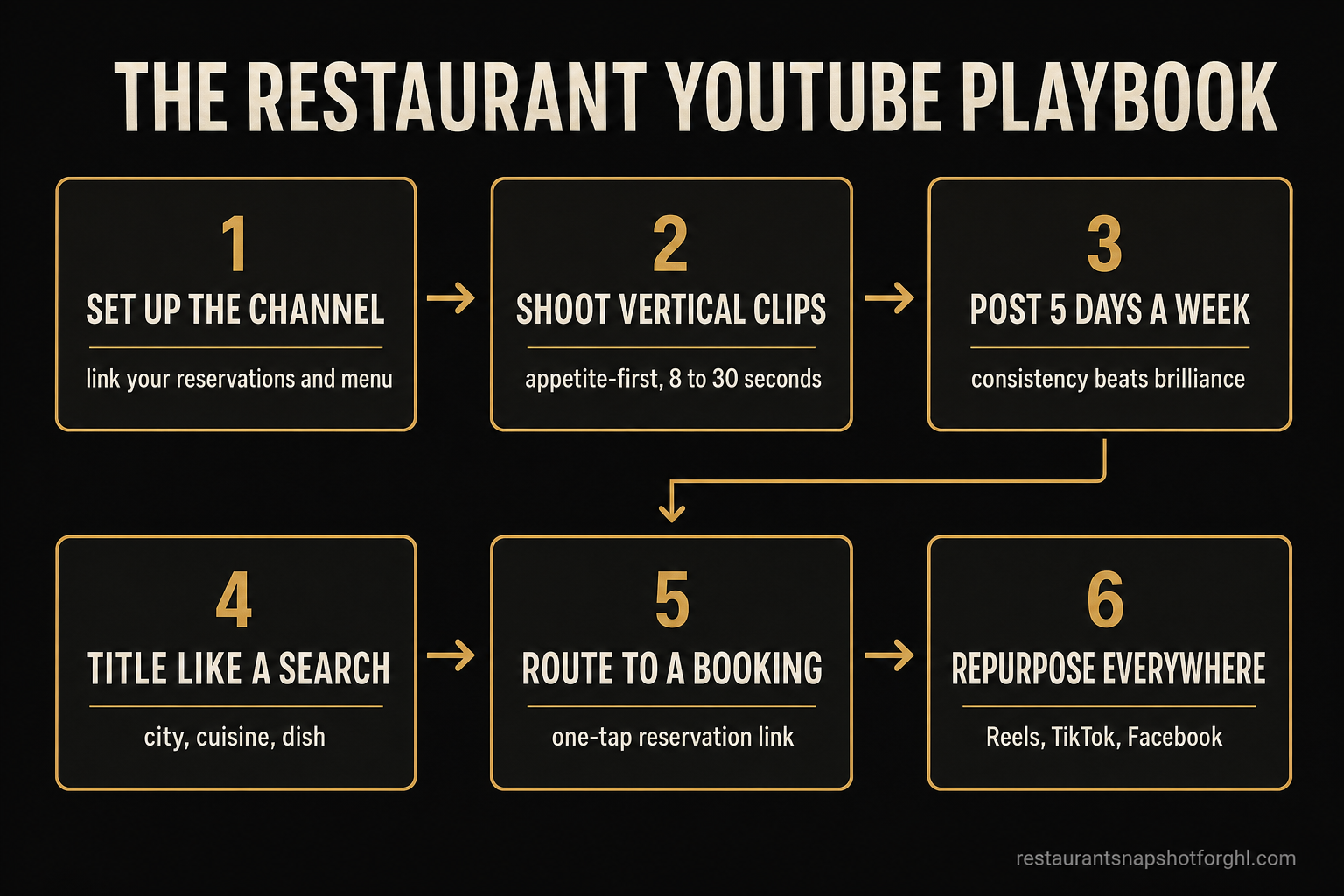
Step 1 — Set up a channel built to convert, not just exist
Create (or claim) a YouTube channel under your restaurant’s exact name, add your city to the description, and treat the banner and “About” section like a storefront window. The single most important setting is the links: your reservation page, your menu, and your phone number, front and center. A channel that goes viral but sends people to a dead end is a missed table. If your website is slow or you can’t easily edit those links yourself, fix that foundation first with a fast, purpose-built restaurant website — the reservation flow is where the view becomes revenue.
Step 2 — Shoot appetite-first vertical clips
Film vertically (9:16), in good light, close to the food. The best-performing restaurant videos are 8–30 seconds and lead with the most sensory moment in the first second — the pull, the pour, the flame, the crunch. Batch it: one 30-minute session during prep can capture a week of clips. Keep a running shot list — dish of the week, a behind-the-pass moment, a staff pick, the room filling up — so you’re never staring at a blank camera. Remember the finding: 72% of diners sought out a restaurant because of how the food looked in a video (MGH, 2024). Your kitchen already makes the content; you just have to point a phone at it.
Step 3 — Publish consistently, several times a week
Consistency beats brilliance on YouTube. The algorithm surfaces channels that upload regularly, and the math is simple: the more Shorts you post, the more shots you get at the one that breaks out to new local diners. Aim for at least 3–5 posts a week. This is the step that quietly kills most restaurant channels — not lack of ideas, but the dinner rush eating the time to edit, caption, and schedule. Batch-film once, then let a system (or a person) handle the daily publishing.
Step 4 — Write titles and descriptions the way people search
YouTube is a discovery engine, and many marketers treat it as a second search bar. Lean into it. Instead of “Yum! 😋”, title the video the way a hungry person types: “Best Birria Tacos in [Your City],” “Where to Take a Date in [Neighborhood],” “Sunday Brunch [City].” Put your city, cuisine, and dish in the title, description, and hashtags. This is the same local-intent logic that powers the Google Map Pack for restaurants — you’re helping the platform match your food to a nearby craving.
Step 5 — Route every view to a booking link
A view is only worth something if there’s a next step. Pin a comment with your reservation link on every video, keep the link in your channel banner and description, and add a clear verbal or on-screen “book your table — link below.” The faster and smoother that path, the more views convert. This is also where speed-to-reply matters: someone who comments “do you take walk-ins Friday?” or DMs “table for 6 Saturday?” is a lead with a shelf life of minutes, and an unanswered comment is a table booked down the street.
Step 6 — Repurpose everywhere and let automation carry the load
The clip you shot for YouTube is a Reel, a TikTok, a Facebook video, and a Google Business Profile post. One filming session should feed all of them — that’s how a small team competes with a chain’s marketing department. Pair that with automation that answers the comments and DMs each video generates, and you have a loop: post → get found → get asked → get booked. That loop is exactly what our done-for-you social media service runs for restaurants across nine channels, YouTube included, with AI agents handling the comment and DM replies so nothing sits unanswered until close. (We break the DM-to-booking mechanics down in detail in the guide to turning Instagram DMs into bookings.)
Turning Views Into Reservations
The difference between a restaurant “doing YouTube” and a restaurant filling tables with YouTube is the plumbing behind the video. Views are the top of the funnel; the money is in what happens in the 60 seconds after someone decides they’re hungry for what they just watched.
Three things have to be true. First, the path to book has to be one tap — a reservation link in the description, pinned in the comments, and live on a fast website, so a diner never has to hunt. Second, someone has to answer, fast — comments asking about hours, dietary options, or private events are booking signals, and the restaurants that reply in minutes win the reservation. Third, the guest’s info has to be captured, so a one-time viewer becomes a contact you can bring back with a weekly special or a birthday offer. An AI chat and DM layer closes all three: it answers instantly around the clock, books the table, and drops the guest’s name and number into your CRM.
Two ways to run a restaurant YouTube channel
| Plan | Post-and-pray | Run as a system recommended |
|---|---|---|
| Price | Random results | Compounding reach |
| Feature 1 | Uploads whenever there's a free hour — usually never during service | 3–5 posts a week, batch-filmed and scheduled in advance |
| Feature 2 | Generic titles the algorithm can't match to a local search | Local-intent titles: city, cuisine and dish, built for search |
| Feature 3 | No booking link, or a link to a slow, hard-to-book site | Every video routes to a one-tap reservation on a fast site |
| Feature 4 | Comments and DMs sit unanswered until after close | AI agents answer comments and DMs and book tables 24/7 |
| Feature 5 | One platform at a time — the clip dies after YouTube | One shoot repurposed to YouTube, Reels, TikTok, Facebook & more |
| The default | See how it works → |
You don’t have to build that system from scratch. The same guest-capture and follow-up engine that powers reservations and reviews inside the Restaurant Snapshot is what turns a YouTube view into a repeat regular — the video gets them in the door, the automation keeps them coming back.
The Mistakes That Keep Restaurant Channels Stuck
Most restaurant YouTube channels fail for the same handful of reasons, and all of them are fixable.
Treating it like TV. Owners wait until they can afford a “real” video and never post. The winning content is a 15-second phone clip of your best dish. Polish is optional; showing up is not.
Posting once and quitting. A single video won’t do it. Reach on YouTube compounds with consistency, and quitting after three uploads is the most common unforced error. Batch your filming so a busy week can’t break the streak.
No local signal. “Amazing pasta 🍝” tells the algorithm nothing. “Best Cacio e Pepe in [Your City]” tells it exactly who to show the video to. Put your location in every title and description.
A dead-end after the view. The video works, the diner is sold — and there’s no link, or the link goes to a site that won’t load. Fix the booking path before you scale the content, and make sure someone (or something) answers the questions the videos generate. If replies are the bottleneck, a comment-automation layer keeps every interested diner from slipping away.
One compliance note, since automation is part of the loop: the moment a DM or comment turns into a text-message conversation, U.S. business texting rules (TCPA and A2P 10DLC) apply — consent, sender ID, and a working STOP opt-out. A properly built system handles that for you, so the follow-up stays a clean win instead of a liability.
Frequently Asked Questions
YouTube marketing for restaurants — common questions
Is YouTube really worth it for a small restaurant?
Yes, because that's where the audience is. 85% of U.S. adults use YouTube — more than any other platform (Pew, 2025) — and Shorts alone pull over 200 billion views a day (YouTube, 2025). For restaurants specifically, 72% of diners have sought out a restaurant because of how its food looked in a video and 58% have visited one after seeing it on short-form social (MGH, 2024). You don't need a big following to benefit; you need consistent, appetite-first clips with local titles and a booking link.
Do I need expensive equipment or a videographer?
No. A modern smartphone shot vertically in good light is all most successful restaurant channels use. The content that performs is the least produced — the sizzle, the pour, the first cut, the full room. Batch-film during prep, keep clips 8 to 30 seconds, and lead with the most sensory moment in the first second.
How often should a restaurant post on YouTube?
Aim for at least 3 to 5 short videos a week. YouTube's algorithm rewards consistency, and the more Shorts you post, the more chances you get at one breaking out to new local diners. Consistency is where most restaurants fall down — not ideas — so batch-filming once and scheduling posts in advance is the practical fix.
YouTube, Instagram Reels, or TikTok — which should a restaurant use?
All three, from one filming session. A single vertical clip works as a YouTube Short, an Instagram Reel, a TikTok, and a Facebook video. YouTube adds the largest U.S. reach and a durable search presence, so the same content keeps getting found for months rather than disappearing in a day. Repurposing everywhere is how a small team competes with a chain.
How do views actually turn into reservations?
Three things have to be in place: a one-tap booking link (in the description, pinned in comments, and on a fast website), fast replies to the comments and DMs each video generates, and guest-info capture so a viewer becomes a contact you can bring back. Restaurants that answer booking questions in minutes win the table; the ones that reply after close lose it to a competitor.
I don't have time to post five days a week — what are my options?
This is the most common blocker, and it's why done-for-you social exists. A service like ours films-worthy content, publishes across YouTube, Instagram, TikTok, Facebook and five more channels in your restaurant's voice, and uses AI agents to answer comments and DMs and book tables around the clock — starting at $397/mo for a single brand. You get the reach without the nightly editing session after service.
Devon runs a small agency that builds and resells GoHighLevel systems to hospitality clients, from food trucks to fine dining. A former line cook turned funnel nerd, he’s obsessed with the unsexy plumbing of restaurant marketing: A2P 10DLC registration, two-way SMS, and content loops that don’t annoy guests. His posts lean technical without losing the operator who has to live with the system.
Related reading
- Restaurant Instagram marketing: turn the feed into bookings
- Turning Instagram DMs into booked tables
- Done-for-you social media management for restaurants
- Instagram comment automation that never misses a diner
- Restaurant local SEO and the Google Map Pack
- GoHighLevel for restaurants: the complete 2026 guide
Sources
- Pew Research Center — 5 facts about Americans and YouTube (85% of U.S. adults use YouTube)
- DataReportal / We Are Social — Digital 2025: The United States of America (~253M reach, ~73%)
- YouTube Official Blog — Neal Mohan, Cannes Lions 2025 (200B+ daily Shorts views; 1B+ hours/day on TV)
- MGH — Restaurant Social Media Survey 2024 (72% sought out a restaurant from video; 58% visited after short-form)
- TouchBistro — 2025 American Diner Trends Report (41% research restaurants on social; 67% of Gen Z)
- Wyzowl — State of Video Marketing 2025 (63% prefer short video vs 12% text; 93% good ROI)
- HubSpot — Video Marketing Statistics (short-form the highest-ROI format)