
It is the first Tuesday after New Year’s and your dining room is a graveyard. Three weeks ago you were turning tables and 86ing the special by eight o’clock. Tonight you have four reservations and a server asking if she can go home early. Nothing broke. January just arrived, the way it does every single year, and you did not have a plan for it.
That is the whole problem with how most independents market. You run flat out, you hit a slow stretch, you panic, you blast a discount, and the next spike swallows you before you can think. You are always reacting to the month you are in.
Here is the short version, and then we build the whole year. Your slow months and your busy ones are not surprises. They repeat on a schedule you can see coming. A marketing calendar means you set up January’s win-back in December, protect Valentine’s Day weeks ahead, and sell the gift cards in November that fill the room in January. You stop reacting and start running the year on purpose.
Table of Contents
- Why you need a calendar, not a campaign
- The shape of the restaurant year
- January to February: survive the slump
- Valentine’s Day and the February spike
- March to May: spring and the busiest day
- June to August: summer and the travel lull
- September to October: the back-to-school reset
- November to December: the Q4 surge
- Three restaurants, three calendars
- The compliance line you cannot skip
- Objections, answered
- FAQ
Why Your Restaurant Needs a Calendar, Not a Campaign
The short answer: a campaign is a thing you do when you panic, and a calendar is a thing that runs whether you panic or not. The difference is whether the slow night catches you flat-footed or already handled.
The industry is projected to do $1.55 trillion in sales in 2026 (National Restaurant Association, 2026), and the operators who take their share of the slow months are not the ones with the biggest coupons. They are the ones who saw the month coming. A calendar does three things a campaign cannot. It lets you prepare the slow stretch during the busy one, when you have the cash and the guest data to do it. It protects your two or three make-or-break dates by starting them early. And it keeps your messaging to a rhythm instead of a scramble, which is the only way to text a guest list without burning it. None of this requires a marketing team. It requires knowing what is coming and setting a few things up once.
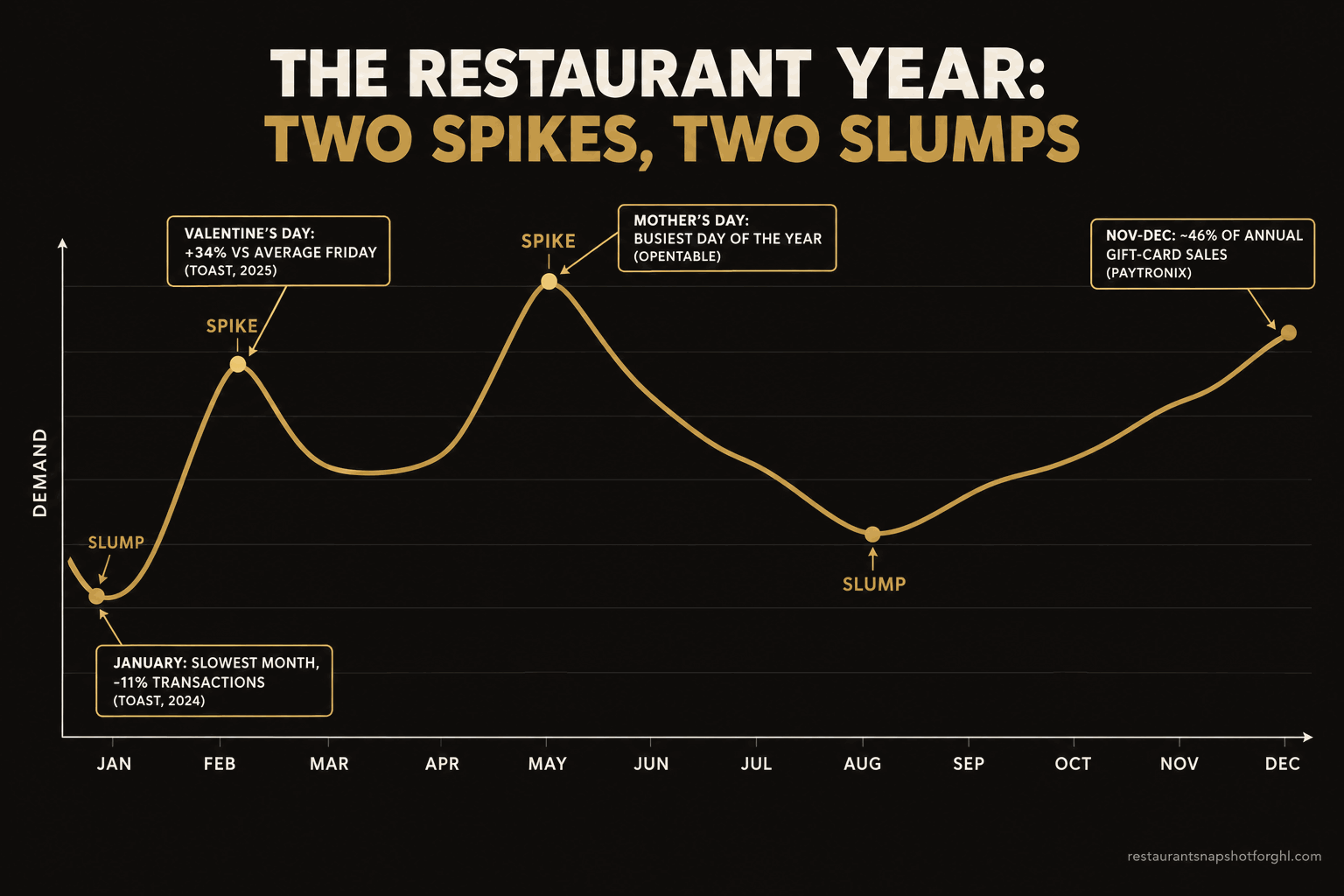
The Shape of the Restaurant Year: Two Spikes and Two Slumps
Before the month-by-month plan, learn the shape, because almost every independent restaurant year rhymes with the same curve.
There are two reliable spikes. Valentine’s Day in mid-February and Mother’s Day in early May are the two highest-demand dining dates on the calendar. OpenTable’s data has Mother’s Day as the single busiest restaurant day of the year (Nation’s Restaurant News, 2025), and Toast’s 2025 numbers put Valentine’s Day full-service revenue up 34 percent against an average Friday (Toast, 2025). Then there is the long Q4 climb through Thanksgiving, holiday parties, and gift-card season.
There are two reliable slumps too. January and early February are the deepest, right after guests spend their holiday money and start Dry January. Late summer, roughly the back half of August, softens in a lot of markets as regulars travel. Your exact pattern depends on your city and concept, so pull your own covers by month for the last two years before you trust any of this. The curve is predictable enough to plan around.
January to February: Survive the Slump Without Discounting
January is the slowest month for restaurants, and it is not close. Toast’s analysis of 2024 transactions found about 11 percent fewer transactions in January than the average for the rest of the year, alcohol sales down roughly 14 percent, and guests spending about 3 percent less per check (Toast, 2025). Holiday budgets are tapped out, Dry January is real, and the weather keeps people home.
So do not open the year by slashing prices into a crowd that is not there. You will train your regulars to wait for the deal and erase a margin that already runs just 3 to 5 percent at full service (Toast, 2026). Instead, run the two moves January rewards. First, the win-back: the guests who were in all through December went quiet the moment the holidays ended, and a warm, specific “we miss you” brings a chunk of them back. We break the trigger down in our 60-day silent win-back playbook. Second, lean into the season instead of fighting it. A Dry January mocktail flight or a cozy comfort-food night gives people a reason to come out that is not a discount.
How it breaks: operators wait until the middle of January to think about January, after two dead weeks have already gone by. The fix is to build the win-back in December while the guest data is fresh and the room is full of people to re-invite later. For the full no-discount approach to slow stretches, see how to fill slow weeknights without discounting.
Valentine’s Day and the February Spike: Book It, Cap It, Upsell It
Valentine’s Day is the first big spike of the year and one of the most profitable nights you will run. Toast’s 2025 data showed full-service revenue up 34 percent versus an average Friday, driven by a 17 percent larger average ticket and a 15 percent jump in foot traffic (Toast, 2025). People come ready to spend. Your job is to capture the demand, not get crushed by it.
Full-service restaurant lift on Valentine’s Day 2025 versus an average Friday, by measure (percent). Source: Toast, 2025.
Win it ahead of time, not on the day. Three weeks out, email your list a prix-fixe menu and a booking link, and take deposits so the night does not evaporate into no-shows. A reserved, prepaid Valentine’s table is money in the bank; a walk-in table you held open is a gamble on your busiest night. Cap the covers at a number your kitchen can actually plate well, because a blown ticket time on this night costs you a review and a couple that will not come back. Then upsell inside the reservation: a wine pairing, a dessert-and-sparkling add-on, a rose at the table. For large-party bookings and deposits, use the templates in our no-show policy for large parties.
How it breaks: you open the night to walk-ins with no deposit, get slammed, run ninety-minute ticket times, and spend the following week answering one-star reviews. Cap it, prepay it, and staff for the cap.
March to May: Spring, Patios, and the Busiest Day of the Year
Spring is a rebuild, and it ends with the biggest day you will see all year. Mother’s Day is the single busiest restaurant day on the calendar per OpenTable, with reservations creeping earlier each year and noon still the most popular time (Nation’s Restaurant News, 2025). Treat the whole stretch from March to early May as the run-up to it.
Early spring is for reopening the patio and relaunching your list after the winter quiet. St. Patrick’s Day and Easter brunch give you two easy on-ramps to get people back in the habit of choosing you. Then, from mid-April, Mother’s Day becomes the priority. Release your Mother’s Day brunch or dinner seatings early, because the people planning for mom book ahead, and the restaurant that opens its book first wins the reservation. Build a waitlist once your prime times fill, so a cancellation becomes an instant fill instead of an empty four-top on your best day. This is also prime guest-collection season: every one of those Mother’s Day parties is a table of new contacts you can add to the list you own. If you are still renting your guest relationships from a booking platform, read how to own your guest list instead of renting it first.
How it breaks: you wait until the first week of May to promote Mother’s Day, after the planners have already booked the place that emailed them in April. Open the book early and release seatings in waves.
June to August: Summer, Graduations, and the Travel Lull
Summer is two different stories, and knowing which one you are living decides the plan. If you have a patio or sit in a tourist market, June and July are a second peak, with graduations, Father’s Day, weddings, and warm-weather walk-ins filling the floor. If you are a neighborhood spot built on office lunches and local regulars, the back half of summer can go soft as those regulars travel and the offices empty out.
Either way, the moves are the same shape. Early summer, capture the volume: push a patio experience, run a summer series (a Thursday oyster night, a frozen-cocktail menu), and collect every contact the crowd gives you, because the list you build in July is what you text in January. Late summer, when it softens, go back to your owned list with a reason to come out that is not a price cut, like a “last call for summer” patio dinner. The economics hold all year: enrolled loyalty members visit and spend 18 to 30 percent more than non-members (Paytronix, 2021), so a summer that grows your list pays you back in the slow months.
How it breaks: you assume all summer is busy and coast through August, or you assume all summer is dead and coast through June. Pull last year’s covers by week and know which weeks are actually yours to fight for. For specials that fill a soft night, see our weekly specials blast that actually fills tables.
September to October: The Back-to-School Reset
September is the calmest profitable stretch of the year, which makes it the best time to fix things. The summer chaos is over, the holiday crush has not started, and your guests are settling back into routines. Use the breathing room.
This is menu-change season and loyalty season. A fall menu launch gives you a genuine reason to email the whole list and pull people back after summer travel. It is also the smartest window to re-engage your database before Q4, because the gift cards and holiday parties you sell in November land far better with a warm list than a cold one. Tag your guests, re-invite the ones who drifted over summer, and get your birthday club and review pipeline running clean, since fresh 5-star reviews are worth the most right before holiday shoppers start looking you up. Most important, build your entire Q4 plan now, because once November hits you will not have a free hour. Set up the gift-card campaign, the holiday-party inquiry flow, and the January win-back while you can still think.
How it breaks: operators treat the fall lull as a rest instead of a workshop, then hit November with no Q4 campaign built and improvise the most important quarter of the year.
November to December: The Q4 Surge That Funds January
Q4 is the most important quarter on your calendar, and not only because the room is full. It is when you sell the gift cards and book the parties that carry you through the January slump. Roughly 46 percent of a restaurant’s annual gift-card sales land in November and December (Paytronix data via Restaurant Technology News), nearly half the year’s total in two months, and a gift card is the rare promo that pays you twice: once when it sells, and again when the recipient comes in and spends past the balance.
Run three plays through November and December. Sell gift cards hard, in-house and online, with a bounce-back twist (buy $100, get a $20 card that is valid in January) so you are literally pre-booking your slowest month. Chase holiday-party and private-dining inquiries with a fast, templated response, because the group that books a December party is a table of future regulars and a stack of new contacts. And keep collecting consent the entire quarter, since the full room in December is the list you will text in January, February, and all the slow nights after. The deeper mechanics of the gift-card engine are in our restaurant gift-card marketing playbook.
How it breaks: you sell a pile of gift cards and then do nothing to drive redemption, so the cards sit in wallets and January stays empty anyway. Pair every gift-card push with a January reason to come in, and your Q4 directly funds your Q1.
Three Restaurants, Three Calendars
The year is the same shape for everyone. What you actually do with it depends on your size and your staff.
The solo spot (one location, owner runs everything). You have no marketing time, so the calendar has to be mostly automated. Set up four things once and let them run: the birthday club, the 60-day win-back, a quarterly menu-launch email, and the Q4 gift-card push. Protect the two spikes by hand, because Valentine’s and Mother’s Day are worth your personal attention. Everything else should fire without you. Start with the birthday club, which returns the most for the least effort.
The busy independent (one strong location, a part-time marketer). Now you can work the full curve. Run a monthly email, a seasonal event or two per quarter, deposit-backed booking on the spikes, and a real Q4 campaign. Your edge is segmentation: regulars, lapsed guests, and occasion guests each get a different seasonal message, which our restaurant SMS marketing playbook and email marketing playbook lay out.
The small group (two to five locations). You are running a program, not a promotion. Keep one shared guest list so a regular at one venue is known at the other, tag by home location, and test a seasonal event at one spot before rolling it out. Your discipline is measurement, because at this scale a sloppy blast to everyone does real damage. Shared loyalty and gift cards across venues are the asset.
The Compliance Line Every Seasonal Blast Has to Clear
Every play above runs on texting and emailing guests, and both are regulated. Two rules govern the texting. The TCPA requires clear prior consent before marketing texts and an easy opt-out in every message (FCC, 2026). A2P 10DLC is the carrier registration that lets your business number send those texts at all; skip it and your Valentine’s blast gets filtered before anyone sees it. The classic violation is the one that feels harmless: a host collects numbers “for the reservation” in December, and you text a January promo to the whole book. That consent does not cover marketing.
Seasonal promos add a second trap that is easy to miss: alcohol advertising is regulated at the state level, and it genuinely differs. Several states restrict or outright ban time-limited drink discounts, so a “half-price Valentine’s cocktails, tonight only” text that is fine in one state is illegal in the next. Scope every drink promotion to your own state’s rules before you send it, not to what you saw another restaurant run online. We cover the SMS side in detail in how to legally text happy-hour deals.
This is not legal advice. Read our full TCPA and A2P 10DLC guide for restaurants and talk to your own counsel.
Objections, Answered Straight
“I don’t have time to plan a whole year.” You do not plan the year in January and then execute by hand for twelve months. You spend a few hours in the September lull setting up the automations and sketching the spikes, and then most of the calendar runs itself. The planning is the once-a-year part; the sending is automated.
“Isn’t this just discounting every holiday?” The opposite. Most of the calendar is access, experience, and timing: a capped prix-fixe, an early reservation release, a birthday invite, a menu launch. The only real discount play is the Q4 gift-card bonus, which makes you money because people overspend the balance. If a seasonal move only works as a price cut, it is a weak move.
“I’m not technical. This sounds like a lot of software.” The guest capture is a QR code and a form. The seasonal sequences, the birthday club, and the win-backs are automations you set up once and leave running. You greet guests while the system sends. If setup is the scary part, that is exactly the part worth having done for you.
“My POS already sends some emails.” Most POS marketing tools can blast an email, but they rarely own your full guest list, segment it properly, or run two-way SMS with the consent tracking you need. The calendar depends on reaching your own guests, on your terms, across text and email. If your data lives inside someone else’s platform, start with owning your guest list.
Frequently Asked Questions
Restaurant marketing calendar: quick answers
What is a restaurant marketing calendar?
It is a month-by-month plan that maps your known busy and slow periods, then assigns a marketing move to each one, so you prepare the slow months during the busy months instead of reacting late. It runs on an owned guest list and a few automations like a birthday club and a win-back trigger.
What is the slowest month for restaurants?
January, reliably. Toast's 2024 data found about 11 percent fewer transactions than the rest of the year and alcohol sales down roughly 14 percent, as holiday budgets run dry and Dry January kicks in. See Toast's January data. The fix is to pre-sell January in Q4 with gift-card bounce-backs and to run a win-back, not to discount into an empty room.
What are the busiest restaurant days of the year?
Mother's Day is the single busiest restaurant day per OpenTable, with Valentine's Day close behind. Both are won weeks ahead by releasing seatings early, taking deposits, and capping covers at what your kitchen can plate well. See OpenTable's Mother's Day data.
When should I start selling restaurant gift cards?
Push gift cards hard through November and December, when roughly 46 percent of annual restaurant gift-card sales happen. Pair every push with a January bounce-back (buy $100, get a $20 card for January) so the cards you sell in Q4 actually drive visits in your slowest month. Our gift-card marketing playbook covers the engine.
Do I need consent to text my guests seasonal promos?
Yes. The TCPA requires clear prior consent before marketing texts and an easy opt-out in every message, and you need A2P 10DLC registration to send at all. A number collected for a reservation does not count. Alcohol and discount promos also have to follow your state's advertising rules. Read our TCPA and A2P 10DLC guide and check with your own counsel.
Can one system run this whole calendar for me?
Yes. The point of the calendar is that it runs on automations set up once: guest capture, segmented email and SMS, a birthday club, a win-back trigger, deposit-backed booking, and a gift-card flow. The CRM and workflow automations and SMS automation are built for exactly this.
The Bottom Line
Go back to that dead first Tuesday in January. It did not have to be a surprise, and it did not have to be a panic. The gift cards you sold in December could have carried bonus cards good this week. The regulars who went quiet after the holidays could already have a “we miss you” in their pocket. The list you built through a busy fall could be the thing filling your room right now.
That is the whole difference between a campaign and a calendar. One is something you reach for when the room is empty. The other is a quiet machine you built when the room was full, running every month so the slow ones stop catching you off guard. Pick the dates off the calendar you can already see coming, set the automations up once, and spend next January greeting guests instead of staring at an empty book.