
You already pay Toast. The POS rings up every check, the printer fires, the nightly report lands in your inbox. Then a rep calls with the same pitch: you’ve got all this guest data in the system, so why not turn it into repeat visits with email and text marketing? Sounds reasonable. So you ask the only question that matters. How much? And the answer is never on the screen in front of you.
That’s not a glitch. Toast’s public pricing page lists the $0 Starter Kit and the $69-a-month Point of Sale plan, and stops there. The marketing tools, loyalty, and the branded app live in suites with no number attached. So this is a numbers-first teardown of what Toast’s marketing actually costs an independent restaurant in 2026, what you get for it, where it breaks, and whether a one-to-three-room operator should pay it or keep the guest list on its own side of the table.
Table of Contents
- The 30-second answer
- Why Toast’s marketing price isn’t on the pricing page
- What Toast Marketing actually costs in 2026
- What you get for $185 (and what you don’t)
- Toast Marketing vs the alternatives, priced out
- Three real budgets: solo, busy independent, small group
- The hidden costs nobody quotes you (and where it breaks)
- Steal this: the texts and emails that earn the spend
- Objections, answered straight
- Frequently asked questions
The 30-Second Answer
Toast’s email and SMS marketing is sold inside the Marketing Essentials Suite, reported at about $185 a month, on top of your base POS plan and card-processing fees, not inside them. So the real marketing line for a single location is roughly $185 a month, about $2,220 a year, before the branded app, loyalty, or the other suites layered on once you’re inside (Restaurant Dive, 2024).
The tools are competent, wired to the guest data your POS already collects. The catch is structural: you pay a monthly fee to message your own guests through a system that owns the connection.
Why Toast’s Marketing Price Isn’t on the Pricing Page
Quote-only pricing on an add-on sells the easy yes first (the $0 or $69 POS plan) and surfaces the real bill, the suites, after you’re committed to the hardware (UpMenu, 2026). By the time marketing comes up, switching costs are already high, which is when a monthly add-on is easiest to sell. That matters, because the margin to absorb it is thin. The National Restaurant Association projects $1.55 trillion in industry sales for 2026 and 15.8 million jobs (NRA, 2026). But the same report found 42% of operators said their restaurant wasn’t profitable in 2025, with more than 60% logging lower traffic (NRN, 2026), on a net margin that usually runs just 3% to 5% (Level CFO, 2026). At those margins, a marketing add-on you half-use is real money.
What Toast Marketing Actually Costs in 2026
Here’s where the published plans and trackers converge. Treat the marketing figure as reported.
- Base POS, Starter Kit: $0 a month, with pay-as-you-go processing around 3.09% to 3.69% + $0.15 per transaction (UpMenu, 2026).
- Base POS, Point of Sale plan: $69 a month, with lower in-person processing around 2.49% + $0.15 (Owner, 2026; UpMenu, 2026).
- Marketing Essentials Suite (email + SMS marketing): reported at $185 a month, about $2,220 a year (Restaurant Dive, 2024).
- Digital Storefront Suite, Premium (branded iOS/Android app): $299 a month (Restaurant Dive, 2024).
- Loyalty: a separate paid module, no public figure.
Reported Toast monthly fees by component, single location, before card-processing fees. Toast does not publish the marketing or app figures; the $185 and $299 are reported third-party numbers, not official quotes. Sources: Restaurant Dive (2024), UpMenu (2026).
The pattern under those numbers: Toast Marketing is a feature of the POS you’re renting, priced as optional when the whole pitch depends on data the POS already holds. A fine deal if you run campaigns every week, an expensive checkbox if you text twice a month, because you pay the same $185 either way.
What You Get for $185 (and What You Don’t)
What’s in the box:
- Email campaigns built on the guest data Toast collects from checks and online orders.
- SMS marketing, with subscriber aids: QR-code printouts, a text-to-join prompt, and templates (Restaurant Dive, 2024).
- An AI text-suggestion feature that drafts copy on a third-party model you review before sending.
- Reporting that ties campaigns back to spend inside the Toast ecosystem.
What’s not in the box, or costs more:
- No-show and reservation recovery. Toast Marketing is campaign messaging, not the two-way booking-and-reminder flow that stops a no-show before it happens.
- The branded app and loyalty are separate paid modules (Restaurant Dive, 2024).
- Deep two-way conversations. The tools broadcast; they don’t run a back-and-forth with a guest who replies.
- Portability. The campaigns, segments, and automations live inside Toast. Leave, and you rebuild from zero.
The honest read: for a specials blast and a review nudge, it works. For the full engine that fills slow nights (the no-show save, the 45-day win-back, the two-way reply), you’re buying more suites or stitching other tools around it.
Toast Marketing vs the Alternatives, Priced Out
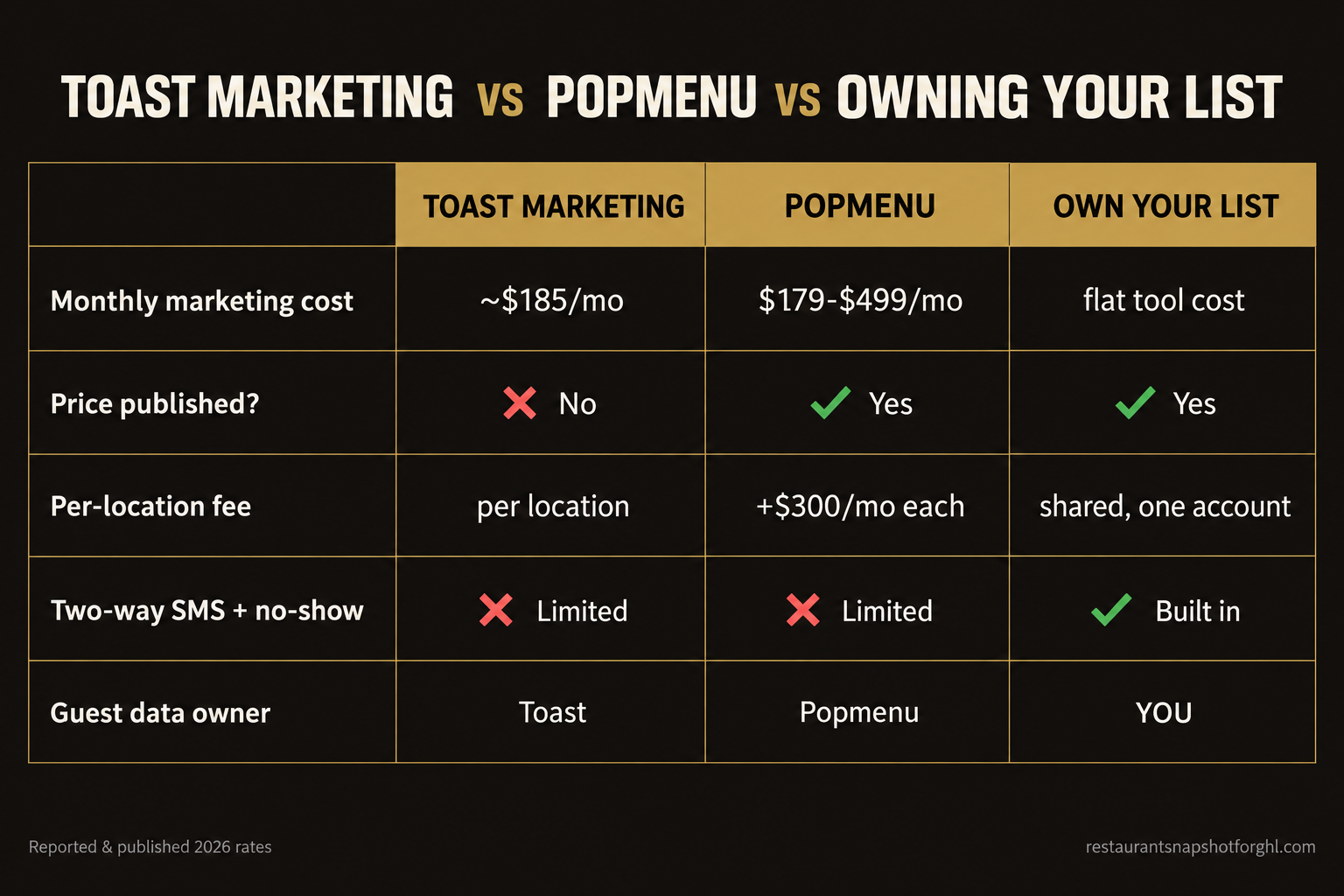
Here’s how Toast’s marketing layer lines up against Popmenu, the platform most often cross-shopped, plus the option owners forget: running the guest relationship from a system you own. Figures reflect 2026 rates.
| What matters | Toast Marketing | Popmenu | Own your list |
|---|---|---|---|
| Monthly marketing cost | ~$185/mo (reported) | $179–$499/mo | Flat tool cost |
| Price published? | No (quote-only add-on) | Yes | Yes |
| Online ordering add-on | Processing fees apply | ~$50/mo + reported ~$1/order | Varies |
| Branded app | $299/mo separate suite | Included on higher tiers | Optional |
| Extra location | Per-location fee | +~$300/mo each | Shared, one account |
| Two-way SMS + no-show flow | Limited | Limited | Built in |
| Guest data owner | Toast | Popmenu | You |
| Best fit | Toast POS loyalists | Website-led independents | Owner who wants the list |
Sources: Restaurant Dive and UpMenu for Toast; PricingSaaS and Sauce for Popmenu. Popmenu’s per-order fee is reported inconsistently, so verify it directly. For the full category view, see our restaurant marketing software cost breakdown.
Toast is the only one of the three that won’t put its marketing price in public. And owning the list gets cheaper per location as you grow, instead of adding $185 every time you open a door.
Three Real Budgets: Solo, Busy Independent, Small Group
The right answer changes with your size. Every figure below is illustrative, marketing layer only, excluding base POS and processing.
Scenario 1: the solo operator. One room, 800 to 1,000 covers a month, wants a specials text and the occasional email.
- Toast Marketing Essentials: $185/mo = ~$2,220 a year.
- The honest read: the clearest “think twice.” Two campaigns a month is roughly $90 per send for a broadcast you could run from a system you own for far less. See owning your restaurant guest list.
Scenario 2: the busy independent. One high-volume room or two locations, a real promo calendar, someone who runs campaigns weekly.
- Toast Marketing at two locations, $185 each = $370/mo, about $4,440 a year, plus the $299 app.
- The honest read: a real debate. If you’ll genuinely run weekly campaigns, review requests, and win-backs, the tools earn more of their keep. Price it against owning the same workflows before the per-location fees compound.
Scenario 3: the small group. Three to five locations, shared guest data, a marketing lead.
- Toast Marketing at $185 per location across five rooms = $925/mo, about $11,100 a year, marketing alone, before the app and loyalty.
- The honest read: this is where per-location pricing hurts most, and where one shared account with no per-door fee changes the number by thousands.
Estimated annual Toast Marketing Essentials spend by operator size, marketing layer only, before base POS, processing, app, and loyalty. Illustrative, built from the reported $185/location figure cited above.
The Hidden Costs Nobody Quotes You (and Where It Breaks)
The $185 is the start, not the bill. Four costs surface after you sign.
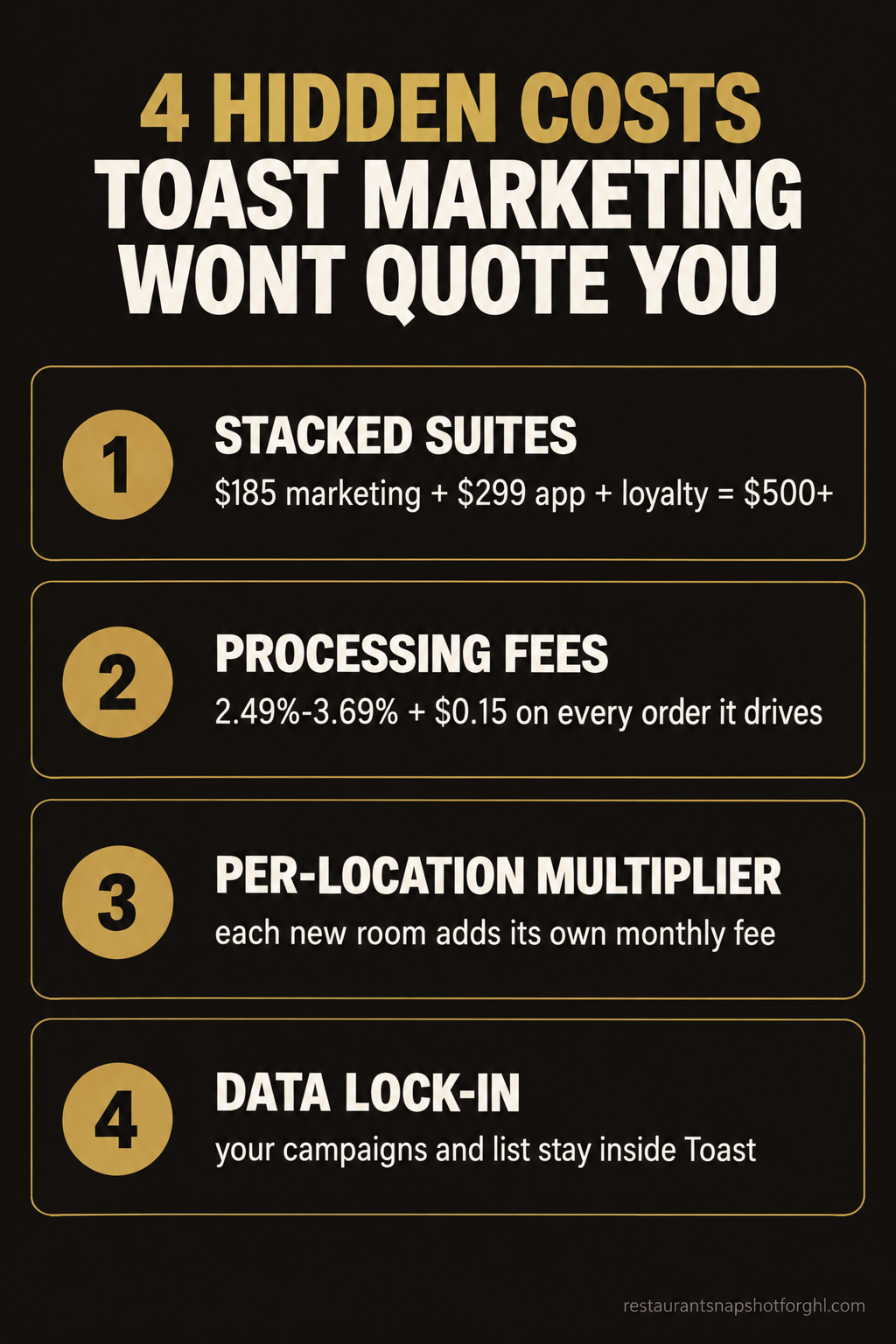
1. The stacked suites. Marketing is $185. The branded app is a separate $299 suite. Loyalty is another paid module (Restaurant Dive, 2024). Where it breaks: the “marketing” you pictured (email, text, app, loyalty) is three or four line items, and because none are on the public page, you can’t benchmark the creep. Your $185 tool is $500-plus by the time it does the job.
2. The processing fees on every order it drives. Every check the marketing brings back still pays card processing of roughly 2.49% to 3.69% plus $0.15 (UpMenu, 2026). Where it breaks: a “free” specials blast isn’t free when the covers it books run through the same processing rate as everything else. Two meters, both running.
3. The per-location multiplier. The marketing fee attaches per location, so each new room adds its own monthly line. Where it breaks: a rounding error at one location becomes a four- or five-figure annual commitment at five, right when a shared-account system would be flattening the curve.
4. The data you can’t take with you. The segments, automations, and campaign history live inside Toast. Where it breaks: the day you consider leaving, the marketing you built is the reason you can’t, because none of it comes with you. You paid monthly to build a relationship that stays in Toast’s system.
Steal This: The Texts and Emails That Earn the Spend
Whatever tool you run, these are the messages that move covers. Copy them straight, swap the brackets, and keep the compliance line on anything promotional.
The missed-call text-back (a call comes in during service and nobody can grab it):
“Hi, this is [Restaurant], sorry we missed you, we’re in the middle of service. Reply here and we’ll get you a table or answer anything. Want to book? Tap [link].”
The three-touch win-back for a regular gone quiet (45, 60, and 75 days since last visit):
Day 45: “We saved your usual table, [Name]. It’s been a few weeks. Come see what’s new on the menu this week? Reply YES and we’ll hold a spot.”
Day 60: “Miss you at [Restaurant]. Here’s $15 off your next visit this month, our treat. Book here: [link].”
Day 75: “Last one from us, [Name]. The $15 is good through Sunday, then we’ll leave you be. [link].”
The review request (send 2 to 3 hours after the check closes, to happy guests only). The “reply here first” line routes an unhappy guest to you before they post publicly:
“Thanks for coming in tonight, [Name]. If we got it right, a quick Google review helps a small local spot like us more than you’d think: [link]. If anything was off, reply here first and we’ll make it right.”
The SMS consent line for your booking form, Wi-Fi splash, or text-to-join prompt. This is the one you can’t skip:
“Text me reservation updates and occasional offers from [Restaurant]. Msg & data rates may apply. Msg frequency varies. Reply STOP to cancel, HELP for help. Consent isn’t a condition of dining with us.”
The moment you text a list collected at the host stand, you’re bound by the Telephone Consumer Protection Act (TCPA) and A2P 10DLC rules, with penalties of $500 to $1,500 per message (FCC). Keep the transactional confirmation and the marketing opt-in separate, log every consent with a timestamp, and honor STOP automatically. Our full TCPA and A2P 10DLC guide covers registration and templates.
Objections, Answered Straight
“I already pay Toast for the POS. Isn’t bundling simpler?” Simpler to set up, yes, but simple isn’t cheap or portable. You’re adding $185 a month to reach guests whose data you already have, and everything you build is locked to Toast. Convenience now is a switching cost later.
“Won’t guests find the automated texts annoying?” Only if you blast everyone the same thing. The messages above are triggered and targeted: a win-back only to a guest gone quiet, a review request only to someone who just had a good night, a specials text only to people who opted in. Permission plus relevance is the whole game.
“I’m not technical. Doesn’t Toast make it easy?” The alternative isn’t wiring it up yourself at midnight. A done-for-you setup installs the booking flow, reminders, review requests, loyalty, and compliant texting into an account you own, so you get the ease without the lock-in or the per-location bill. See a done-for-you GoHighLevel system for restaurants.
“We’re tiny. Do we even need this?” You need the follow-up, not necessarily Toast’s version of it. Winning a new customer costs about five times more than keeping one you have (Bain & Company), so the highest-return move for a small room is a reliable way to bring a lapsed regular back, which runs from a $185 suite or a system you own. The cheaper, more durable option is usually the second.
The One Line That Changes the Math
The marketing add-on, the per-location fee, the data you can’t export: each charges you to talk to people who already chose you, and each is priced exactly because leaving is hard. Toast’s tools are fine. The structure is the problem.
So the highest-return line in your budget isn’t the slickest POS-native campaign. It’s the one that keeps the list and the automations on your side of the table: a reminder that stops the no-show, a win-back at 45 days, a loyalty program that doesn’t need a punch card, and a specials text that goes to people who asked for it. For a one-to-three-room operator, the better move is usually to buy the marketing you’ll actually run, not the suite that sits next to the POS.
Frequently Asked Questions
How much does Toast Marketing cost per month in 2026?
Toast sells email and SMS marketing inside the Marketing Essentials Suite, reported at about $185 a month (roughly $2,220 a year) per location. That price isn't on Toast's public pricing page, which lists only the $0 Starter Kit and the $69-a-month Point of Sale plan. It sits on top of your base plan and card-processing fees, and it's a reported figure, so confirm your own quote.
Why isn't Toast's marketing price on the pricing page?
Toast publishes its base POS plans but routes marketing, loyalty, and the branded app to 'talk to sales' instead of a number. Quote-only add-on pricing sells the easy yes first (the cheap or free POS) and surfaces the real cost of the suites after you're committed to the hardware. The only real number is your written quote, so ask for the all-in monthly total per location before you sign.
What's included in Toast Marketing Essentials?
Email campaigns and SMS marketing built on your POS guest data, subscriber aids like QR-code printouts and a text-to-join prompt, email and social templates, an AI text-suggestion tool, and reporting tied to Toast spend. It does not include the branded mobile app, which is a separate $299-a-month Digital Storefront suite, and loyalty is a separate paid module.
Is Toast Marketing worth it for a small independent restaurant?
Often not, if you send only a couple of campaigns a month. At about $185 a month per location you pay the same whether you run weekly campaigns or two texts, and everything you build is locked to Toast. A solo operator usually gets the same specials blast, review request, and win-back from a system it owns for a fraction of the cost.
Does Toast Marketing charge extra per location?
Yes. The marketing fee attaches per location, so each room adds its own monthly line. At five locations the marketing layer alone runs around $925 a month, roughly $11,100 a year, before the app and loyalty. A shared-account system with no per-door marketing fee is where multi-location operators see the biggest difference.
What are the best Toast Marketing alternatives for independents?
Popmenu is the common cross-shop for website-led independents, with published plans from about $179 to $499 a month plus online-ordering add-ons. If your goal is to own the guest relationship end to end, running email, two-way SMS, no-show recovery, reviews, and win-backs from a system you control avoids the per-location fees and data lock-in of a POS-native add-on.
Related reading
- What restaurant marketing software actually costs in 2026
- What SevenRooms actually costs now that DoorDash owns it
- Own your restaurant guest list instead of renting it
- TCPA & A2P 10DLC: what restaurants need to know before sending one SMS
- Win back lapsed diners with a 60-day silent trigger
- Get the done-for-you system installed in 24 hours
Sources
- Toast marketing & app pricing: Restaurant Dive (2024)
- Toast base plans & fees: UpMenu (2026); Owner (2026)
- Popmenu pricing: PricingSaaS (2026); Sauce (2026)
- Industry: NRA 2026 State of the Industry; NRN on 2026 cost pressures; Level CFO margins
- Retention & compliance: Bain on retention; FCC TCPA
- Competitor context: EatApp, OpenTable pricing