
It is 4:50pm on a Tuesday and your dining room is going to be two-thirds empty in three hours. The fix is sitting in your point-of-sale: a couple thousand guest phone numbers, people who have already eaten your food and paid for it. You open the message box, the cursor blinks, and you have no idea what to type that will not sound desperate, get you reported as spam, or land you in a lawsuit. So you close the laptop and hope for walk-ins.
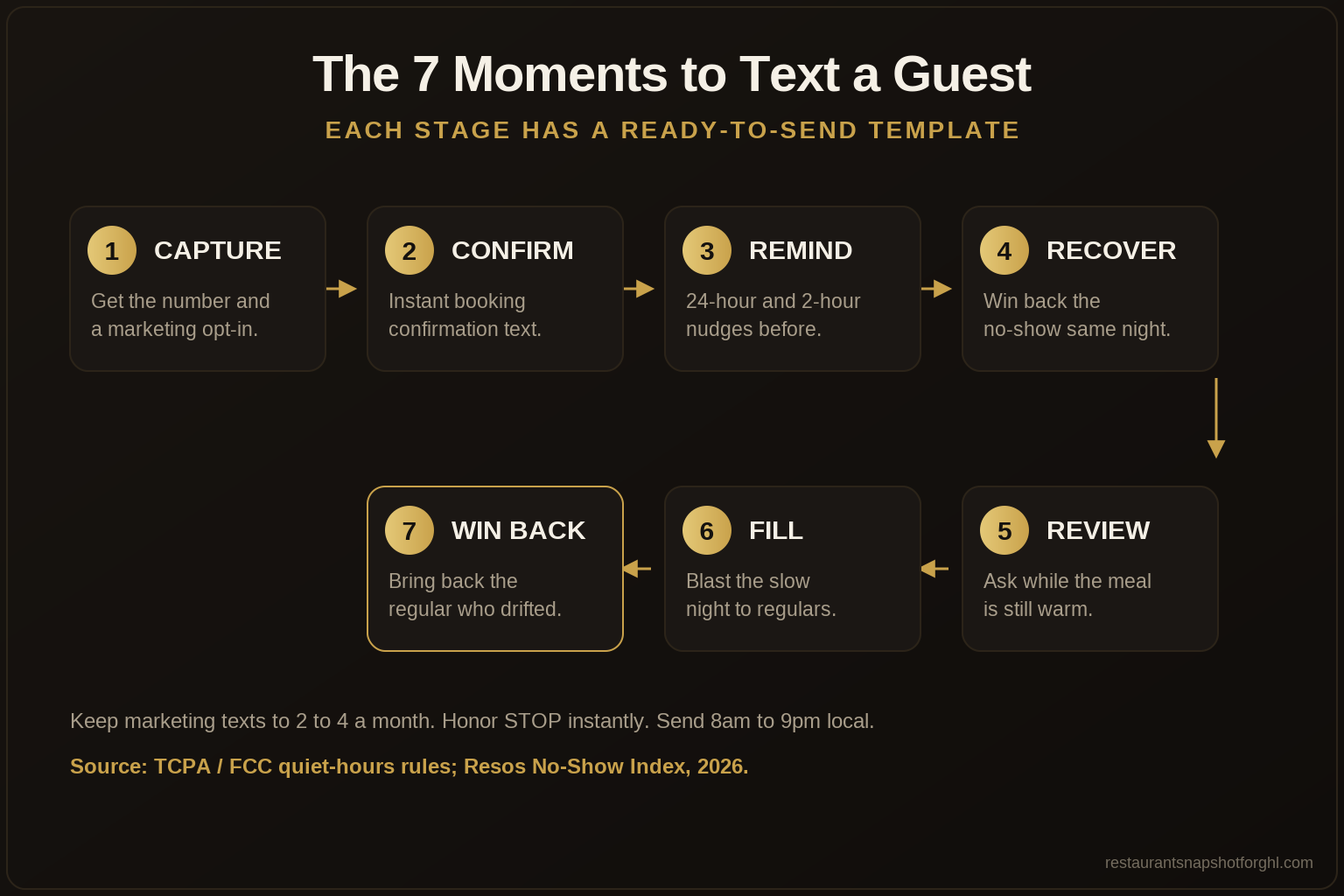
This post fixes the blank cursor. Below is a swipe file of 16 restaurant text messages for every moment in a guest’s visit: the exact words, when to send them, and the rules that keep every one of them legal.
Table of Contents
- The short answer
- What a sloppy text program actually costs you
- The rules that make every template legal
- The 16 templates, by moment in the visit
- Run it for your size: solo, busy independent, small group
- Send timing and rules, at a glance
- Objections, answered straight
- Frequently asked questions
- Related reading
The Short Answer
A restaurant text program is seven moments in a guest’s life, each with a message waiting for it: capture the number and the consent, confirm the booking, remind before the reservation, recover the no-show, ask for the review while the meal is warm, fill the slow night, and win back the regular who drifted. Every template below plugs into one of those moments.
Square brackets are merge fields: wherever you see [FirstName] or [Restaurant] or [Time], your system swaps in the real value. Keep each message under about 160 characters, put your restaurant name in the first line, and never send to a number that did not opt in.
What a Sloppy Text Program Actually Costs You
The channel is the best one you own. SMS open rates cluster around 98% for delivered messages, and most are read within minutes (Infobip, 2026). Treat that as directional, since there is no open pixel in a text, but even discounted heavily it buries the 20-something percent email gets.
That reach is why getting it wrong is expensive. The Telephone Consumer Protection Act lets a person sue for $500 per unwanted marketing text, up to $1,500 if the send was willful (National Law Review, 2026). Courts count each text as its own violation, so a blast to a thousand unconsented people is a thousand problems. The common trap: you collect numbers at the host stand for “reservation stuff,” then blast a happy-hour promo. That consent did not cover marketing, and now you are exposed.
There is a quieter cost too. Since early 2025, US carriers block business text traffic not registered under A2P 10DLC (Telnyx, 2026). Blocked means blocked, not slowed. If you grabbed a cheap texting app and never registered, a chunk of your texts are dying in the network with no bounce to warn you.
Share of messages opened, SMS versus email. SMS open rates are modeled, not pixel-tracked, so treat them as directional. Source: Infobip SMS benchmarks, 2026.
The Rules That Make Every Template Legal
First, the plumbing.
Get express written consent for marketing. A number you took to confirm a booking is not permission to promote. You need a separate opt-in: a checkbox on your booking page, a texted keyword, or a line on a paper form agreeing to marketing texts. Keep the record, because in a dispute the consent log is your whole defense. Our TCPA and A2P 10DLC walkthrough covers the paperwork, so this post stays on the words.
Register under A2P 10DLC. Through your texting provider, register your restaurant as a brand and your use as a campaign. One-time setup that stops carriers from blocking you.
Carry an identity and an exit. The first promo to a new subscriber names your restaurant and tells them how to leave:
[Restaurant]: You're in! Expect a few texts a month about
specials and events. Reply STOP to opt out, HELP for help.
Msg&data rates may apply.
Stay inside the hours. Send marketing texts between 8am and 9pm in the guest’s local time, the federal quiet-hours window plaintiffs watch (FCC, 2026). A special at 10:45pm is both annoying and a liability.
Opt-in, register, identify, honor STOP, respect the clock. Now the words.
The 16 Templates, by Moment in the Visit
Copy these, swap the brackets for your details, and set the send timing noted with each. They are written to sound like a person typed them, because the robotic ones get muted.
Stage 1: Capture the Number and the Consent
1. The keyword reply (auto-fires when someone texts your keyword, say SPECIALS):
[Restaurant]: You're on the list for weekly specials and
first dibs on events. Reply STOP to opt out, HELP for help.
Msg&data rates may apply.
2. The after-dinner opt-in ask (to a guest who booked by phone):
Hope dinner was great tonight, [FirstName]. Want our slow-night
specials and event invites by text? Reply YES to join. From [Restaurant].
How it breaks: treating a booking or waitlist number as marketing consent. It is not. Keep a separate marketing list and only promote to people who said yes.
Stage 2: Confirm the Booking and Kill the No-Show
A delivered reminder is associated with a 16% lower no-show rate in the largest recent dataset (Resos, 2026).
3. Instant confirmation (fires when the booking is made):
Booked! [Restaurant] is holding a table for [PartySize] on
[Date] at [Time]. See you then, [FirstName]. Need to change it? Reply here.
4. The 24-hour reminder with a one-tap out:
Reminder: your table at [Restaurant] is tomorrow, [Date] at
[Time] for [PartySize]. Reply C to confirm or X if plans changed.
5. The two-hour nudge:
See you tonight, [FirstName]! [Restaurant] at [Time], table for
[PartySize]. Running late or need to cancel? Just reply and we'll sort it.
How it breaks: reminders with no easy way to cancel backfire. A guest who cannot reach you to cancel simply ghosts, and you hold a dead table. Always give a reply path and make confirming a one-tap job.
Stage 3: Recover the No-Show and the Large Party
6. The same-night no-show follow-up (an hour after the missed time):
Hi [FirstName], we missed you at [Restaurant] tonight. No worries,
things come up. Want to rebook this week? Reply and we'll hold a spot.
7. The large-party deposit request (parties of 6 or more, sent at booking):
[Restaurant]: to hold your table for [PartySize] on [Date], we
take a $[Amount] deposit that goes toward your bill. Secure it here: [Link]
How it breaks: the deposit reads as a cash grab unless you say the money comes back as credit. In the Resos data, reservations requiring no-show protection ran a 0.80% no-show rate against 2.47% without one (Resos, 2026). See our no-show policy for large parties.
Stage 4: Ask for the Review at the Right Second
8. The happy-path review request (sent 1 to 2 hours after the check is paid):
Thanks for dining with us, [FirstName]! If tonight was a 5-star
night, would you share it? Takes 20 seconds: [GoogleReviewLink]. From [Restaurant].
9. The private-feedback fork (to guests who flagged less than great):
[FirstName], we want every visit to [Restaurant] to be great and
it sounds like we missed tonight. Tell us what happened? We read every reply.
How it breaks: blasting every guest straight to your Google link, the unhappy included, is how you collect public one-star reviews. Route sentiment first: the five-star crowd goes to Google, the unhappy go to a private reply you can fix. See review automation that does not burn out your staff.
Stage 5: Fill the Slow Night
This is the one you opened the laptop for at 4:50pm. Segment it: the slow-night offer goes to people who have not been in lately, not to the regular already booked for Friday.
10. The Sunday-night specials blast (the workhorse, sent Sunday around 6pm):
This week at [Restaurant]: [Special] on [Weekday]. Tables go
fast, book early: [Link]. Reply STOP to opt out. See you soon, [FirstName]!
11. The same-day flash (late morning on a slow day, scarcity does the work):
[FirstName], quiet night at [Restaurant] means [Special] tonight
only. We've got a handful of tables left. Grab one: [Link].
How it breaks: the fastest way to torch your list is frequency. More than half of people who opt out say it is because the business texted too often (SimpleTexting, 2026). Two to four marketing texts a month is plenty. For the segmentation that makes the Sunday blast land, read the specials blast that fills weeknight tables.
Stage 6: Win Back the Regular Who Drifted
Every restaurant has a quiet leak: the Thursday couple who came for a year and then stopped. They did not get mad, life happened, and a text brings a chunk of them back.
12. The 45-day “we miss you” (no discount yet, just warmth):
[FirstName], it's been a minute since we've seen you at
[Restaurant]. We saved your favorite table. Come back this week? Reply to book.
13. The 90-day stronger offer:
We miss you, [FirstName]! Here's a little nudge: [Offer] on your
next visit to [Restaurant] this month. Book here: [Link]. Hope to see you.
How it breaks: fire win-backs too early and a guest who was in last week gets a “we miss you” and feels unseen. Base the trigger on real visit data, not a guess, and cap the sequence. See how to win back lapsed diners.
Stage 7: Birthday, Loyalty, and the First-Timer
These turn a customer into a regular, and repeat guests drive around 60% of revenue (Olo, 2024).
14. The birthday-week invite (sent 7 days before their birthday):
Happy birthday week, [FirstName]! Celebrate at [Restaurant] and
[BirthdayOffer] is on us. Book your night: [Link]. From all of us here.
15. The loyalty-milestone reward:
[FirstName], that's your [Number]th visit to [Restaurant]! Your
next [Reward] is on the house. Just show this text. Thanks for being a regular.
16. The first-timer nudge (to someone on their first-ever visit, 2 days later):
So glad you found us, [FirstName]! Here's [Offer] for round two
at [Restaurant] this month: [Link]. Hope the first visit won you over.
How it breaks: birthday and loyalty texts need clean data, a real birth date and visit count, or they fire wrong. A “happy 10th visit” to someone on their second is worse than silence. Wire these to your point-of-sale, not a spreadsheet you update by hand.
Run It for Your Size: Solo, Busy Independent, Small Group
The 16 templates are the same at every scale. What changes is how much a human touches them.
The solo operator, by hand. Do not run all seven stages at once. Start with the two that pay immediately: the booking reminders (templates 3 to 5) and the Sunday specials blast (template 10), sent from your reservation tool and a simple A2P-registered app. Add the review ask next. The rest waits until those are a habit.
The busy independent, semi-automated. Automate the booking stage so reminders fire untouched, and route the review ask through a sentiment fork so unhappy guests never reach your public Google link. Run the specials blast and win-back on a schedule. This is where texting quietly fills the covers you were losing.
The small group, two to five locations. Here consistency is the enemy: five managers freelancing their own texts means five voices and no shared view of who opted out where. Centralize it. One registered sender identity, one consent list per location rolling up to the group, one approved template set. A guest who opted out downtown must be suppressed uptown too, or you are back to TCPA exposure. The automation is not optional at this size.
Send Timing and Rules, at a Glance
| Moment | Send when | The rule that matters |
|---|---|---|
| Opt-in / welcome | Instantly, on signup | Must name you + STOP + rates line |
| Booking confirmation | At time of booking | Transactional, needs a reply path |
| 24-hour reminder | Day before, daytime | Offer a one-tap confirm or cancel |
| 2-hour reminder | Same day | Keep it warm, not naggy |
| No-show follow-up | ~1 hour after miss | Rebook, never scold |
| Large-party deposit | At booking, 6+ guests | Say the deposit becomes credit |
| Review ask | 1 to 2 hours post-check | Route sentiment before Google |
| Specials blast | Sunday ~6pm, weekly | 2 to 4 marketing texts a month, max |
| Win-back | 45 / 90 days lapsed | Base it on real visit data |
| Birthday / loyalty | 7 days before / on milestone | Needs clean POS data to fire right |
| Quiet hours | 8am to 9pm local, always | Federal window, plaintiffs watch it |
Objections, Answered Straight
“Won’t guests find the texts annoying?” They find too many texts annoying, not texts. About 86% of US consumers are opted in to business texts on purpose (EZ Texting, 2025). Annoyance comes from frequency, which is why the templates are capped at two to four marketing sends a month. A special once a week is a service, not a nuisance.
“I already pay OpenTable or Toast to text my guests. Why do this?” Those tools text on the platform’s terms, and the number and opt-in often live with the platform, not you; leave and the list may not come with you. They also tend to cover only the transactional stuff, not the win-backs, birthday club, specials, and review fork where repeat covers come from. Owning the list is the point, which we argue in owning your guest list instead of renting it.
“Do I need to be technical to set this up?” No, but you need two pieces of plumbing: a texting tool that handles A2P 10DLC registration for you, and a clean opt-in list. The copy is already done above. If registration and consent logging sound like a weekend you do not have, that is the gap a done-for-you system fills.
“Is sending marketing texts even legal?” Yes, when you do it right, and “right” is not vague: consent before the first promo, register under 10DLC, identify yourself, honor STOP, stay in the 8am-to-9pm window. Ignore those five and the exposure is real, $500 to $1,500 per text (National Law Review, 2026). This is not legal advice, but the federal floor is clear.
Frequently Asked Questions
How often should a restaurant text its guests?
Keep marketing texts to two to four a month. Booking confirmations and reminders are transactional and do not count toward that. The fastest way to lose subscribers is frequency: more than half of people who opt out of business texts say it is because the company texted too often. One weekly specials blast plus the occasional event invite is the right rhythm.
Do I need consent to text guests who gave their number for a reservation?
For booking messages, that transactional consent is enough. For marketing, specials, events, and win-backs, you need separate express written consent. The cleanest fix is a checkbox on your booking page or a texted keyword opt-in, kept as a record. A reservation number is not a marketing list, and treating it as one is the most common TCPA mistake restaurants make.
What is A2P 10DLC and do I really have to register?
It is the US framework that registers a business and its texting campaigns so carriers know the messages are legitimate. Since early 2025, carriers block unregistered business text traffic outright. If you text from a 10-digit number without registering, a share of your messages silently never arrive. Any reputable texting provider handles the one-time registration for you.
What happens if a guest replies STOP?
You must stop sending that number marketing texts immediately and permanently, unless they opt back in. Your platform should handle STOP automatically, but confirm it does. Continuing after a STOP is one of the most-litigated TCPA violations, and each message after the opt-out can count as a separate 500 to 1,500 dollar claim. Suppress across every location if you run a group.
Will these templates work with Toast, Square, or Clover?
The copy is platform-agnostic, so you can send it from almost any texting tool. What matters is connecting the triggers, booking made, visit lapsed, review threshold, to your guest data so the right text fires at the right moment. Many restaurants run the templates through a dedicated automation layer on top of the point-of-sale rather than the POS texting feature.
Related Reading
- Restaurant SMS Marketing: The Complete 2026 Playbook for the strategy behind these templates.
- TCPA and A2P 10DLC: What Restaurants Need to Know Before Sending One SMS for the compliance plumbing in full.
- Missed-Call Text-Back for Restaurants to catch the calls you miss during service.
- The Sunday-Night Specials Blast That Actually Fills Wednesday Tables to make Stage 5 land.
- Own Your Restaurant Guest List Instead of Renting It for why the number belongs to you.
The blank cursor at 4:50pm was never a copywriting problem. It was a missing system. You now have the words for all seven moments and the rules that keep them legal. Paste the ones that fit tonight and the next slow Tuesday finally has a fighting chance.