
It is a slow Tuesday and two reps have left voicemails. One is Toast, pitching the new AI marketing agent that lives inside the POS you already run. The other is Popmenu, offering a website that talks back and an interactive menu that photographs well. Both promise the same thing: more covers from the guests you already have. So you ask the only question that decides it. What does it cost, all in, every month? The two answers could not be further apart.
Toast’s marketing has quietly become one of the most expensive lines a small restaurant can add. Popmenu’s sticker looks friendlier until you price the parts that actually fill tables. This is a numbers-first comparison of both for a one-to-three-room independent in 2026: what each costs, what you get, who owns your guest list at the end, and which one (if either) is worth the bite out of a 3-to-5% margin.
Table of Contents
- The 30-second answer
- What each one actually is
- What Toast IQ Grow and Popmenu really cost in 2026
- The eight-point comparison
- Three real budgets: solo, busy independent, small group
- Where each one breaks
- Steal this: the messages that earn the spend
- The compliance part nobody mentions on the demo
- Objections, answered straight
- Frequently asked questions
The 30-Second Answer
Toast IQ Grow starts at $699 a month in late 2026 and runs AI-built email, SMS, social and ad campaigns off your POS data. Popmenu starts at $179 a month for a website and interactive menu, with marketing and SMS on higher tiers and the ordering and phone pieces priced as add-ons. Toast is the pricier, hands-off engine that requires you to stay on Toast; Popmenu is the cheaper entry that is really a website platform with marketing attached, where the parts that fill tables cost extra.
For a single room, $699 is a lot of spend to hand an AI you don’t control on a margin that thin. Popmenu makes more sense if your actual problem is a weak website and direct ordering. But if your problem is empty weeknights, no-shows and regulars drifting away, both leave you paying a platform to reach your own guests while the list stays on their side of the table. That is the whole argument for owning your guest list instead of renting it.
What Each One Actually Is
The names blur together on a sales call, so pin down the category first.
Toast IQ Grow is Toast’s AI marketing product from the spring 2026 release. A Marketing Agent reads your past sales data, finds an opportunity (a lapsed-guest segment, a slow daypart), then builds and runs campaigns across email, SMS, social and paid ads once you approve them. It bundles an SEO Agent, a Reviews Agent, an Offers Agent and a human Marketing Success Manager who steers the AI (NRN, 2026). It is not standalone: it runs on Toast’s POS and the guest data that POS collects, which is the whole pitch and the whole catch.
Popmenu is a restaurant website and marketing platform: a dynamic, SEO-friendly site with an interactive menu, plus email and text marketing, reviews and a guest database. Higher tiers add direct online ordering, an AI phone line and automation. It is independent, not owned by a POS or a booking giant. We pulled apart its real bill in what Popmenu costs in 2026.
So they overlap on marketing, but the gravity differs: Toast pulls you deeper into one POS, Popmenu into one website platform. Neither takes reservations the way OpenTable or Resy do, which matters if a rep implies otherwise.
What Toast IQ Grow and Popmenu Really Cost in 2026
Here is where the published numbers and the trackers converge. Treat the Toast figure as the bigger story, because it moved fast.
Toast IQ Grow launched in May 2026 at $499 a month, pitched as cheaper than buying point solutions separately (BusinessWire, 2026). By the October 2026 fall release, the trade press reported it starting at $699 a month, a roughly 40% jump in five months, with Toast calling it its fastest-growing new product ever (NRN, 2026). That $699 sits on top of your base POS plan ($0 Starter Kit or $69/mo Point of Sale) and card-processing fees of roughly 2.49% to 3.69% plus $0.15 per swipe (UpMenu, 2026). Ad spend and delivery fees are billed separately.
Popmenu publishes three base plans for a single location: Starter $179/mo, Essentials $299/mo, Premier $499/mo, about 10% off annually (Sauce, 2026; PricingSaaS, 2026). Essentials adds mass email, social and 500 SMS a month; Premier adds 5,000 SMS and segmentation. Online ordering, catering and (on lower tiers) AI phone answering are add-ons quoted by sales, reported around $50/mo plus $1 per order for ordering and $150/mo for phone, with onboarding near $1,300, all unverified against Popmenu’s own pages (Zay-OS, 2026).
Published monthly base pricing, single location, before add-ons, processing or ad spend. Sources: Sauce (2026), PricingSaaS (2026), NRN (2026).
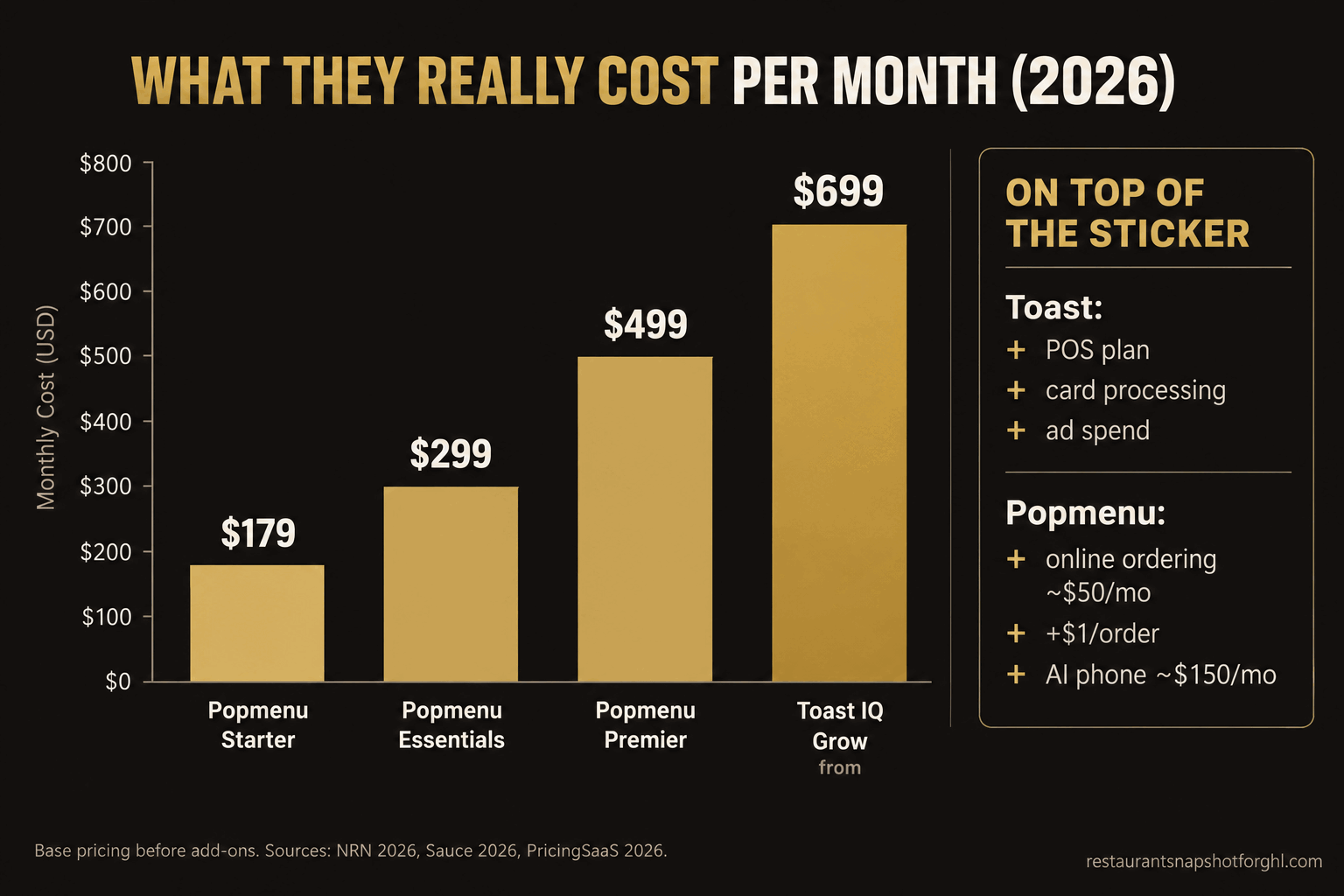
Read those lines against the margin math. The National Restaurant Association projects $1.55 trillion in industry sales for 2026 and about 15.8 million jobs, but the same report found 42% of operators weren’t profitable in 2025 (NRA, 2026; WTOP, 2026), on net margins of 3% to 5% (Level CFO, 2026). At a 4% margin, a $699 tool has to drive roughly $17,500 in extra monthly sales just to pay for itself. That is the number that belongs on the whiteboard, not the subscription.
The Eight-Point Comparison
Pricing is one axis. Here is the honest head-to-head across the eight things that decide it.
| Criterion | Toast IQ Grow | Popmenu |
|---|---|---|
| Starting price | From ~$699/mo (was $499 at May launch) (NRN) | $179–$499/mo base (Sauce) |
| What runs the marketing | AI Marketing Agent + human success manager | You and your team, with Popmenu’s tools |
| Core channels | Email, SMS, social, paid ads | Website, email, social, SMS (tiered) |
| SMS included | Bundled, usage not publicly capped | 500/mo (Essentials), 5,000/mo (Premier) |
| Website / online ordering | Separate Toast products | Website included; ordering is a paid add-on |
| Requires | A Toast POS plan + processing fees | Nothing; POS-agnostic |
| Guest data lives | Inside Toast | Inside Popmenu |
| Best fit | Toast shops wanting hands-off campaigns | Independents needing a strong site + direct ordering |
Three rows decide it. Who runs the marketing is the biggest split: IQ Grow does the work for you (the agent proposes, you approve, it sends), while Popmenu hands you the tools and expects you to drive. Requires is where the real money hides: Popmenu runs on any POS, so the base plan is close to the floor, but IQ Grow only exists if you are a Toast customer, so the honest cost is IQ Grow plus your POS plan plus processing on every check (we detailed that stacking in what Toast’s marketing tools cost). Guest data lives inside whichever platform you pick, and that line outlasts the contract: leave Toast and the audiences built on its data stay behind; leave Popmenu and your website, menu and reviews funnel go dark. Both are renting, with different landlords.
Three Real Budgets: Solo, Busy Independent, Small Group
The right answer genuinely changes with your size. Run the framework three ways.
The solo operator (one room, tight margin). IQ Grow at $699 is almost certainly too much for one room: $8,400 a year before ad spend, chasing covers you could often recover with a reminder text and a win-back. Popmenu Starter at $179 gets you a sharp site, but the marketing lives on Essentials ($299) and ordering is another quote. The higher-return move is usually to spend less on the platform and more on the follow-up: a reminder that stops the no-show, a win-back at 45 days, a specials text to people who opted in, run from a system you own.
The busy independent (one full room, real volume). Here the math shifts. You have the traffic and data for an AI agent to work with, so IQ Grow can pay off if you are already all-in on Toast and have no one to run campaigns. Budget $699 plus processing, and hold the agent to a real number: extra covers on slow dayparts, not “engagement.” Popmenu Premier at $499 plus ordering is competitive if your bigger gap is the website and direct orders that dodge marketplace commissions.
The small group (two to five locations). Both get expensive and hard to read here. IQ Grow is per-location on a per-location POS, so a three-room group faces roughly $2,100 a month in subscription alone. Popmenu doesn’t publish per-location rates; trackers report roughly $300 per added location, so a three-location group can clear $1,000 to $1,500 a month fast with base plans and add-ons (Zay-OS, 2026). At group scale, one shared system with a single guest database and no per-door fee is usually cheaper and easier to control than stacking either platform across every room.
Where Each One Breaks
The demo shows the happy path. Here is where each one breaks for a small operator, because the failure modes are what nobody prices for you.
Toast IQ Grow, where it breaks. The price moved 40% in five months, from $499 to $699, so the introductory number is not a promise (NRN, 2026). Because everything runs on Toast, switching POS later means abandoning the marketing engine too. What to do: treat IQ Grow as a one-year commitment you re-evaluate at renewal, hold it to a covers number, and never let it be the reason you cannot leave Toast.
Popmenu, where it breaks. The $179 Starter is the easy yes, and the parts that fill tables (ordering, phone answering, catering) are the quotes that come after (Sauce, 2026). If phone coverage is your real problem, that feature pushes you to the $499 Premier tier or a $150 add-on, and multi-location pricing is invisible until you negotiate. What to do: get the all-in quote in writing, per location, per month, with every add-on, onboarding fee and renewal rate named, before you sign.
The failure both share. Neither tool fixes a quiet follow-up. A pretty website with no win-back, or an AI agent blasting a list that never opted in, both end the same way: money out, no covers in. The platform never fills the table. The message and its timing do.
Steal This: The Messages That Earn the Spend
Whatever platform you pay for, these are the messages that move covers. Copy them, change the names, and make sure every recipient opted in. Neither a $699 agent nor a $179 website does this unless you tell it exactly what to say.
The no-show saver (sent 24 hours before a booked table):
Hi [first name], it’s [restaurant]. Looking forward to seeing you tomorrow at [time] for [party size]. Reply C to confirm or R if your plans changed. Either way your table’s held; confirming just helps our kitchen.
The slow-Tuesday fill (sent Monday afternoon to opted-in locals):
[Restaurant] here. Tuesday’s quiet and the kitchen’s got room to play: [chef’s special] is on tomorrow night. Walk in or book at [link]. Reply STOP to opt out anytime.
The win-back (sent to a regular you haven’t seen in 45 days):
We miss you at [restaurant], [first name]. It’s been a minute. Your table’s waiting and your first round’s on us this week. Book here: [link].
The review request (sent 2 hours after the check is paid):
Thanks for dining with us tonight, [first name]. If we got it right, a quick review means the world to a small place like ours: [Google review link]. If anything was off, reply here first and the owner will see it.
That last one keeps a bad night off your Google listing: unhappy guests route to you, happy ones to public reviews. We built the full flow in restaurant review automation, and the same logic belongs in whatever platform you choose.
The Compliance Part Nobody Mentions on the Demo
Here is the sentence that should scare you more than the price: the classic restaurant violation is texting a promo to a list you collected at the host stand. Under the TCPA, marketing SMS needs prior express written consent, and A2P 10DLC requires registered campaigns with clear opt-in and opt-out (FCC, TCPA). A number given to hold a table is not consent to receive your Tuesday specials.
Neither platform can give you consent you never collected; they only send what you tell them. If the AI agent blasts numbers gathered without opt-in, the liability is yours, not the platform’s, and TCPA penalties run per message. Before the first send on either system, confirm every recipient opted in with clear language, every message carries a STOP instruction, and your A2P campaign is registered. We laid out the sample consent language and registration steps in TCPA and A2P 10DLC for restaurant SMS and the broader playbook in restaurant SMS marketing done right.
Objections, Answered Straight
“IQ Grow is AI-run, so isn’t it worth more?” Maybe, if you have zero marketing time and real volume for the agent to learn from. But $699 a month is a premium for hands-off, and the agent only knows what Toast knows about your guests. For a single room, the same no-show saver and win-back above, sent from a cheaper system you control, often beat a generic AI blast. Pay for hands-off only when your time is the bottleneck.
“Popmenu is cheaper, so isn’t it the obvious pick?” Only if your real problem is the website. The $179 base is a website plan. Add the marketing tier, ordering and phone answering and a busy independent lands around $400 to $600 all in, closer to Toast than the sticker suggests. Price the whole thing, not the entry point.
“I’m already on Toast, so IQ Grow is easiest, right?” Easiest, yes; best, not automatically. Convenience is exactly how a $699 line gets added without anyone checking whether it drives covers. Pilot it for a defined period against a covers target and cancel if it misses. And if you don’t want to rent your guest list from anyone, neither is your end state: both keep your audience inside their platform, while a system you own outright means leaving a vendor never means leaving your guests.
Frequently Asked Questions
How much does Toast IQ Grow cost per month in 2026?
It launched in May 2026 at $499 a month and, by the October 2026 fall release, the trade press reported it starting at $699. That sits on top of your Toast POS plan ($0 Starter Kit or $69/mo Point of Sale) and card-processing fees, with ad spend billed separately. Treat $699 as a floor, not a ceiling, because the price has already moved once.
How much does Popmenu cost compared to Toast IQ Grow?
Popmenu's base plans are $179 (Starter), $299 (Essentials) and $499 (Premier) a month for one location, about 10% off annually, with ordering, catering and AI phone answering as paid add-ons. So its entry is far cheaper than IQ Grow's ~$699, but a fully loaded Popmenu setup for a busy room can reach $400 to $600 all in. Popmenu also runs on any POS, while IQ Grow requires Toast.
Is Toast IQ Grow or Popmenu better for a single independent restaurant?
For one room on a tight margin, IQ Grow at $699 is usually more spend than the location can justify, and Popmenu is really a website plan until you add the marketing tier. Both leave your guest data inside their platform. A solo operator often gets the same no-show reminders, specials blasts and win-backs from a system it owns, for less, which keeps the guest list portable.
Does either platform handle reservations?
No. IQ Grow is an AI marketing product and Popmenu is a website, ordering and marketing platform. Neither is a reservation network like OpenTable or Resy, so if reservations are your core need, compare the booking platforms separately.
What happens to my marketing if I leave Toast or Popmenu?
You lose the engine you built inside it. IQ Grow runs on Toast's POS data, so leaving Toast abandons the audiences tied to it; Popmenu owns the website and menu your presence lives on. In both cases the relationship is rented, and owning your list in a system you control is the only way leaving a vendor doesn't cost you your audience.
Are Toast IQ Grow and Popmenu TCPA compliant out of the box?
The platform sends what you tell it to; the consent is your responsibility. TCPA and A2P 10DLC require prior express written consent and a clear opt-out for marketing SMS, and a number collected to hold a table is not consent to text promotions. Neither vendor shields you from a violation if you blast a list that never opted in, so register your A2P campaign and confirm opt-in before the first send.
Related reading
- What Toast’s marketing tools actually cost in 2026
- What Popmenu costs in 2026, add-ons and all
- Best OpenTable alternatives for independent restaurants
- Own your restaurant guest list instead of renting it
- TCPA & A2P 10DLC: what restaurants must know before sending one SMS
- Get the done-for-you system installed in 24 hours
Sources
- Toast IQ Grow pricing & features: BusinessWire (2026); NRN (2026); Toast POS base & fees: UpMenu (2026), Owner (2026)
- Popmenu pricing & add-ons: Sauce (2026); PricingSaaS (2026); Zay-OS (2026)
- Industry, margins & compliance: NRA 2026; WTOP (2026); Level CFO; FCC TCPA