
It is 7:45pm on a Saturday and the room is full. A party of four walks in, no reservation, and asks how long. Your host guesses “maybe forty-five minutes” and watches their faces fall. They write a name on the paper list and say they will “walk around and come back.” Twenty minutes later a table opens, you call the name twice into a loud room, nobody answers, and you seat the next walk-in. That four-top is three blocks away by now, eating someone else’s food.
That felt like a good night. You were slammed. But a busy Saturday is when you leak your best future regulars: that four-top was four people who might have come back on slow Tuesdays for two years, and you never even got a phone number.
Table of Contents
- The 30-second answer
- What a walk-away actually costs you
- The 6-stage waitlist system
- Steal this: the exact waitlist texts
- Run it for your size: solo, busy independent, small group
- Paper list vs a real waitlist system
- Can you legally text your waitlist?
- Objections, answered straight
- Frequently asked questions
The 30-Second Answer
Stopping walk-in bleed is not about a bigger room or faster tables. It is about never letting a guest stand at your door with nothing but a guess and a paper list. Capture their name and cell on arrival, quote a wait you can actually hit, let them wander with a text in hand, and ping them the second a table opens instead of yelling a name nobody hears. Then save those numbers for your slow nights. Below is the six-stage system, the exact texts, and how to run it at any size.
What a Walk-Away Actually Costs You
Start with the obvious loss: a $160 to $240 check you will not ring tonight. That is the smallest part of the bill. The bigger cost: they may never come back. Lightspeed surveyed 1,000 U.S. consumers in 2025 and found long waits are a real deal-breaker: 27% said a long wait would keep them from returning, and nearly one in three said they have walked out of a restaurant before even ordering (Lightspeed, 2025). For a quarter of them, a long wait is the reason they pick the place down the street next time.
Share of U.S. diners who say each problem would stop them returning. Long waits sit alongside cold food. Source: Lightspeed 2025 consumer survey, 1,000 U.S. consumers.
Now stack on what the paper list throws away. Repeat guests drive roughly 60% of restaurant revenue, measured across more than 100 million guest records (Olo, 2024). When a walk-in’s name and cell live on a legal pad that gets tossed at close, you threw out a repeat guest with the paper.
It is the same math as a no-show, which OpenTable’s 2026 survey pegs at about $80 for a table of two (Nation’s Restaurant News, 2026), except a good waitlist fills that hole in minutes. With only 42% of operators profitable last year (National Restaurant Association, 2026), a half-full room on your busiest night is leakage you learned to live with.
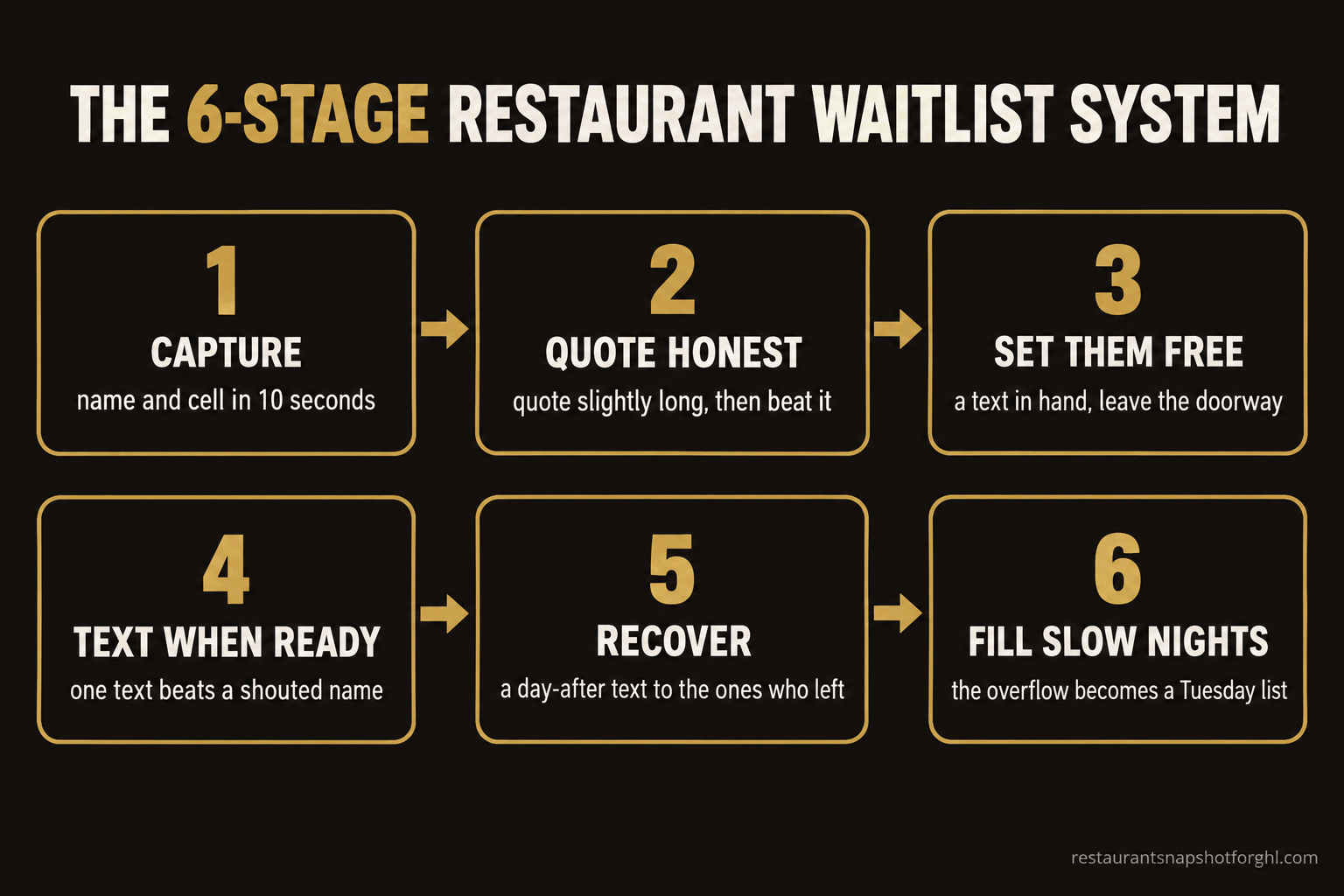
The 6-Stage Waitlist System
A waitlist is a relay, and you drop the baton at the handoffs. Here are the six stages, and for each, how it breaks and how to fix it.
Stage 1: Capture the walk-in, name and cell, in ten seconds
The moment a guest asks “how long for two?”, your host enters a name and a mobile number into one place, not a first name on paper. Ask for three things: name, party size, and the best cell. One sentence does it: “I’ll text you the second your table’s ready, what’s the best number?”
How it breaks: the number dies on a paper list at close and no guest record survives. The fix: capture it digitally so the contact lives on, turning a busy Saturday into a list you can use in January. More on why that list matters: how to own your restaurant guest list.
Stage 2: Quote a wait you can actually hit
The fastest way to lose a guest is to quote 30 minutes and seat them in 55. A wait longer than promised is a big reason a quarter of diners do not come back. So quote slightly long and beat it: if the real wait is 40 minutes, say 50. Guests seated early feel like they won; those who wait past the quote feel lied to.
How it breaks: the host guesses from the gut on the busiest night, always optimistically. The fix: base the quote on how tables are actually turning tonight, and pad it. A guest seated ten minutes early is in a good mood before the first drink lands.
Stage 3: Set them free with a text in hand
The quiet upgrade a waitlist unlocks: the guest does not have to stand in your entryway. On the list with a number, they can grab a drink at the bar or walk the block. A resentful crowd at the door becomes guests who feel looked after, and your bar picks up a few extra rounds.
How it breaks: you tell them to wander but still call the name out loud, so the ones who left never hear it. The fix: commit to the text. On the list means a text, every time, so they can leave and keep their place.
Stage 4: Text the second a table opens, don’t shout a name
A table clears. Instead of calling a name into the din, you send one text: “Your table’s ready.” This is where SMS earns its keep: 32% read a new text immediately and 87% within 15 minutes (EZ Texting, 2026). A name shouted over a Saturday crowd reaches no one who stepped outside; a text reaches almost everyone.
Share of U.S. consumers who have read a new text by each point (cumulative %), which is why a table-ready text beats a shouted name. Source: EZ Texting 2026 Consumer Texting Behavior Report, ~959 U.S. adults.
Send a two-minute warning first, then the “ready now” text, and hold the table a stated grace period (five to seven minutes is fair). How it breaks: you release the table 90 seconds later and a guest who stepped into the bathroom loses it. The fix: a stated grace window, plus that warning text so they are already walking back when the table clears. This same fast-text muscle powers missed-call text-back and no-show recovery.
Stage 5: Recover the ones who walked
Some guests give up and leave before a table opens. If someone drops off the list or ignores the ready text, send one honest follow-up the next day: a short apology and a reason to come back on a quieter night. You already have their number from Stage 1, so recovery costs nothing but a line of copy.
How it breaks: you treat a walk-away as a dead loss, so a bad first impression sticks forever. The fix: a day-after text that owns the wait and offers an easy return on a night you want to fill. That is how a Saturday you were too busy for becomes a Tuesday booking.
Stage 6: Turn the overflow into a slow-night engine
This is the stage almost nobody runs, and where the money is. Every name you captured on your busiest nights already wanted to eat with you, the warmest list in your building. With consent, text them a standing slow-night offer: a Tuesday chef’s special, a Monday bar deal. You are not discounting Saturday; you are using its demand to feed your dead Tuesday.
How it breaks: the numbers sit in your system unused because nobody owns the follow-up, or you blast a promo without consent and land in TCPA trouble. The fix: a simple, consent-based win-back flow that runs on a schedule, not on somebody remembering. For the full playbook on filling the quiet nights, read how to fill slow weeknights without discounting.
Steal This: The Exact Waitlist Texts
Here is the copy. Swap in your details, keep it short and human, and keep a STOP opt-out on any marketing message.
Messages 1 through 3 are operations and fire automatically. Messages 4 and 5 are marketing, so they only go to guests who opted in and carry the STOP line. That separation is the whole compliance story.
Run It for Your Size: Solo, Busy Independent, Small Group
The six stages are the same at every size; what changes is who runs them.
The solo owner or small bistro. Your enemy is the rush eating your attention when the door is busiest. Automate everything that does not need a human: confirmation, warning, ready text, and recovery all fire on their own. You tap a name when a table clears, and add a personal line to the slow-night invite, because a small place wins on the owner’s voice.
The busy independent with a host team. Your enemy is inconsistency between hosts, one quoting 20 minutes and the next 45 for the same room. Standardize the quote on real table turns, keep the host-stand script by the stand, and route every number into one guest list so a name entered Friday is reachable by the Tuesday win-back.
The two-to-five-location group. Your enemy is a guest list trapped in silos. Run one central waitlist and one database across every location, so a diner who waited too long downtown can be invited to the uptown room. When one spot is slammed and another has tables, a shared list moves the overflow.
Paper List vs a Real Waitlist System
| What happens | Paper list at the stand | A real waitlist system |
|---|---|---|
| Guest arrives, no table | First name scribbled, no number | Name and cell captured in 10 seconds |
| The wait | Guess, usually optimistic | Quoted on real table turns, padded |
| While they wait | Stuck crowding your doorway | Free to roam with a text coming |
| Table opens | Name shouted twice, often missed | One text, read within minutes |
| Guest who left | Gone for good | Day-after recovery to a slow night |
| After close | List in the trash | Owned guest records for win-backs |
The paper list is not free. It costs you the data every night, and the data is the asset.
Can You Legally Text Your Waitlist?
Short answer: yes for the booking itself, with real limits on the marketing.
When a guest hands you their cell so you can tell them their table is ready, texting about that table is exactly what they asked for. Those operational texts are fine. What you cannot do is take that number and start blasting Friday happy-hour promos, because that is marketing, and U.S. marketing texts fall under the TCPA and the A2P 10DLC rules carriers now enforce: clear prior express consent, a working STOP opt-out you honor immediately, and a registered texting number.
The clean way to run it: use the waitlist thread for the waitlist, and ask separately whether they would like occasional offers. Only the ones who opt in get the slow-night invite. Keep the two streams apart and you stay compliant while still mining your busiest nights for repeat covers. We go deep on the consent language in our TCPA compliance guide for restaurant SMS.
Objections, Answered Straight
“We’re always slammed anyway, why chase the ones who leave?” Because being slammed tonight does not fill you next Tuesday, and a guest who left angry tells other people. The waitlist turns tonight’s overflow into a list that fills the nights you are not slammed.
“Won’t guests find a text annoying?” The opposite. The annoying experience is standing in a crowded doorway straining to hear a name. A text that frees them to grab a drink is a favor. The only text that annoys people is a marketing blast nobody asked for, which is why Stage 6 is consent-based.
“We already use OpenTable or Yelp for this.” Those tools do run waitlists, but the guest relationship and data often live on the platform, not with you, and the platform can charge for the audience you built. OpenTable’s published plans start at $149 a month plus a per-cover fee (OpenTable pricing), and third-party listings put Yelp Guest Manager in the $99 to $299 a month range (G2). The point here is the numbers end up in your database, so you are not renting your guest list back. For the full breakdown, see what OpenTable, Resy, Tock, and SevenRooms really cost.
“My host is too slammed to type names into an app.” Capturing a name and number takes about ten seconds, less than writing it legibly and shouting it later. And it is the highest-value thing your host does all night, the only step that keeps the guest.
Frequently Asked Questions
What is a restaurant waitlist system and how is it different from a reservation tool?
A waitlist manages walk-in guests who arrive without a booking: it captures their name and cell, quotes a wait, and texts them when a table opens. A reservation tool books tables in advance. Most independents need both, but the walk-in waitlist is where a packed night quietly leaks guests, because a paper list cannot reach someone who stepped outside. See our guide to owning your guest list.
How long should I quote for a wait?
Quote slightly longer than the real wait and beat it. If the room is turning at about 40 minutes, say 50. A guest seated early feels like they won; a guest seated later than promised feels misled, and long waits keep 27% of diners from returning (Lightspeed, 2025).
Is it better to text guests or call out their name?
Text them. A name called over a Saturday crowd misses everyone who stepped out, while 87% of people read a new text within 15 minutes (EZ Texting, 2026). A text also lets the guest leave the doorway and come back, which empties your entryway.
Can I text my waitlist guests promotions later?
Only with their consent. Texting about the table they are waiting for is fine, because they gave you the number for that purpose. Marketing texts require clear prior express consent under the TCPA and A2P 10DLC rules, plus a working STOP opt-out. Ask separately whether they want offers, and only text the ones who say yes. Details in our TCPA guide for restaurant SMS.
Do I need special software, or can I just use my phone?
Start with any tool that captures a name and cell into a record you keep, not a paper list. The non-negotiables: the number lives in your own guest database, the table-ready and recovery texts fire quickly, and marketing texts stay separate and consent-based. A restaurant CRM like the one in our SMS automation and appointment automation features bundles all of that, and feeds the slow-night win-backs in how to fill slow weeknights without discounting.
Back to That Saturday
Run the night back. It is 7:45pm, the room is full, the party of four walks in. This time your host says, “About 50 minutes, I’ll text you the second your table’s ready, so grab a drink, what’s the best cell?” They order a round at the bar and wander next door. At 8:30 a text goes out and the four-top is back before the busser finishes the table. The next morning their number is in your system, so they get a note about your quiet Tuesday special, and three weeks later they are in your dining room on a night you were desperate to fill.
That is the difference between a paper list and a system. The demand was always there; the waitlist is how you stop pouring it down the drain and turn a full Saturday into a full Tuesday. Want more covers from guests you already have? Read how to win back lapsed diners and why your restaurant is slow on weeknights next.