
The plywood came off the windows two doors down six weeks ago. New awning, exposed-bulb lights, a line out the door on opening weekend. You walked past on your night off and your stomach did a small flip. Then last Tuesday the Hendersons weren’t at their usual six o’clock four-top. The week after, the couple who always split the branzino didn’t come in either. Same food, same prices, same team. They just stopped showing up, and you have a pretty good guess where they went.
This is the quietest way a restaurant bleeds: a newer, shinier room pulling your regulars into its orbit one dinner at a time. Here’s what happens to your base when a competitor opens nearby, what that drift costs you, and the step-by-step system to catch the ones drifting and make your place the habit they don’t break.
Table of Contents
- The 30-second answer
- What really happens when a new place opens
- What the drift actually costs you
- The six-step system to defend your base
- The messages you can steal tonight
- Run the system for a solo spot, a mid-size team, and a small group
- The compliance part you can’t skip
- Objections, answered straight
- Frequently asked questions
The 30-Second Answer
When a new restaurant opens nearby, you don’t lose regulars to its food. You lose them to its novelty, and only if you give them nothing to come back to. Your guests will try the new place; the data says almost two-thirds try somewhere new every month. The ones you lose are the ones who drift, go longer between visits, forget the Tuesday ritual, and quietly rebuild their habit elsewhere, while you have no idea because you can’t see it and can’t reach them.
So the answer isn’t to out-shiny the new room or slash prices. It’s to defend the relationship: know which regulars are slipping before they’re gone, reach them with a real reason to come back this week, and make your place a habit worth keeping. That takes three things most independents don’t have: contact info in a list you own, a way to watch who’s gone quiet, and messages that sound like you. Build that, and a new competitor is a bad weekend, not a death spiral.
What Really Happens When a New Place Opens
Your regulars trying the new spot is not a verdict on your cooking. It’s novelty, and novelty is running hot. In a blind survey of 1,466 US adults in October 2025, Toast found that 64% had tried a new restaurant in the past month, up sharply from 39% the year before (Toast, 2025).
Share of US diners who tried a new restaurant in the past month. The jump from 39% to 64% in a year is the behavior a new opening triggers in your regulars. Source: Toast, 2025 (1,466 US adults).
Two things matter. Guests are adding new places to their rotation, not necessarily deleting yours, and they find them by word of mouth (38%) or by walking past (30%) (Toast, 2025), both of which a spot two doors down nails at once. The trial is guaranteed; what you influence is whether it becomes a habit. The loss happens later and silently, when the new room becomes the default.
What the Drift Actually Costs You
The quiet version is the expensive one. Olo’s analysis of 100 million-plus guest records found that 20% of guests drive about 60% of restaurant revenue (Olo). Your regulars aren’t a nice-to-have; they are the business.
Where restaurant revenue comes from: a small core of repeat guests drives most sales. Lose a slice of that 20% and you lose far more than a few covers. Source: Olo.
Now layer on how leaky the bucket already is. Roughly 70% of guests never return after a visit, and about 65% of one year’s guests don’t come back the next (Olo). You’re already losing guests on a normal week. A new competitor doesn’t create that leak; it widens it where your most valuable regulars sit.
Replacing them is brutal math. Winning a brand-new customer costs 5 to 25 times more than keeping an existing one (Harvard Business Review, 2014), while nudging retention up just 5% can lift profit by 25% or more (Bain & Company). Buy ads for new faces and you pay top dollar to replace guests you could have kept for the price of a text. That stings more now: 42% of restaurants didn’t turn a profit in 2025 (National Restaurant Association, 2026). The covers you’re about to lose are the most profitable and the cheapest to keep.
The Six-Step System to Defend Your Base
You defend a base the way you’d defend anything valuable: know what you have, watch for the first sign of trouble, act while the save is still cheap. Six steps, each with how it breaks and the one thing that fixes it.
Step 1: Know who your regulars actually are
Before you can defend your base, you have to see it, and most independents can’t: a feel for the Hendersons, but no list, no visit dates, no way to answer “who hasn’t been in for a month?” Pull every guest into one place (name, phone, email, last-visit date), where your customer lifetime value lives, and rank them by recency and frequency. The regulars who’ve gone quiet are your bullseye.
How it breaks: the “list” is a shoebox of loyalty cards, a reservation platform that owns the data, and a server’s memory, none of it queryable. The fix: one guest database you own, built from reservations, online orders, Wi-Fi sign-ins, and the host stand.
Step 2: Own the relationship before they open, not after
The best time to lock in a regular is before the competitor’s awning goes up. If you have their number and they hear from you with something worth opening, the new place is a one-off in a rotation you anchor. This is why owning your guest list instead of renting it is the single highest-impact thing you can do: a platform may “have” your guest, but you can’t text them on a slow Wednesday, and it can.
How it breaks: owners assume the booking platform “has the customer covered,” then find they can’t message their own regulars without paying a middleman. The fix: capture contact info into your own CRM from day one, with clear consent.
Step 3: Make the first move before the habit sets
Novelty has a clock. The new place is brightest in its first month, then guests settle back toward their defaults, but only if their default is still active in their life. Stay present in that window without looking rattled: a warm, specific note from the owner, a reason to come in this week, a nod to the regular’s actual order.
How it breaks: the owner either does nothing and hopes, or overreacts with a desperate 30%-off-everything that screams weakness and trains guests to wait for deals. The fix: a planned, light-touch sequence that lands a genuine reason to come back during the novelty window, aimed first at your highest-value regulars.
Step 4: Catch the drift on recency, automatically
This is the step that wins or loses the war, and the one almost nobody does. When a regular who normally comes weekly hasn’t been in for, say, 21 days, a friendly check-in should fire while the relationship is still warm. Wait until they’ve been gone 90 days and you’re not reminding a regular, you’re cold-pitching a stranger who used to love you. We go deep on the signals in why regulars stop coming in.
How it breaks: you only notice churn when a whole section goes cold, three months too late and ten times harder to reverse. The fix: an automatic recency trigger tied to each guest’s normal rhythm, so the nudge goes out the week they break pattern.
Step 5: Win back the ones who already strayed
Some regulars will already be gone by the time you build this. A win-back campaign with a silent trigger pulls a real share of them home, because “we haven’t seen you, here’s your table” lands differently than any ad. It has to be specific and human, reference what they used to order, and give an easy yes. The guest who tried the new place is still winnable: you have history, the new place has one dinner.
How it breaks: the win-back is a generic “come back, 15% off” to the whole list, reaching people who never left and insulting the ones who did. The fix: target lapsed regulars by name, with a message that remembers them, and measure who comes back.
Step 6: Make your place the habit, not the occasion
The permanent defense is ritual. Occasions are vulnerable to novelty; habits aren’t. The birthday club, the regulars’ table, the loyalty program that runs without paper stamps, the Sunday-night text about Wednesday’s special: these make your room part of a guest’s week instead of a place they visit when they remember. A guest with a running habit tries the new spot and comes right back.
How it breaks: the “loyalty program” is a punch card nobody fills and a birthday email nobody automated, so there’s no ritual, just the hope of one. The fix: a few automated touches that create rhythm, running whether or not anyone remembers to send them.
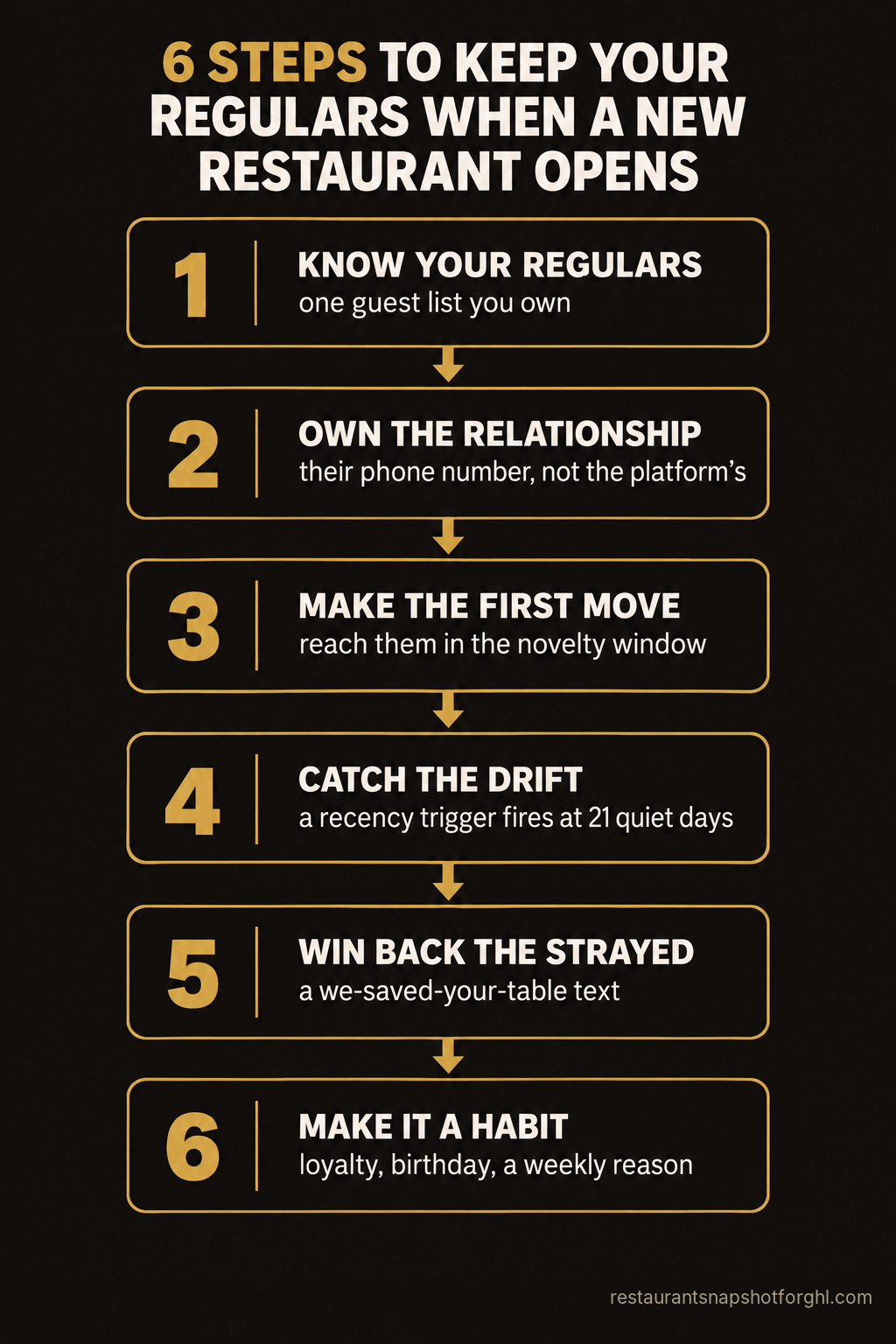
Five of these six steps have nothing to do with your menu and everything to do with reach: who you can see, who you can message, and whether you catch the drift in time. That’s buildable in a week; a better kitchen takes years.
The Messages You Can Steal Tonight
Here’s the actual copy. Steal it, swap your name and your regular’s order, keep it in your own voice. The rule: a text that reads like a coupon machine gets muted; a note that reads like the owner typed it gets a table.
The check-in, for a regular who’s gone a little quiet (Steps 3 and 4):
Hi Dana, it’s Gina at Marlow’s. Noticed we haven’t seen you and your usual window two-top in a few weeks and wanted to check in. We’ve got the short-rib ragu back on this week, your favorite. Save you a table Thursday or Friday? Reply with a day and I’ll hold it.
The novelty-window touch, for your top regulars the week they open (Step 3):
Hey Marcus, Gina here. Quiet little thank-you to our regulars: come in before Sunday and dessert’s on us, no strings. It’s been too long since we caught up at the bar. Reply YES and I’ll have the kitchen ready for you.
The win-back, for a regular gone 60 days or more (Step 5):
Dana, it’s Gina at Marlow’s. It’s been a while and we miss having you in. Your table by the window is still the best seat in the house and the branzino’s still the move. Come in this week and your first glass is on me. Want me to hold Friday at 7?
The weekly reason, fully automated (Step 6):
Midweek plan sorted: Wednesday it’s $28 bouillabaisse and live guitar from 7. Regulars get first pick of the bar. Want me to hold two seats?
What makes these work: they name the guest, reference a real detail, give one clear action, and never blanket-discount the whole menu. Every automated marketing text carries a working opt-out, both the law and basic respect. Full playbook on timing and segments in restaurant SMS marketing.
Run the System for a Solo Spot, a Mid-Size Team, and a Small Group
The six steps don’t change. How much you automate and how you staff them does.
The solo owner-operator (one room, you do everything). You don’t have time to watch a list, so automation does it all: a guest database, a 21-day recency trigger, a monthly “we miss you” win-back, a weekly specials text. Ten minutes a week to see who came back. You hand-text only your very top regulars, because for a handful of people a personal note beats any system.
The mid-size team (one busy room, a manager, 10 to 30 staff). Run segments: top regulars, occasional guests, and lapsed, each a different message. Your manager owns the dashboard, flags who’s drifting weekly, and assigns the personal touches. Triggers and win-backs run automatically, but a human answers “reply YES” within the hour, because speed is the whole point in a crunch.
The small group (two or three locations). The risk is a competitor opening near one location while the others are fine, unnoticed until the quarterly numbers land. Run one shared database with per-location views, standardize the templates, let each location fire its own win-backs, and put one person in charge of retention.
The Compliance Part You Can’t Skip
The fastest way to turn a smart retention play into a legal headache is to text people who never agreed to hear from you. Marketing texts in the US fall under the TCPA and A2P 10DLC rules, and the classic violation is exactly what tempts a panicked owner: blasting a promo to every number you ever collected at the host stand.
The clean version is simple. Get clear prior express written consent before marketing texts (a checkbox or keyword opt-in), keep booking texts separate from promo texts, and put a working STOP opt-out on every message. Register your sending number for A2P 10DLC so texts deliver instead of getting filtered. Full breakdown in our TCPA and A2P 10DLC guide. Skipping it risks fines that dwarf whatever the new place could cost you.
Objections, Answered Straight
“If my food’s good, my regulars come back on their own. Why do I need a system?” Some will. Most won’t, not because your food slipped, but because habits are fragile and life is busy (remember, 70% of guests never return even in normal times, per Olo). Good food gets a guest in the door. It doesn’t, by itself, pull them back the week a brighter option opens next door. A gentle, timely reason does.
“I can’t out-spend the new place on marketing.” Good, because you shouldn’t try. They’re spending to acquire strangers, which costs 5 to 25 times more than keeping the regulars you have (Harvard Business Review, 2014). Your advantage isn’t budget, it’s history: you know these guests and reaching them costs the price of a text.
“I’m not technical. This sounds like a CRM project I don’t have time for.” It’s the opposite of a project once it’s built. The watching and messaging run automatically, so the only ongoing work is reading who came back and sending a few personal notes to your top regulars. If setup is what’s stopping you, that’s what a done-for-you install is for: the system without learning the software.
Run it back to the Hendersons. Do nothing and you learn they left when the month closes soft. Build the system and a trip-wire fires the week they go quiet, a note about the short-rib ragu lands in Dana’s pocket, and they’re back by Friday, grumbling happily that the new place was fine but the branzino here is better. Same food, same prices. This time you saw them going, and reached out before the habit moved.
Frequently Asked Questions
A new restaurant just opened near me. How worried should I be about losing my regulars?
Worried enough to act, not enough to panic. Your regulars will almost certainly try it, since about 64% of US diners try somewhere new in a given month (Toast, 2025). The trial isn't the threat; the quiet drift afterward is. If you can see who's slipping and reach them directly, a new opening is a bad weekend, not a crisis.
Should I run a discount to compete with the new place?
Not a blanket one. An all-menu discount mostly reaches regulars who'd have come anyway, so you hand money back on your most loyal people and train everyone to wait for deals. Winning a new customer costs 5 to 25 times more than keeping one (Harvard Business Review, 2014). If you offer anything, make it a small, time-boxed gesture aimed at your top regulars during the novelty window, not a fire sale.
How do I know which regulars are drifting before they're fully gone?
By recency. Track each guest's normal rhythm and flag the ones who've broken it. A weekly regular who hasn't been in for three weeks is drifting now; a 90-day gap means they're already gone and much harder to win back. An automatic trigger catches it the week it starts, as we cover in why regulars stop coming in.
Is it legal to text my guests a promo to bring them back?
Yes, with consent. Marketing texts require clear prior express written consent under the TCPA and A2P 10DLC rules, plus a working STOP opt-out, and your sending number should be registered for A2P 10DLC so texts deliver. Keep booking texts separate from promo texts. Full detail in our TCPA and A2P 10DLC guide.
My guest list is a mess of reservation data and loyalty cards. Where do I start?
Get it all into one place you own: name, phone, email, and last-visit date, pulled from reservations, online orders, Wi-Fi sign-ins, and the host stand. The point is a single database you can query and message, not one a platform controls. See how to own your guest list instead of renting it.
Related Reading
- Why Regulars Stop Coming In (and Never Tell You). The warning signs of a drifting regular, caught early.
- How to Own Your Restaurant’s Guest List Instead of Renting It. The foundation that makes any of this possible.
- Win Back Lapsed Diners with a 60-Day Silent Trigger. The automated campaign that pulls strayed regulars home.
- How to Turn First-Time Diners Into Regulars. The same engine, pointed at new faces.