
It is Saturday at 9pm and the room is perfect. Every table is full, the energy is up, a four-top is on their second bottle, telling the server it is the best meal they have had all year. You will never see most of them again.
That is the quiet problem under a busy restaurant. You spend money getting a stranger in once, they have a great time, then they vanish into the rotation of twenty other places. The first visit is not the win. It is the audition. The win is the second visit, because a guest who comes back twice is on the path to regular, and regulars are the whole business.
Here is the short version, then we build it. You turn a first-timer into a regular by owning a way to reach them, following up in a tight window after that first meal, and giving them a dated reason to come back before they forget how good it was. No discount required, and almost none of it done by hand.
Table of Contents
- Why the second visit is the whole ballgame
- The second-visit system, start to finish
- Stage 1: Capture the guest before they leave
- Stage 2: Tag who they are and why they came
- Stage 3: Follow up in the 48-hour window
- Stage 4: Give them a dated reason to return
- Stage 5: Make the second visit feel recognized
- Stage 6: Hand the regular to an automatic loop
- Three restaurants, three plans
- The compliance line you cannot skip
- Objections, answered straight
- FAQ
Why the Second Visit Is the Whole Ballgame
The short answer: a first visit proves nothing, and a second visit changes the math of your whole business. The first time, someone is deciding whether you are a place or just a meal. The second time, they are making you a habit, and that shift is where profit lives.
Guest value climbs with repeat visits. Bloom Intelligence’s analysis of restaurant guest data shows average spend rising sharply as a one-time diner becomes a frequent one: roughly $36 at a single visit, $88 across two to four visits, and $241 across five to nine (Bloom Intelligence). The guest who comes back is not one more cover. They anchor a growing share of your revenue and bring friends.
Average guest spend rises steeply with repeat visits. The gap between a one-time diner and a returning one is where the money is. Source: Bloom Intelligence guest-data analysis.
Now add the retention economics. Winning a brand-new customer costs 5 to 25 times more than keeping one you already served, and a 5 percent lift in retention can raise profits 25 to 95 percent (Harvard Business Review, 2014). The people already in your room are the cheapest, warmest audience you will ever have, and most operators let them walk out with no plan.
That last number is why discounting your way to a second visit is a trap. Full-service restaurants run net margins of about 3 to 5 percent (Toast, 2026), so a “come back for 25 percent off” offer can erase the very profit the second visit was meant to create. It has to be earned with recognition and a reason, not bought with a markdown.
The Second-Visit System, Start to Finish
The system is six stages, each set up once and left to run. Not a heroic marketing push, but a quiet machine that catches first-timers, remembers them, and nudges them back before the memory fades.
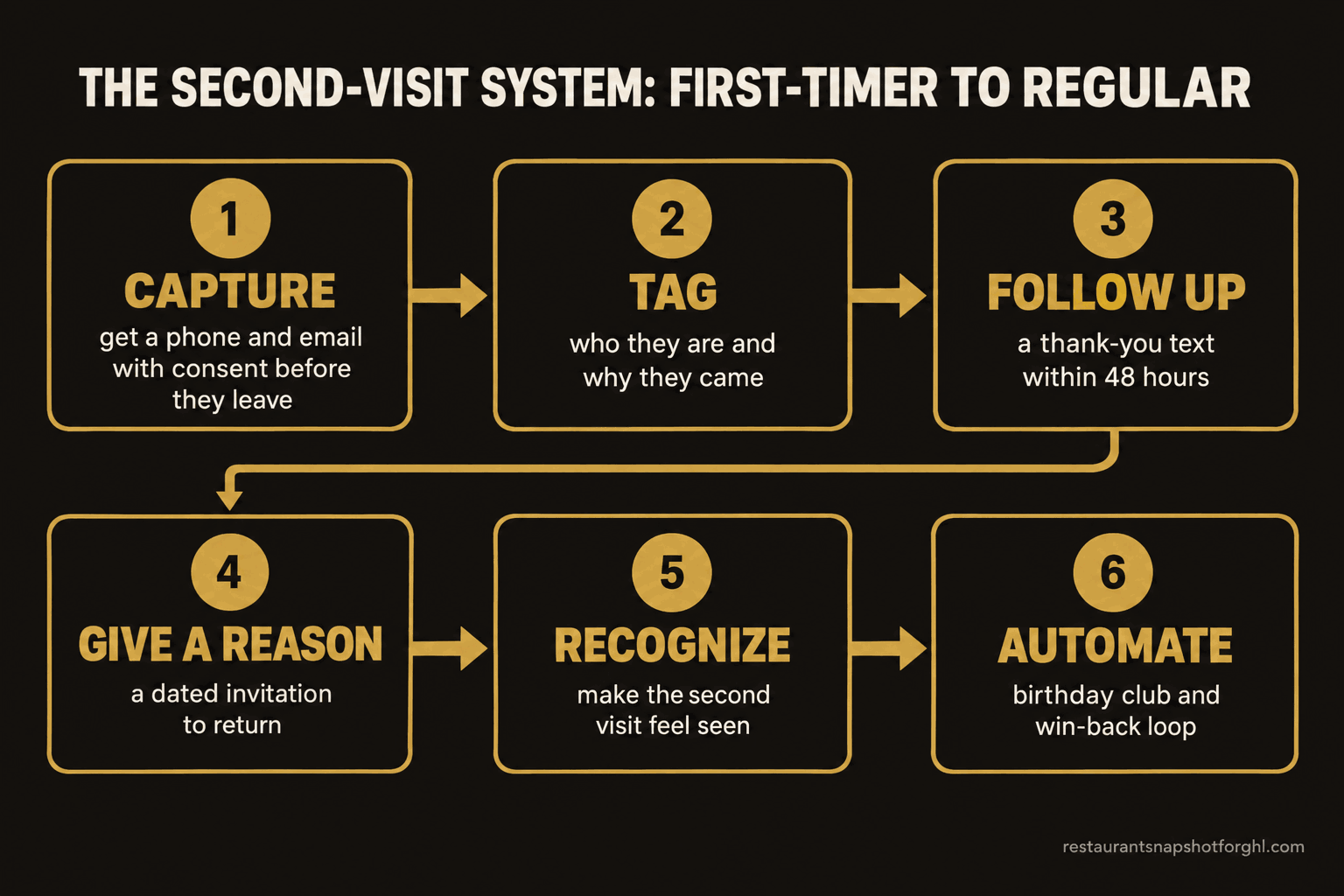
Stage 1: Capture the Guest Before They Leave
You cannot invite back a guest you have no way to reach, and this is the stage everyone skips. If the only record of tonight’s four-top is a reservation inside OpenTable or a ticket in your point-of-sale, you have a transaction, not a relationship. You need a phone and email, given with consent, that you can message any day for free.
Capture without turning the end of a great meal into a form. The lightest-touch methods win: a receipt-by-text option at payment, a table-tent QR code offering something small in return, a Wi-Fi splash page, or a quick ask at online booking. Each is a moment where a guest who just had a good time is glad to stay in touch. We go deep in how to own your guest list instead of renting it.
How it breaks: you collect numbers with no consent language, which makes them legally unusable, or you capture nothing and rely on the guest to remember you. Build capture into the flow of service so it happens every night without anyone thinking about it.
Stage 2: Tag Who They Are and Why They Came
A name and number is a start. What turns it into a second visit is context. The follow-up that delights a couple who came for an anniversary feels wrong to a family who stopped in on a Tuesday, and wrong again to coworkers on an expense account.
You do not need a data team. You need four or five simple tags your staff or system sets as the guest interacts with you: first-time versus returning, the occasion if there was one (birthday, anniversary, date, business), party size, anything notable they ordered, and the channel they came through. Those tags let the first follow-up sound like it was written by someone who was there. The mechanics live in our restaurant SMS marketing playbook.
How it breaks: nobody tags anything, so every first-timer gets the identical generic “thanks for visiting” blast. It reads like a chain, and your one shot at a warm follow-up is gone.
Stage 3: Follow Up in the 48-Hour Window
Timing is the part operators get wrong most, and the cheapest to fix. A thank-you the next morning feels warm and personal; the same words three weeks later feel like marketing, because by then they are. Send the first follow-up within 24 to 48 hours, while the guest can still taste the food.
The first message is not a sales pitch. It is a genuine thank-you with one small next step, usually a review ask for the happy ones, which builds the reputation that brings in the next stranger (its own system, in review automation without burning out your staff). A text gets seen fast: SMS vendors report delivery rates near 98 percent, best read as a delivery estimate since texts carry no open tracking (Infobip, 2026). Email, at a restaurant open rate around 31 percent (Klaviyo, 2026), carries the longer story. Text for the time-sensitive touch, email for the richer follow-up.
How it breaks: the follow-up goes out on a monthly schedule instead of per guest, so a first-timer hears from you four weeks after a meal they have half-forgotten. Tie the message to the visit, not the calendar, and let it fire automatically.
Stage 4: Give Them a Dated Reason to Return
A thank-you opens the door. A reason walks them through it. The most common failure here is a message that says “come back soon” with no when and no why. “Soon” is not a date, and a guest with no date does nothing.
The reason should add value without cutting price, and carry a time. A seat at a chef’s counter night this Thursday. The seasonal menu that drops Friday. A members-only tasting next month. Each gives the guest a specific moment to aim at, and the scarcity (12 seats, this week only, first-timers invited) does the work a discount would, without training anyone to wait for a deal. To design these without denting your margin, see filling slow weeknights without discounting.
How it breaks: the invitation is really a coupon in a costume, so the guests who return were price-shopping anyway and never become regulars. They move the moment the next place undercuts you. Lead with access and experience, and the second visit sticks.
Stage 5: Make the Second Visit Feel Recognized
This is the stage almost nobody builds, and the one that actually creates a regular. When the first-timer you nudged comes back, the system should tell your floor who they are before they sit down, so they are not treated like a stranger on the visit where they hoped to belong.
It can be small. A note on the reservation that this is their second visit, and they came for an anniversary last time. A server who says “welcome back” and means it. A kitchen that remembers they loved the short rib. That recognition flips the guest from “I tried that place” to “that’s my place.” Making it automatic is the job of our CRM and workflow automations.
How it breaks: the marketing gets them in the door and then the floor treats them like a cold lead, so the second visit feels identical to the first and nothing suggests a third would differ. Close the loop between the data and the floor, or the system stalls one step from the finish.
Stage 6: Hand the Regular to an Automatic Loop
Once a guest has a second and third visit under their belt, they graduate into the retention loop that keeps regulars regular. Three automations carry almost all of it, all running without you.
A birthday club that invites each guest to celebrate during their birthday month, on a night you want to fill. A loyalty layer that rewards frequency without a punch card nobody carries, covered in how to run a loyalty program without stamps. And a win-back trigger that watches for a regular gone quiet, say 60 days, and fires a genuine “we miss you” before they drift for good, the subject of our 60-day win-back playbook. Loyalty economics earn the setup: enrolled members visit and spend 18 to 30 percent more than non-members (Paytronix, 2021).
The industry is already moving here: in the National Restaurant Association’s 2026 outlook, 26 percent of operators use AI-related tools and 19 percent of full-service operators use them for marketing like this (Restaurant Dive, 2026). The operators pulling ahead automate the follow-up.
How it breaks: the data stops being maintained, so birthdays go missing and the win-back fires at a regular who was in last night. Keep capture and tagging consistent from Stage 1, and the loop runs itself.
Three Restaurants, Three Plans
Same six stages. What you build depends on your size and the time you have.
| Solo spot | Growing group | Established operator | |
|---|---|---|---|
| Setup | One location, owner does it all | 2 to 3 locations, part-time marketer | 4+ locations, a marketing lead |
| Start here | QR capture + 48-hour text + birthday club | Shared guest list across venues | Shared loyalty layer across all sites |
| The hard part | Finding time, so automate everything | Keeping one profile per guest, not one per venue | Measuring second-visit rate, not just covers |
| The win | A follow-up that runs while you cook | A regular at one venue is known at the next | A program, tested at one site, rolled out |
The solo spot wins by automating everything and starting with the birthday club. The growing group wins by keeping one shared guest list across venues. The established operator wins on measurement, because at scale a full room can hide a leaky bucket. For multi-location builds, see GoHighLevel development for restaurants.
The Compliance Line You Cannot Skip
Stages 3 and 6 depend on texting guests, and that is regulated. The TCPA requires clear prior consent before marketing texts and an easy opt-out in every message (FCC, 2026). A2P 10DLC is the carrier registration that lets your business number send at all; skip it and messages get filtered before a guest sees them. The classic violation: a host collects a number “for the reservation,” then the restaurant texts a second-visit invitation, and that consent does not cover marketing.
This is not legal advice. Read the full breakdown in our TCPA and A2P 10DLC guide for restaurants and talk to your own counsel.
Objections, Answered Straight
“My guests will find a follow-up text annoying.” They will find a bad one annoying. A single, warm, well-timed thank-you the morning after a great meal, with a real opt-out, reads as hospitality, not spam.
“I already pay OpenTable. Isn’t that handling my repeat guests?” It fills your book, but the guest relationship largely belongs to the platform, and reaching those diners to earn a second visit is expensive or impossible through it. A list you own lets you message your guests whenever you want them back.
“I’m not technical. This sounds like a lot of software.” The capture is a QR code and a form. The tagging, follow-up, birthday club, and win-back run on automations you set up once, then greet guests while the system sends. If the setup is the scary part, that is the part worth having done for you.
“Won’t this just discount my way to a fake second visit?” Only if you build it wrong. The system earns the return with recognition and a dated reason, not a markdown, which is why Stage 4 has the no-discount test. Done right, the returning guests are becoming regulars, not hunting coupons.
Frequently Asked Questions
Turning first-time diners into regulars: quick answers
How do I get first-time restaurant customers to come back?
Capture a phone and email with consent before they leave, follow up with a warm thank-you within 24 to 48 hours, then send one dated, specific reason to return (a tasting night, a new menu) within the first week. Fast follow-up plus a reason is what earns the second visit. See our guide to owning your guest list.
Why is the second visit so important for a restaurant?
After a second visit, the odds of a third rise to about 54.8 percent per Bloom Intelligence, and average guest spend climbs steeply as visits add up. Retention is also far cheaper than acquisition, which runs 5 to 25 times more expensive per Harvard Business Review.
How soon should I follow up after a guest's first visit?
Within 24 to 48 hours. The positive memory of a great meal fades fast, so a thank-you the next morning feels personal while the same message weeks later feels like marketing. Tie the follow-up to the visit date, not a monthly calendar.
Should I offer a discount to get a second visit?
Usually no. Full-service margins run about 3 to 5 percent, so a discount can erase the profit the visit was meant to create, and it attracts deal-hunters rather than future regulars. Lead with access and experience, like a dated tasting night or a new seasonal menu, instead of a markdown.
Do I need consent to text my restaurant guests?
Yes. The TCPA requires clear prior consent before marketing texts and an easy opt-out in every message, and you need A2P 10DLC registration to send at all. A number collected for a reservation does not count. A CRM that tags guests at capture can fire the thank-you, birthday invite, and win-back automatically. Read our TCPA guide and see our CRM automations.
Related Reading
- How to own your restaurant guest list instead of renting it
- Why your regulars quietly stop coming in
- The 60-day silent-trigger win-back playbook
- How to run a loyalty program without stamps
The Bottom Line
Back to that perfect Saturday room. Every guest in it is an audition you already won once. The question is whether you can invite them back, give them a reason worth returning for, and have a floor that remembers them when they do. Build the capture, follow up in the first 48 hours, give a dated reason instead of a discount, make the second visit feel seen, and let the birthday club and win-backs carry it from there. Do that, and the strangers who filled your room tonight stop being a one-night crowd and become the regulars who make the whole business work.