
It’s 10:52am, you’re elbow-deep in prep for the lunch rush, and a stranger with a clipboard and a county badge walks through the front door. No appointment. That’s the point. Your inspector shows up unannounced, and in the next hour decides whether the card in your window says A or C, the first thing a guest sees in many cities.
The good news: a health inspection is not a gamble. Inspectors check a short, predictable list of the same high-risk things, shift after shift, city after city. Run that list every service and the person with the clipboard finds nothing new. This is the full prep checklist, station by station, with the exact temperatures, the violations that drop a grade, what a B or C costs you, and the scripts and post-inspection copy you can steal before your next service.
Table of Contents
- The 30-second answer
- What a bad grade actually costs you
- How inspections are scored (and why your city matters)
- The station-by-station prep checklist
- Three real scenarios: solo, busy independent, small group
- Steal this: the logs, scripts, and post-inspection copy
- What happens when you get a B or a C
- Objections, answered straight
- Frequently asked questions
The 30-Second Answer
Your inspector is grading a daily routine, so pass by running it daily. Keep cold food at or below 41°F and hot food at or above 135°F, make handwashing non-optional, separate raw from ready-to-eat, keep the building tight against pests, and write it all down. Do that every shift and the inspection is a formality, not a crisis. And in cities that post letter grades, that card is marketing: a fresh A is a free trust signal, a B or C a public knock next to your star rating.
What a Bad Grade Actually Costs You
Food safety is a public-health issue first. The CDC estimates that each year roughly 48 million Americans get sick, 128,000 are hospitalized, and 3,000 die from foodborne illness, with about two-thirds of outbreaks tied to restaurants or delis (CDC).
But the business cost is bigger than most owners think. When Los Angeles County began making restaurants post letter grades in the late 1990s, economists Ginger Jin and Phillip Leslie studied the money. Once the grade was visible, demand turned sensitive to hygiene: an A-grade restaurant saw revenue rise about 5.7% while C-grade spots saw revenue fall (Jin & Leslie, QJE 2003). A separate study linked the program to a 13.1% drop in foodborne-disease hospitalizations the year after launch (Leslie et al., Journal of Environmental Health).
The National Restaurant Association projects $1.55 trillion in industry sales in 2026, but a cautious, cost-pressured year (NRA, 2026). On margins that thin, a grade that quietly pushes 5% of walk-by guests next door is a real line item.
How Inspections Are Scored (and Why Your City Matters)
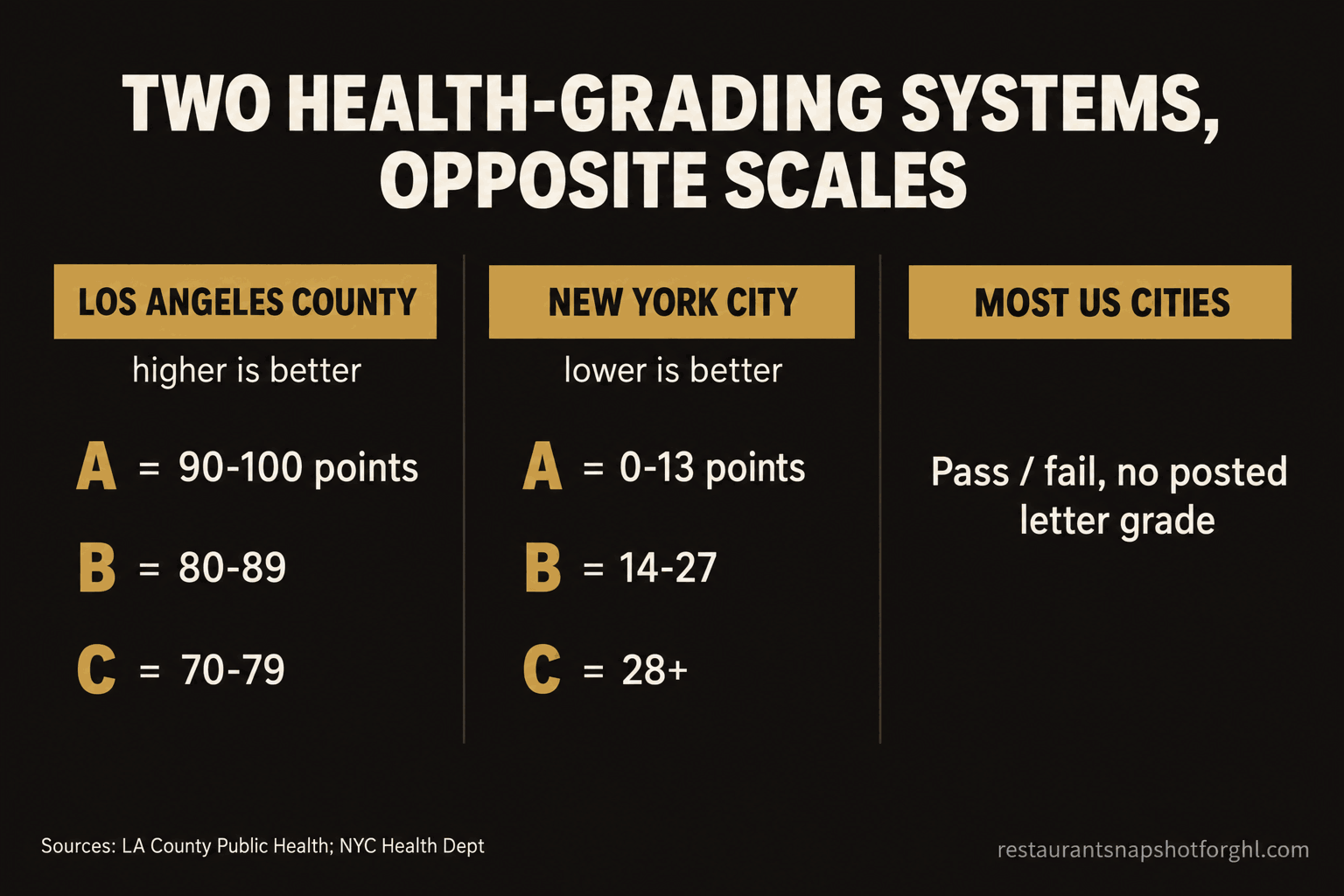
Most US inspections start from a clean 100 points and subtract for each violation by how dangerous it is. What changes city to city is whether that score becomes a public letter grade, and which way the scale runs. Two of the biggest systems score in opposite directions, which trips up operators with locations in different metros:
| How grading works | Los Angeles County | New York City | Most other US jurisdictions |
|---|---|---|---|
| Public letter grade posted? | Yes, in the window | Yes, in the window | Usually no (pass / fail or score only) |
| Scale direction | Higher is better | Lower is better | Varies |
| A grade | 90 to 100 points | 0 to 13 points | n/a |
| B grade | 80 to 89 points | 14 to 27 points | n/a |
| C grade | 70 to 79 points | 28+ points | n/a |
| Can you stay open on a B or C? | A or B open; C must correct immediately | B/C can post a grade-pending card and contest | Must correct critical items to stay open |
Sources: LA County Public Health grading rules and NYC Health Department scoring. NYC began requiring posted grades in July 2010; LA County’s program dates to the late 1990s. Even within LA County a few cities run their own departments, so operators in Pasadena, Long Beach, and Vernon report to those cities directly (LA County).
So before your first inspection, find out whether your jurisdiction posts a public grade and which way the scale runs. In a graded city your score is marketing; in a pass/fail city it’s your license to operate. The prep is the same either way.
The Station-by-Station Prep Checklist
Inspectors look for a short list of high-risk factors, not a thousand tiny things. The FDA Food Code names five that drive most foodborne illness: food from unsafe sources, inadequate cooking, improper time-temperature control, contaminated equipment, and poor personal hygiene (FDA Food Code 2022). Walk your kitchen as six stations and you’ve covered all five.
Station 1: Cold Holding and the Cooler
Standard + daily move: every cold TCS food (meat, dairy, cut produce, cooked items) at or below 41°F (FDA Food Code 2022). Probe-check and log walk-in, reach-in, and line temps at open, mid-shift, and close, date-label first-in-first-out, and don’t overfill a cold well above the chill line.
Where it breaks: a cook slams diced chicken into an already-stuffed cold well, the top layer never drops below 45°F, and the probe catches it at 2pm. That’s a major critical violation. The fix is smaller pans, deeper wells, and a probe in every cook’s apron.
Station 2: Hot Holding, Cooking, and Cooling
Standard + daily move: hot food at or above 135°F, and cooling moves fast: 135°F to 70°F within two hours, then to 41°F within the next four (FDA Food Code 2022). Check hot-hold temps on every steam-table item and cool large batches in shallow pans or an ice bath.
Where it breaks: a six-gallon pot of chili goes in the walk-in at 9pm still at 130°F and is a brick of bacteria-friendly warmth at 1am. Improper cooling is one of the most-cited temperature violations there is, invisible until someone probes the center.
Station 3: Handwashing and Personal Hygiene
Standard + daily move: dedicated hand sinks stocked with soap and towels, never blocked or used to rinse a pan, and staff who wash at every change of task. Stock and check every sink before and during service, and enforce a written sick policy out loud, because a “powering through it” cook is your single biggest risk.
Where it breaks: people are the problem far more often than equipment. In the CDC FoodNet analysis, food worker health and hygiene were a factor in 64% of single-cause outbreaks, food-prep practices in 34%, and pre-restaurant contamination in 22% (CDC). A hand sink buried behind bus tubs is both a violation and a root cause.
Contributing factors in single-cause restaurant foodborne outbreaks, CDC FoodNet analysis (factors overlap, so shares don’t sum to 100). Source: CDC.
Station 4: Cross-Contamination and Allergens
Standard + daily move: raw meat below and away from ready-to-eat food, color-coded cutting boards, surfaces sanitized between tasks, and allergens controlled so a nut-free order is actually nut-free. Check walk-in shelf order every morning (raw chicken on the bottom, always), keep sanitizer buckets tested, and sanitize boards between proteins and produce.
Where it breaks: raw salmon dripping onto cut melon one shelf down, or the same board for raw chicken and the salad garnish in a rush. Both are major critical violations, and both are what a tired crew does at 7:45pm. A labeled shelf diagram on the walk-in door fixes it.
Station 5: Pests and the Facility
Standard + daily move: no evidence of rodents or insects, no gaps under doors, screens on anything that opens, and a pest-control program with recent service records. Walk the back dock and dry storage for droppings or live activity before service, keep the dumpster area clean and the back door closed, and fix the door sweep.
Where it breaks: this is where a decent score becomes a closure. A vermin infestation or loss of water can trigger a permit suspension and a heavy deduction on its own, separate from everything else you did right. One mouse nest undoes a spotless line; prevention is a $12 door sweep and a nightly walk.
Station 6: Documentation and the Day-Of Walk
Standard + daily move: a certified food safety manager where required, current temperature and cleaning logs, allergen info, and your most recent report on hand. Keep logs filled in real time, not back-filled Sunday night (inspectors can tell), and do a five-minute “inspector’s eyes” walk at open, window to walk-in.
Where it breaks: missing or faked logs read as “this kitchen doesn’t manage temperature,” and the inspector probes harder. Clean, real documentation does the opposite, and often shortens the visit.
Three Real Scenarios: Solo, Busy Independent, Small Group
The checklist is the same everywhere; how you run it changes with your size.
Scenario 1: the solo operator. One room, an owner who’s also the chef, a crew that turns over. The risk is that prep lives entirely in your head, so the night you’re out sick is the night the inspector shows up. Get the routine onto a laminated line-check card at every station and train one trusted lead to run it your way. The card plus a thermometer per cook is 90% of the job.
Scenario 2: the busy independent. One high-volume room or two locations and shifts that slam. Volume is the enemy of cold holding and cooling, because nobody has time to split the chili into shallow pans at 9pm. Build the checklist into the shift: temps logged at fixed times, a mid-service hand-sink check assigned to a named person, a close-down routine that resets the walk-in shelf. Make it someone’s job, not everyone’s hope.
Scenario 3: the small group. Three to five locations, a GM at each, and a brand compared across all of them. A bad grade at one address is a reputation problem for the whole group, especially in a graded city, and one failed inspection that hits local news touches every door you own. You need the same logs, standards, and response to a slip, run from one system that gives you a single view across every location instead of five managers improvising.
Steal This: The Logs, Scripts, and Post-Inspection Copy
These pieces make prep repeatable and turn a good result into marketing. Copy them, swap the brackets, use them tonight.
The pre-shift line-check (post it at every station):
COLD: cold wells + reach-ins ≤ 41°F, probe-checked and logged. Nothing above the chill line. HOT: steam table + hot holds ≥ 135°F. Cooling batches in shallow pans only. HANDS: every hand sink stocked (soap + towels), clear, not blocked. Anyone sick goes home. SEPARATE: raw below ready-to-eat, color-coded boards, sanitizer buckets tested. PESTS: back dock + dry store walked, no activity, back door closed. PAPER: temp logs filled in real time, last report + certs findable.
The temperature log is one line per check, three times a shift: Date, Time, Unit (walk-in / reach-in / line / steam table), Temp °F, Initials, and the action taken if it reads out of range.
The “inspector just walked in” staff script. Train it once and it removes the panic:
“An inspector is here. [Manager] greets them and walks with them the whole time. Kitchen: work normally, wash hands now, put probe thermometers on every station, pull the logs and last report. Don’t clean frantically, don’t argue, and don’t guess. Unsure of an answer? Say ‘let me get the manager.’”
The “we earned our A” guest message (post it the day your fresh grade lands). This is where food safety becomes marketing:
“We just passed our health inspection with an A. The team that cooks your food sweats the small stuff so you don’t have to. Come see us this week: [link].”
The response to a bad grade. Don’t go quiet. A B or C handled in the open reads better than silence:
“We scored a B on our last inspection. We found the issue, fixed it the same day, and asked for a reinspection. Clean food is the one thing we won’t cut corners on. Thanks for holding us to it.”
A posted grade behaves like a public review, so the same muscle you use to respond to Google reviews gets you ahead of a grade story, and a fresh A is a reputation asset to ask happy guests to echo.
What Happens When You Get a B or a C
Prep fails sometimes, and knowing the path back keeps a bad day from becoming a bad month.
The point of the checklist is to keep this section theoretical. Repeat violations and a permit-threatening score shut restaurants down, not a slip you corrected on the spot.
Objections, Answered Straight
“We always pass. Why do I need a checklist?” Because “always” holds right up until the shift your best person is out and the fill-in doesn’t know the walk-in shelf order. A checklist isn’t for the days you’re sharp. It’s insurance for the days you’re short-staffed or distracted, exactly when inspectors find things, and it keeps food safety from living in one person’s head.
“Do health grades actually move sales?” They do. Once a grade is posted where customers can see it, demand shifts toward the cleaner restaurants, and an A was worth roughly 5% more revenue than a B (Jin & Leslie, QJE 2003). In a graded city, your inspection score is a marketing number whether you treat it like one or not, which is why managing it is the same job as managing your reviews.
Frequently Asked Questions
How often do restaurants get health inspected?
It varies by jurisdiction, but most full-service restaurants are inspected once or twice a year, and higher-risk operations more often. Inspections are typically unannounced, and a complaint or prior violation can trigger an extra visit. Because you can't predict the date, the only reliable prep is running the daily checklist every shift rather than scrambling when you think one is due.
What temperatures do health inspectors check?
The big ones are cold holding at or below 41°F and hot holding at or above 135°F, with the range between them the danger zone where bacteria grow fastest. Cooling is also scored: cooked food must drop from 135°F to 70°F within two hours, then to 41°F within the next four, per the FDA Food Code 2022. Improper cooling of large batches is one of the most commonly cited temperature violations.
What is the most common health code violation in restaurants?
Temperature control and personal hygiene lead the list. Improper holding and cooling temperatures show up constantly, and people are the biggest root cause of actual illness: a CDC FoodNet analysis found food worker health and hygiene were a factor in about 64% of single-cause restaurant outbreaks. Blocked hand sinks and cross-contamination between raw and ready-to-eat food are also frequent citations.
How do restaurant letter grades work?
In graded cities, inspectors convert the inspection into a public A, B, or C posted in the window, but the systems run in opposite directions. Los Angeles County scores higher-is-better (A is 90 to 100 points), while New York City scores lower-is-better (A is 0 to 13 points). Most US jurisdictions don't post a letter grade and instead use pass/fail or publish the raw report, so confirm how your health department works.
Does a bad health grade hurt restaurant sales?
Yes, where grades are posted publicly. Research on Los Angeles County's grade-card program found that once grades were visible, demand responded to hygiene, with A-grade restaurants seeing revenue rise about 5.7% and C-grade restaurants seeing revenue fall. The same program was linked to a 13.1% drop in foodborne-illness hospitalizations the year after launch. The grade works like a public review next to your Google stars.
Related reading
- Restaurant reputation management: how to respond to Google reviews
- Turn a bad review into a recovered guest
- Own your restaurant guest list instead of renting it
- How to legally text happy-hour and specials to your guests
- Restaurant local SEO and the Google map pack
- Get the done-for-you system installed in 24 hours
Sources
- Food safety standards: FDA Food Code 2022
- Illness burden & outbreak factors: CDC foodborne burden estimates; CDC FoodNet outbreak analysis
- Grading systems: LA County Public Health grading rules; NYC Health Department scoring
- Grades and revenue: Jin & Leslie, Quarterly Journal of Economics (2003); Leslie et al., hospitalizations study
- Industry outlook: National Restaurant Association 2026 State of the Industry