
It is a slow Tuesday at 3pm and the phone rings. A friendly voice says they are from Yelp, they noticed some of your competitors showing up above you in the app, and for a small daily budget they can fix that. You half-listen while you prep for service. By the time you hang up you have agreed to a trial, and you still do not know the one thing you asked: what is this going to cost me a month?
That is Yelp’s whole pricing move. The two things Yelp sells a restaurant with a real bill attached, advertising and Yelp Guest Manager, both arrive without a public number. So this is a numbers-first teardown of what Yelp actually costs an independent restaurant in 2026, where the bill quietly grows, and whether a one-to-three-room operator should pay it at all.
Table of Contents
- The 30-second answer
- Why Yelp’s real price isn’t on a rate card
- What Yelp Ads actually cost in 2026
- What Yelp Guest Manager actually costs in 2026
- Yelp vs OpenTable vs owning your list
- Three real budgets: solo, busy independent, small group
- Where the Yelp bill quietly breaks
- Steal this: the messages that turn a Yelp visit into a regular
- Objections, answered straight
- Frequently asked questions
The 30-Second Answer
Yelp is worth a small, measured test for most independent restaurants, and worth almost nothing if you pay it blind. Yelp Ads bill per click with no fixed price, starting around $150 a month and climbing to $300 to $500 once you follow a rep’s advice. Yelp Guest Manager is a separate reservations and waitlist subscription, reported between about $99 and $349 a month by tier (Stacker, 2026; G2, 2026).
The catch is the same with both: you rent reach and bookings on a platform that keeps the guest. The review a visitor leaves and the number they book with never land in a list you own. Pay for the click if the math works, but make sure the guest ends up somewhere you control.
Why Yelp’s Real Price Isn’t on a Rate Card
Yelp hides the number on both products it sells. Advertising is auction-priced per click: Yelp sets each click’s cost dynamically by your category, your city, and how many other restaurants are bidding for the same search at the same time (Stacker, 2026). There is no rate card because the rate changes by the hour.
Yelp Guest Manager, the reservations, waitlist, and table-management product, has tiers, but the dollar figures are quote-driven and the public listings disagree, which tells you the price is negotiated rather than fixed (Capterra, 2026).
Quote-only pricing sells the easy yes first and surfaces the real bill after a rep has your attention. That matters because the margin to absorb a bad guess is thin. The National Restaurant Association projects $1.55 trillion in sales for 2026 (NRA, 2026), yet 42% of operators were not profitable in 2025, on net margins that usually run just 3% to 5% (NRN, 2026; Level CFO, 2026). At those margins, a monthly spend you cannot tie to covers is real money.
What Yelp Ads Actually Cost in 2026
Yelp Ads put you at the top of relevant searches and on competitors’ pages, and you pay only when someone clicks. The real numbers:
- The floor: start at about $5 a day, roughly $150 a month, with no term contract on the self-serve plan (Stacker, 2026).
- The real restaurant spend: most small operators who run Yelp Ads land between $300 and $500 a month once a rep nudges the budget up (Stacker, 2026).
- Cost per click: Yelp publishes none, so estimates vary. Third-party guides put restaurant clicks from under $1 in soft markets to $3 to $8 in competitive metros, and rising (iCatch, 2026).
Reported monthly Yelp Ads spend for one restaurant, low to high. Third-party reported ranges; Yelp publishes no rate card (Stacker (2026); iCatch (2026)).
The honest read: the per-click model is fair in theory. The problem is what happens after the click. Yelp’s dashboard shows clicks and leads, not whether a click became a booked table (SuperDupr, 2026), so you can spend $400 a month and not know if it bought ten covers or one. Solvable, but only if you build the tracking yourself.
What Yelp Guest Manager Actually Costs in 2026
Yelp Guest Manager is the front-of-house product: online reservations, a waitlist, table management, and a booking link on your Yelp page (Yelp, 2024). The pricing gets murky: the public listings do not agree, itself a signal the number is negotiated. Treat every figure as reported and confirm your own written quote.
- Basic tier (reservations and waitlist): reported around $99 to $159 a month, capped near 500 covers, with no POS integration or deep guest profiles (G2, 2026; Capterra, 2026).
- Higher tier (Plus): reported around $279 to $349 a month by billing cycle, adding table management, POS links, and guest data (G2, 2026).
- Enterprise: custom pricing for groups, quote only.
- Easy-to-miss add-ons: a guest-experience survey tool near $129 a month and a self-serve kiosk near $99 a month, both on top of the base (FitGap, 2026).
A restaurant that wants Yelp to drive diners through ads and take the booking through Guest Manager carries two monthly bills. On the modest end, about $150 in ads plus $129 for Basic is roughly $279 a month. On the end a rep steers you toward, $400 in ads plus a $315 Plus plan with one add-on is over $700 a month, about $8,400 a year.
Yelp vs OpenTable vs Owning Your List
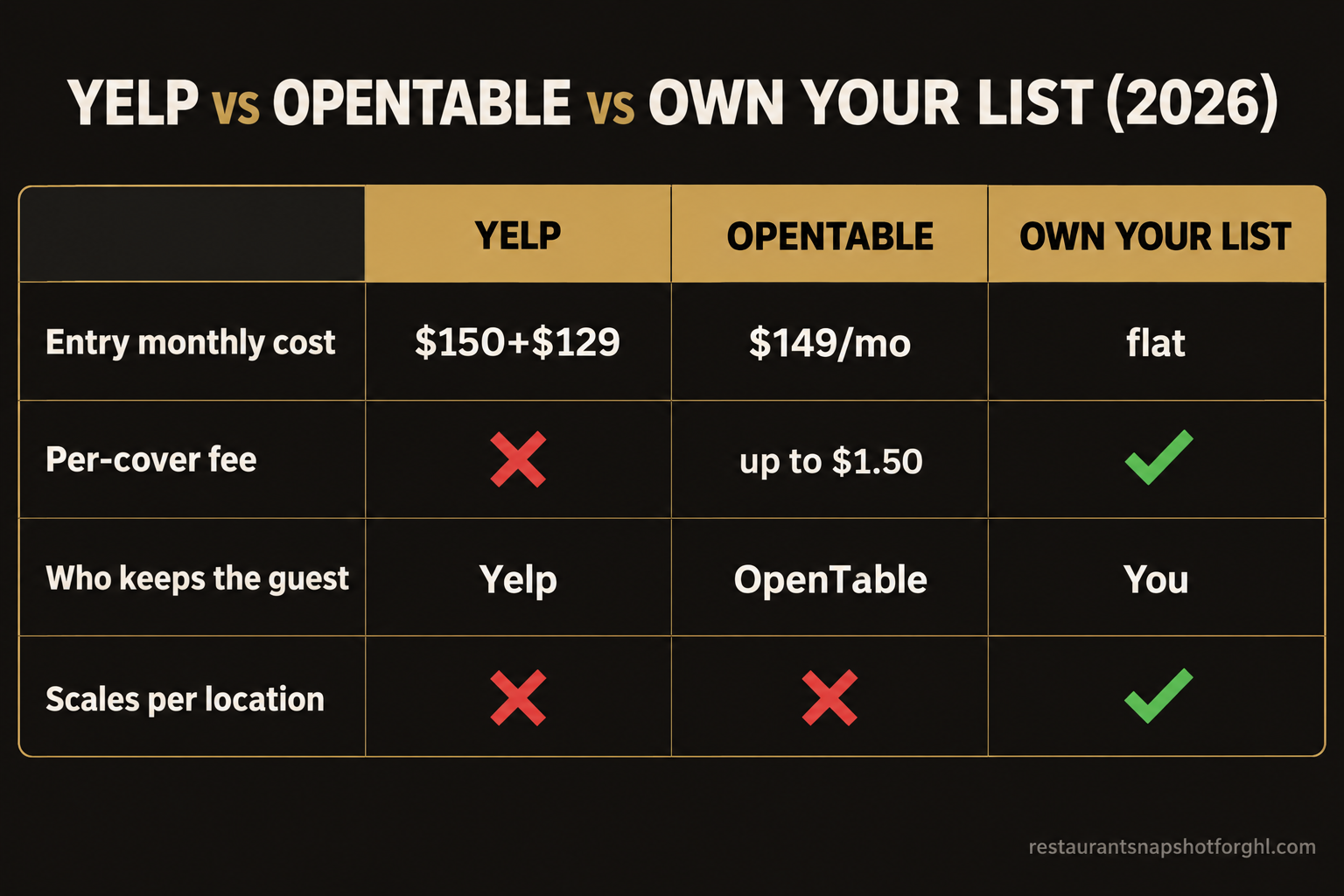
Here is how Yelp’s paid stack lines up against OpenTable, the platform most independents cross-shop, and against the option owners forget: running the guest relationship from a system you control (2026 reported rates).
| What matters | Yelp (Ads + Guest Manager) | OpenTable | Own your list |
|---|---|---|---|
| Entry monthly cost | ~$150 ads + ~$129 GM | $149/mo base | Flat tool cost |
| Price published? | No (per-click + quote) | Partly (base shown) | Yes |
| Per-cover fees | No per-cover on ads | Yes, up to ~$1.50/cover | None |
| Higher tier | ~$279-$349/mo GM | Up to $499/mo | Optional |
| Booking traffic source | Yelp app searches | OpenTable network | Your own channels |
| Two-way SMS + no-show flow | Limited | Limited | Built in |
| Who owns the guest data | Yelp | OpenTable | You |
| Best fit | Discovery-driven rooms | High-volume bookers | Owner who wants the list |
OpenTable base and per-cover model from EatApp, 2026; for the full reservations view, see our OpenTable vs Resy vs Tock vs SevenRooms cost breakdown. Yelp’s one pricing edge is no per-cover fee, but both platforms keep the guest. The only column that gets cheaper per location as you grow is the one where the list is yours.
Three Real Budgets: Solo, Busy Independent, Small Group
The right answer changes with your size. Every figure is illustrative, Yelp layer only, before card processing and base POS.
Scenario 1: the solo operator. One room, 800 to 1,000 covers a month, mostly walk-ins. Ads at the floor, about $150 a month, and a simpler booking tool instead of Guest Manager: ~$1,800 a year. The honest read: run it as a 60-day test with tracking attached, and cut it first if you cannot tie the spend to covers.
Scenario 2: the busy independent. One high-volume room or two locations that takes real reservations. Ads at $400 plus Basic Guest Manager at ~$129 is about $529 a month, roughly $6,350 a year, and a rep will push Plus. The honest read: a real debate. If reservations run your floor a booking tool earns its keep, but ask whether Yelp’s version, which keeps the guest, beats a booking flow you own.
Scenario 3: the small group. Three to five locations, a marketing lead, a shared guest base. Ads plus a Plus plan per location, say $700 each across four rooms, is about $2,800 a month, roughly $33,600 a year, before add-ons. The honest read: this is where per-location software hurts most. Four Yelp subscriptions mean four guest databases that never talk. One shared account with no per-door fee changes the number, and the data, by a wide margin.
Estimated annual Yelp spend by operator size, Yelp layer only. Illustrative, from the reported figures cited above.
Where the Yelp Bill Quietly Breaks
The monthly number is the start, not the bill. Here is where Yelp costs more than the quote.
1. The review filter can bury your best reviews. Yelp’s recommendation software hides some reviews on a “not currently recommended” page most diners never click. Yelp says about 75% are recommended, leaving roughly a quarter filtered, including genuine raves from real guests (NBC LA; Search Engine Land). You pay for the ad that drives someone to a page the filter may leave under-selling you.
2. The attribution gap. Yelp shows clicks and leads, not booked covers (SuperDupr, 2026). Three months in, you are spending $400 a month and cannot say whether it works. The fix is a tracked phone number and a booking link that logs the source, which Yelp does not build.
3. The budget creep. Yelp Ads are auction-priced, reported costs per click keep rising, and reps are paid to move your budget up (iCatch, 2026). The $150 test becomes a $450 standing cost over two or three calls with no matching rise in covers. Set the budget in writing and treat any increase as a decision, not a default.
4. The guest you never get to keep. The review lives on Yelp, the booking in Guest Manager, the diner’s details in Yelp’s system, not yours. The day you want to text your best 200 guests a slow-Tuesday offer, you cannot, because the relationship you paid to build sits on a platform you rent. That is the quiet, compounding cost the monthly quote never mentions.
Steal This: The Messages That Turn a Yelp Visit Into a Regular
Whatever you pay Yelp, the move that pays you back is capturing the guest it sends and bringing them back on channels you own. Copy these straight, swap the brackets, and keep the compliance line on anything promotional.
The post-visit review request (2 to 3 hours after the check closes, to happy guests only). The “reply here first” line routes an unhappy guest to you before they post publicly, and the Google ask matters because a Google review cannot be filtered out of sight like a Yelp one:
“Thanks for coming in tonight, [Name]. If we got it right, a quick Google review helps a small local spot like us more than you’d think: [link]. If anything was off, reply here first and we’ll make it right.”
The two-touch win-back for a guest who found you on Yelp, came once, and went quiet (sent at 45 and 60 days since last visit):
Day 45: “Miss you at [Restaurant], [Name]. Here’s $15 off your next visit this month, our treat. Book here: [link].”
Day 60: “Last one from us, [Name]. The $15 is good through Sunday, then we’ll leave you be. [link].”
The SMS consent line for your booking form, Wi-Fi splash page, or text-to-join prompt. This is the one you cannot skip:
“Text me reservation updates and occasional offers from [Restaurant]. Msg & data rates may apply. Msg frequency varies. Reply STOP to cancel, HELP for help. Consent isn’t a condition of dining with us.”
The moment you text a list collected at the host stand, you are bound by the Telephone Consumer Protection Act (TCPA) and A2P 10DLC rules, with penalties of $500 to $1,500 per message sent without proper consent (FCC). Keep the booking confirmation and the marketing opt-in separate, log every consent with a timestamp, and honor STOP automatically. Our TCPA and A2P 10DLC guide covers registration and templates.
Objections, Answered Straight
“A Yelp rep told me my competitors are stealing my customers. Isn’t that worth paying to stop?” That line is a script, not a diagnosis. Yes, Yelp shows competitor ads on your page and yours on theirs. But the fix is a tracked test, not an open-ended budget: $150 a month for 60 days with a dedicated phone number and a booking link that logs the source, then look at covers, not clicks.
“Won’t the automated texts annoy the guests Yelp sends me?” Only if you blast everyone the same thing. The messages above are triggered and targeted: a review request to someone who just had a good night, a win-back to a guest who went quiet, a specials text only to people who opted in. Permission plus relevance is the opposite of a cold ad.
“I’m not technical. Isn’t Yelp easier because it’s all in the app?” Easier to start, harder to leave. A done-for-you setup installs the booking flow, reminders, review requests, loyalty, and compliant texting into an account you own, without the lock-in or the per-location bill. See a done-for-you GoHighLevel system for restaurants.
“We’re tiny. Do we even need any of this?” You need the follow-up, not necessarily Yelp’s version of it. Winning a new customer costs about five times more than keeping one you have (Bain & Company), so for a small room the highest-return move is bringing a lapsed guest back, from a $150 Yelp habit or a cheaper system you own.
The One Line That Changes the Math
When that rep calls again at 3pm, you now have an answer. Yelp Ads, the Guest Manager subscription, and the review filter each charge you, in money or in reach, to talk to people already looking for a place like yours, and the click is yours only for a moment while the guest never is. So the highest-return line in your budget is not the biggest Yelp ad. It is the one that keeps the guest Yelp sends you: a tracked test you can measure, a booking flow that drops the diner into a list you own, a win-back at 45 days, a loyalty program that does not need a punch card, and a review request that builds your Google presence instead of Yelp’s. For a one-to-three-room operator, rent the click, own the relationship, and measure the difference.
Frequently Asked Questions
How much does Yelp cost for a restaurant per month in 2026?
There is no single number. Yelp Ads bill per click with no flat fee, starting near $150 a month and commonly running $300 to $500. Yelp Guest Manager, the reservations and waitlist product, is a separate subscription reported between about $99 and $349 a month by tier. Using both can run $279 to $700-plus before add-ons. All figures are reported, so confirm your own written quote.
Is Yelp advertising worth it for a small restaurant?
It can be, as a small tracked test rather than a standing cost. Start near the $150 floor, attach a dedicated phone number and a booking link that logs the source, and run it for 60 days. Then measure booked covers, not clicks, since Yelp's dashboard does not show whether anyone booked. Keep it if the covers are there, cut it if they are not.
What does Yelp Guest Manager cost, and is it the same as Yelp Ads?
Different products. Guest Manager is a reservations, waitlist, and table-management subscription, reported around $99 to $159 a month for the basic tier (often capped near 500 covers) and about $279 to $349 for Plus, with survey and kiosk add-ons. Yelp Ads are a separate per-click spend. Paying for one does not include the other.
Why are my good Yelp reviews getting hidden?
Yelp's recommendation software moves some reviews to a 'not currently recommended' page most diners never open. Yelp says about 75% are recommended, so roughly a quarter are filtered, often genuine ones, especially those that look solicited. You cannot override it, and paying for ads does not change it. Building review volume on Google is the more reliable path.
What's the best alternative to paying Yelp every month?
For most independents, use Yelp sparingly for discovery and own the guest relationship yourself. Run booking, two-way SMS, no-show recovery, review requests, loyalty, and win-backs from a GoHighLevel account you control, so the guests Yelp sends you land in a list you keep, with no per-location fee and no platform that can filter your reviews.
Related reading
- OpenTable vs Resy vs Tock vs SevenRooms: the real 2026 cost
- What restaurant marketing software actually costs in 2026
- The best OpenTable alternatives for independent restaurants
- Own your restaurant guest list instead of renting it
- TCPA & A2P 10DLC: what restaurants need to know before sending one SMS
- Get the done-for-you system installed in 24 hours
Sources
- Yelp Ads: Stacker (2026); iCatch (2026); SuperDupr (2026)
- Guest Manager pricing: G2 (2026); Capterra (2026); FitGap (2026); Yelp (2024)
- Review filter: NBC LA; Search Engine Land
- OpenTable: EatApp (2026)
- Industry: NRA 2026; NRN (2026); Level CFO
- Retention & compliance: Bain; FCC TCPA