
It’s 8:15 on a Tuesday and you’re standing at the pass counting empty two-tops. The kitchen is fully staffed, the lights are on, the rent cleared your account on the first like it always does, and you’ve turned maybe nine covers all night. Four days later that same room has a 40-minute wait, two servers in the weeds, and a host stand turning people away. Same food, same neighborhood, same prices. One night loses money, the other prints it.
Most owners treat these as two puzzles: a slow Tuesday to fix and a busy Saturday to protect. They’re one lopsided demand curve, and the quiet Tuesday costs far more than it looks, because your biggest bills don’t care if the room is full. Here’s the honest version of why your restaurant is slow on weeknights, what a dead Tuesday drains from your bottom line, and the fix that fills midweek without burning the night that pays for everything.
Table of Contents
- The 30-second answer
- What a dead Tuesday actually costs you
- What the data says about your week
- The six real reasons your week is lopsided
- The messages you can steal tonight
- Run the fix for a solo spot, a mid-size team, and a group
- The compliance part nobody warns you about
- Objections, answered straight
- Frequently asked questions
The 30-Second Answer
Your weeknights are slow because dining out on a Tuesday is a decision, and dining out on a Saturday is a default. Weekends have the occasion baked in: the week is done, people have time, plans happen without anyone needing a reason. Tuesday has none of that. For a guest to pick your room on a random weeknight, something has to pull them in, and for most independents nothing does. You don’t text them, you don’t own their number, and the only time they think about you is when they already feel like going out, which is Friday.
So demand piles up on two or three nights and evaporates on the rest. That’s not a food problem or a location problem. It’s a demand-distribution problem, and it hurts because your rent, insurance, salaried managers, and kitchen crew cost the same on a dead Tuesday as a packed Saturday. The fix isn’t a louder ad campaign to strangers. It’s giving guests you already served a reason to come in on a slow night, and a way to reach them.
What a Dead Tuesday Actually Costs You
Start with the money. The restaurant industry will do a projected $1.55 trillion in sales in 2026 (National Restaurant Association), but that hides how little of each dollar an operator keeps: after food, labor, rent, and everything else, independent margins typically land in the low single digits, often under 5% (Restaurant365, 2026). Here’s where a representative sales dollar goes:
Where every $100 of restaurant sales tends to go. Food runs roughly 28% to 35% and labor 25% to 35% of revenue, leaving a net margin that frequently sits below 5%. Sources: Restaurant365, 2026; Slang.ai restaurant KPIs.
Look at that “rent and overhead” slice, because it’s what makes a slow night brutal. Those costs are fixed: rent, insurance, software, utilities, and salaried managers don’t flex down because the room is empty. So the dead Tuesday is the expensive night, not the cheap one. When you’re slammed, fixed costs spread across 180 covers and the margin is real. When you turn 9, that same cost spreads across almost nobody and the night runs at a loss before you’ve paid for a single ingredient. You’re subsidizing the empty room out of the three or four nights that actually work.
And this isn’t a you problem. In the 2026 outlook, 60% of operators reported softer customer traffic than the year before, and 42% said they weren’t profitable in 2025 (National Restaurant Association). Thin margins plus soft midweek traffic is the exact squeeze closing good restaurants.
What the Data Says About Your Week
You already feel the lopsidedness. The numbers confirm it’s structural. Reservation data from Toast shows demand clustering hard on the back half of the week, Saturday the clear peak, the start of the week trailing far behind:
Approximate share of restaurant reservations by day of week. Friday through Sunday take about 63% of bookings, while Monday and Tuesday are the quietest nights. Source: Toast reservation data.
Saturday alone takes roughly a quarter of the week’s reservations. Add Friday and Sunday and the weekend swallows close to two-thirds of all bookings, leaving Monday through Wednesday to fight over the scraps. If your numbers look like this, you’re not failing. You’re average, and “average” quietly loses money four nights a week. The demand you’re missing on Tuesday isn’t demand that doesn’t exist. It defaults elsewhere because nothing redirected it, and that gap is your weeknight opportunity: cheaper to capture than any new customer.
The Six Real Reasons Your Week Is Lopsided
Slow weeknights usually trace back to the same handful of causes. Only one is about the food. For each, here’s how it shows up in your dining room, and the one thing that fixes it.
Reason 1: You built the whole business around the weekend
Your staffing, specials, and attention all point at Friday and Saturday, where the money is. It’s self-fulfilling: weeknights get no promotion, so they stay dead and you invest even less. The slow night isn’t naturally dead. It’s dead because nobody tried to wake it up.
How it breaks: operators “fix” a slow Tuesday by cutting hours or closing, which shrinks the business and trains regulars that you’re unreliable midweek. The fix: treat one weeknight as a project with its own hook (a prix fixe, an industry night, a regulars’ table) and actually market it.
Reason 2: On a Tuesday, you’re invisible
On Saturday, guests come to you. On Tuesday, you have to reach them, and most independents have no way to. No list, no texts, no reason landing in anyone’s pocket at 4pm. The guest isn’t rejecting you midweek. They’ve forgotten you until the weekend feeling kicks in.
How it breaks: the only “marketing” is a social post a sliver of followers see, hours after the decision to go out was made. The fix: a direct channel you control (email and SMS), so a Tuesday offer lands with the people most likely to act, before they’ve made other plans.
Reason 3: You rent your guest list instead of owning it
This is the quiet killer. If your bookings run through OpenTable or a third party, the guest’s contact info often belongs to the platform, not you. So on a slow Tuesday you can’t text the thousands who’ve already dined with you, because you don’t have their numbers. You’re paying to acquire guests and handing the relationship away. Owning your guest list instead of renting it from OpenTable is the single highest-impact change most operators can make.
How it breaks: you assume the booking platform “has you covered,” then discover at your slowest moment that you can’t reach your own regulars. The fix: capture names, emails, and phone numbers into a database you control, so your list is an asset you keep.
Reason 4: You discount Saturday instead of shifting demand
When panic sets in, the instinct is a blanket discount. But one that runs all week mostly gets used by people already coming Saturday, so you’ve handed money back on your one profitable night and done nothing for Tuesday. Worse, you train guests to wait for the deal, which erodes the full-price weekend that keeps the lights on.
How it breaks: “20% off” with no day restriction cannibalizes your strongest night and resets what guests think your food is worth. The fix: time-box the offer to the slow night only (a Tuesday-only chef’s special), so it pulls demand into the valley instead of discounting the peak. We go deep on this in the fill slow weeknights without discounting playbook.
Reason 5: Your regulars quietly faded and nobody noticed
A chunk of your missing Tuesday covers are regulars who slipped away without a word. Repeat guests drive roughly 60% of restaurant revenue (Olo), and they’re the ones who used to fill your weeknights on habit. When one stops coming, you don’t get a complaint. You get a softer month, three months late.
How it breaks: you only notice churn when a whole section goes cold, long after the save was cheap. The fix: watch recency and nudge a regular the moment their rhythm breaks. Here’s why regulars stop coming in and how to catch it early.
Reason 6: You’re buying strangers instead of filling with guests you have
To plug the gap, operators lean on delivery and marketplace covers, which charge 15% to 30% commission plus extra fees (Independent Restaurant Coalition, 2025). You’re renting demand at a brutal rate instead of activating demand you already earned. Meanwhile acquiring a new customer costs five to twenty-five times more than keeping an existing one (Harvard Business Review), so you’re paying top dollar for strangers while your past guests sit unreached.
How it breaks: the fix for a slow night becomes a permanent 30% tax, and you still don’t own the customer. The fix: point that budget at reactivating guests who’ve already paid you once, at a fraction of a marketplace fee per cover.
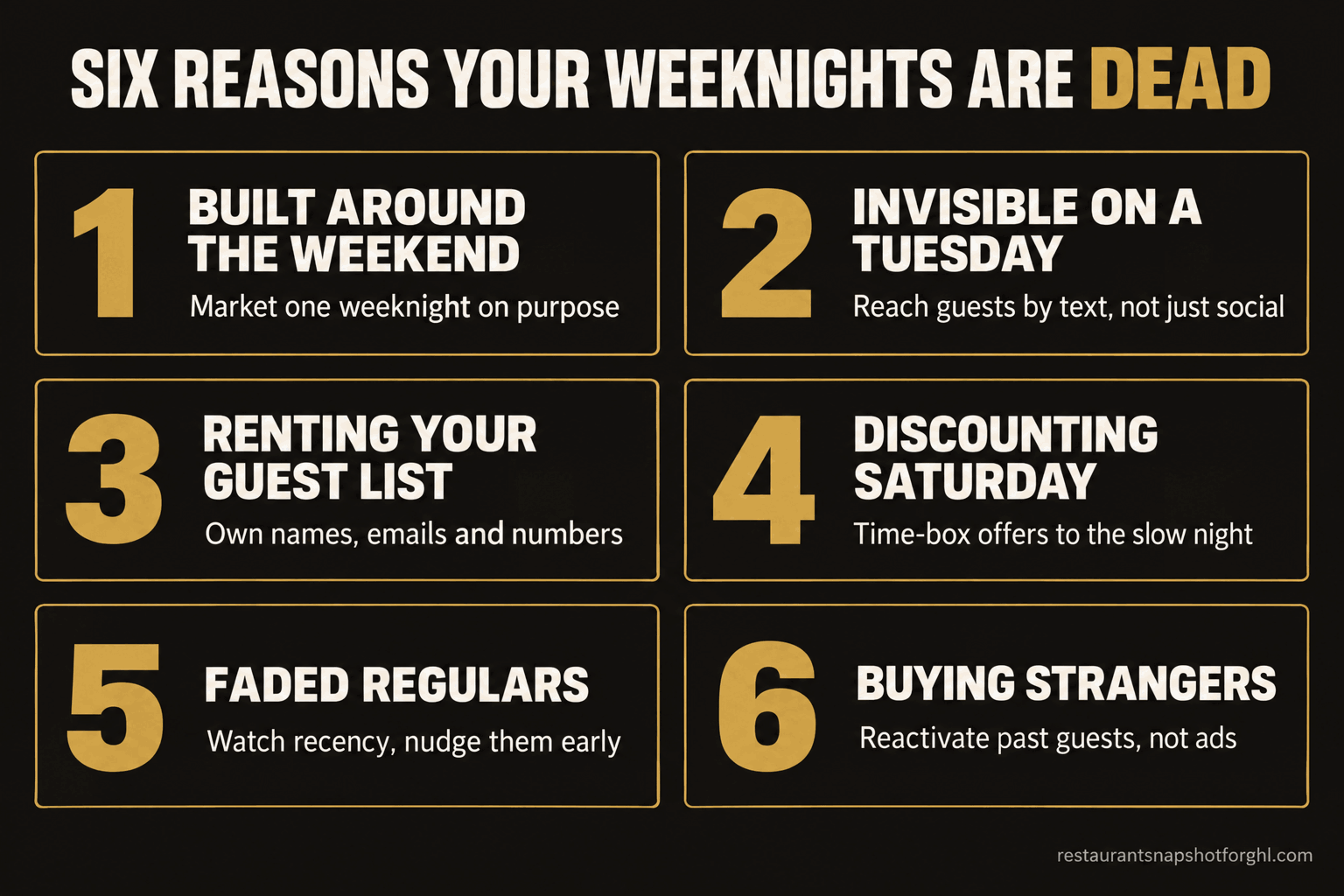
Five of the six have nothing to do with your cooking. They’re about reach: who you can contact, when, and with what reason. That’s fixable in a week. Recipes take years.
The Messages You Can Steal Tonight
Theory is cheap. Here’s the actual copy: real texts that pull demand into a slow weeknight, written so you can paste them in and swap your name. A blast that reads like a coupon machine gets muted. A note that reads like the owner typed it gets a table.
Three rules make these work: lead with warmth not the discount, time-box every offer to the slow night so you never cannibalize the weekend, and send from a real two-way number so a reply like “yes, 7pm for 4” becomes a booked table. For the full program, see our restaurant SMS marketing playbook.
Run the Fix for a Solo Spot, a Mid-Size Team, and a Group
The same framework (own the list, nudge the slow night, watch recency) scales differently by size.
The solo operator / single room. No marketing person, so the system has to run itself. Capture every guest into one place (a QR code on the table tent, a Wi-Fi sign-in that asks for a mobile number, a reservation flow that keeps the contact), then automate exactly two things: a Tuesday nudge to anyone who’s visited in the last 90 days, and a win-back to anyone quiet for 45-plus days. Those two fill more weeknight seats than any posting, and set up in an afternoon.
The mid-size team (one busy location, a few managers). Volume is high enough that recency matters. Tag guests by rough frequency so a weekly regular who goes quiet gets flagged faster than an occasional one, give a manager the two-way SMS inbox so replies become booked tables inside the hour, and add a standing weeknight event promoted only to the owned list, never a public discount.
The multi-unit group (2 to 50 locations). The guest list is now a shared asset, and the risk is fragmentation: each location hoarding its data, no single view of a guest who visits two rooms. Centralize the database across venues, run the campaigns per location with shared templates, and watch per-location recency to spot which rooms are leaking regulars. A guest lapsed at one spot is a warm lead for another.
The Compliance Part Nobody Warns You About
Start texting guests to fill weeknights and you’re in regulated territory, where getting it wrong is expensive. Two rules matter most.
First, TCPA. You need express written consent before you text marketing to anyone, and every message needs a clear opt-out (that “Reply STOP” is not optional). A number collected at the host stand without a clear opt-in is not consent, and the classic violation is exactly that: blasting a promo to a list you gathered without permission. Penalties run $500 to $1,500 per text (FCC), so a careless blast to a few thousand guests is a business-ending number.
Second, A2P 10DLC. Carriers now require business texting numbers to be registered and vetted, or your messages get filtered before they reach a phone. This is why so many “I’ll just text from my cell” setups quietly fail.
None of this should scare you off texting. Done right, SMS is the highest-response channel you have for a slow night, and it’s a setup you do once.
Objections, Answered Straight
“Won’t a Tuesday promo just cannibalize my Saturday?” Only if you run it wrong. A blanket, all-week discount does, which is why Reason 4 exists. A time-boxed, slow-night-only offer does the opposite: it pulls incremental demand into a night that was empty anyway. The guest filling your Tuesday at a $26 special wasn’t going to pay full price on Saturday. You’re monetizing a seat that was earning zero.
“Isn’t a slow Tuesday just normal? Everyone’s dead midweek.” It’s common, not inevitable, and “normal” is losing money four nights a week. Demand clusters on weekends, yes, but it’s also shiftable: the same guests eat out midweek when given a reason.
“I already pay OpenTable and Toast. Isn’t this handled?” Those tools take bookings and run your POS. They don’t reactivate a lapsed regular or fire a Tuesday nudge to guests you own, and in OpenTable’s case the guest relationship is largely theirs. A reservation book is not the same as owning and activating your guest list.
“I’m not technical. This sounds like a project.” The setup is a project; running it is not. Once the list captures automatically and the automations are built, the system reaches guests and books tables while you’re on the line, instead of “text the regulars about Tuesday” dying on a to-do list every week.
Frequently Asked Questions
Why is my restaurant so slow on weeknights but packed on weekends?
Weekend dining is a default (the week is over, people have time and plans) while weeknight dining is a decision that needs a trigger. Roughly 63% of reservations land Friday through Sunday. Most independents have no way to reach guests midweek with a reason to come in, so that demand defaults elsewhere. It's a reach problem, not usually a food problem.
Is a dead Tuesday really losing money if the room is open anyway?
Yes. Your largest costs (rent, insurance, salaried managers, base labor, software) are fixed and run the same whether you turn 9 covers or 90. On a packed night they spread across many covers; on a dead night they spread across almost none, so the night often runs at a loss before you've bought an ingredient.
How do I fill a slow weeknight without discounting my busy nights?
Time-box any offer to the slow night only (a Tuesday-only special or midweek perk) and promote it only to a guest list you own, not as a blanket public discount. That shifts demand into the empty night instead of cutting prices on the full one. An all-week discount mostly rewards guests who were already coming Saturday.
Do I need to own my guest list to do this?
Effectively, yes. If your bookings run only through a third-party platform, you often can't text or email past guests because their contact info belongs to the platform. Capturing names, emails, and phone numbers into a database you control (via Wi-Fi sign-in, QR codes, reservations, and checkout) is what lets you reach guests on a slow night at all.
Is it legal to text my guests about weeknight specials?
Yes, with consent. Under the TCPA you need express written opt-in before marketing texts, and every message must include an opt-out like 'Reply STOP.' Your number also has to be registered for A2P 10DLC or carriers filter the messages. Drink-special promotions carry state-specific alcohol-advertising rules too.
How fast can this actually move the needle on a slow night?
The list-building and automations take about an afternoon to set up, or 24 hours with a prebuilt system. Once live, a Tuesday nudge to guests who've visited in the last 90 days plus a win-back to lapsed regulars usually shows up in covers within a week or two, because you're activating demand that already exists.
Back to that Tuesday at the pass, counting empty two-tops. Nothing about the night was wrong except that nobody who loves your food knew it was a good time to come in, and you had no way to tell them. Fix the reach and the slow night becomes a night you fill on purpose, with guests who already chose you once. The weekend was never the problem. The four nights you’re leaving on the table are, and they’re the most fixable money in your building.