It is 7:15 on a Friday and the delivery tablet will not stop chiming. Tickets pile up and you are plating forty dinners for people whose names you will never know. The order fires, the driver grabs the bag, the customer is gone. You made money once, and the app kept the relationship.
That is the quiet tax nobody puts on the P&L. The commission is the bill you can see. The one you cannot: every delivery order is a customer you paid to acquire and then handed back to DoorDash. Next Friday they open the app, not your website, and you pay again.
Here is the short version, then we build it. You do not fix delivery by quitting the apps. You use them as a paid sampling channel and build a system that moves those customers onto a list you own, gets them ordering direct, and turns the best of them into regulars. The apps find the customer once. You keep them.
Table of Contents
- What a delivery order actually costs you
- The system, start to finish
- Stage 1: Know what you are allowed to capture
- Stage 2: Put something in every single bag
- Stage 3: Build the channel they opt into
- Stage 4: Make the first direct order a no-brainer
- Stage 5: The follow-up sequence (copy to steal)
- Stage 6: Turn direct orderers into dine-in regulars
- Three restaurants, three different plans
- The compliance line you cannot skip
- Objections, answered straight
- FAQ
What a Delivery Order Actually Costs You
The short answer: a third-party order costs you a big slice of the ticket and gives you zero ownership of the customer. A direct order costs card processing and gives you everything. That gap is the whole reason to build this.
The money you can see: DoorDash publishes three plans, Basic at 15 percent on delivery, Plus at 25 percent, Premier at 30 percent, pickup 6 percent across all three (DoorDash, 2026). Uber Eats and Grubhub sit in a similar range. For the full math, see what delivery apps cost your restaurant.
The money you cannot see: on a marketplace order you do not get real contact details. DoorDash masks the phone number, and it only works until roughly 30 minutes after delivery (DoorDash Developer docs). You cannot text a thank-you or an invite back; the app owns that line.
What leaves the till per delivery order, by channel. The three tiers are DoorDash’s published commission rates; the direct bar is a typical card processing fee. Source: DoorDash, 2026.
It is not even what your guests want. In the NCR Voyix 2025 Customer Experience Report, 58 percent of customers said they prefer to order delivery straight from a restaurant’s own app or website, and another 15 percent would rather call (Restaurant Dive, 2025). Most are on the app out of habit; give them a reason and a way, and a big share will switch.
And keeping a guest is the cheapest growth there is. Harvard Business Review put acquiring a new customer at 5 to 25 times the cost of keeping one, citing Bain research that a 5 percent lift in retention raises profits 25 to 95 percent (HBR, 2014). The apps rent you customers. This system lets you own them.
The System, Start to Finish
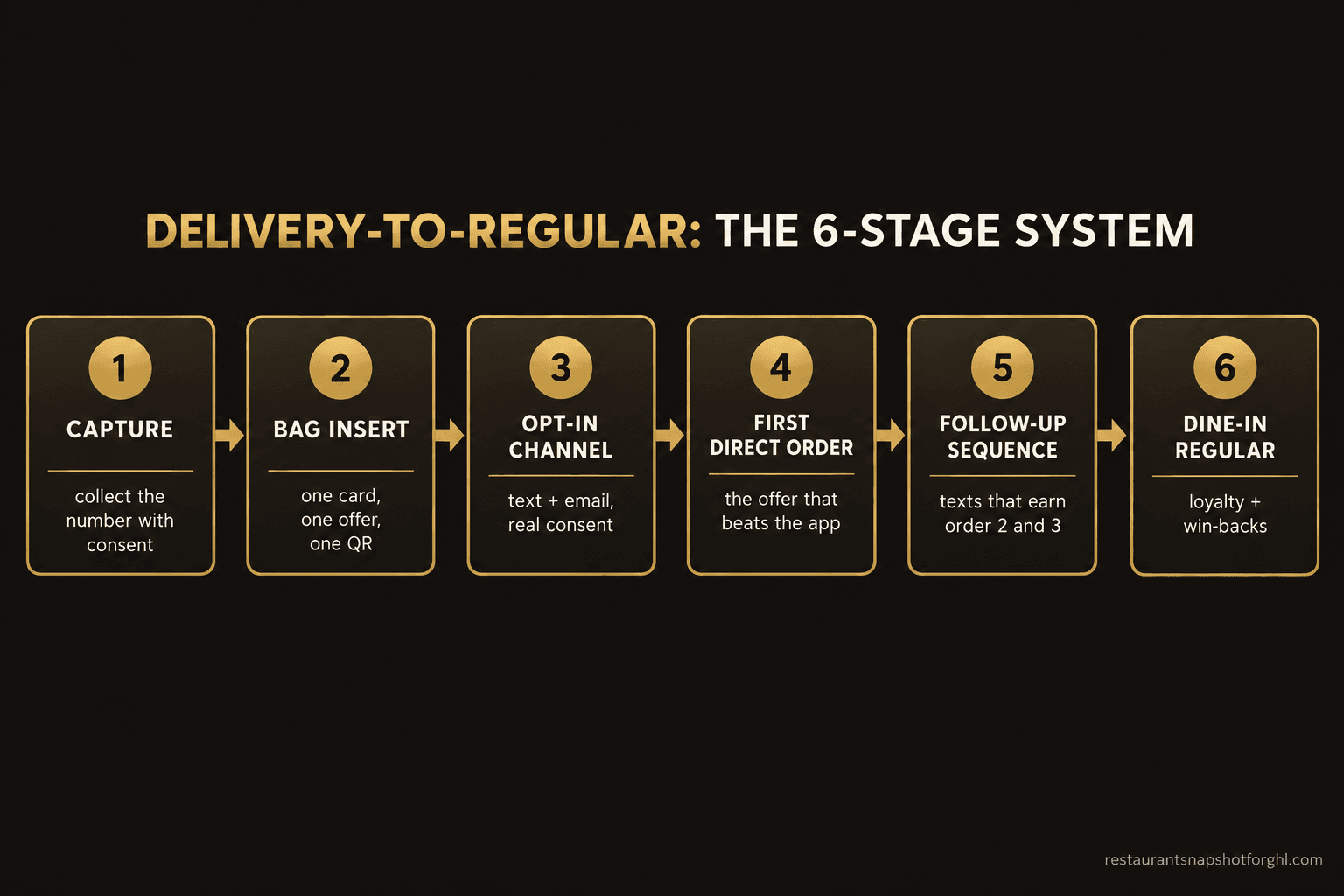
The whole thing is six stages, in order. Each has a job and a way it breaks.
- Know what you are allowed to capture. The data reality on the apps.
- Put something in every single bag. The physical nudge from app to you.
- Build the channel they opt into. Text and email, joined with real consent.
- Make the first direct order a no-brainer. The offer that beats the app.
- The follow-up sequence. The texts that turn order one into two and three.
- Turn direct orderers into dine-in regulars. Loyalty and win-backs.
You can run the first three stages with tape, a printer, and a phone number. The back half is where automation earns its keep.
Stage 1: Know What You Are Allowed to Capture
Setup: On a marketplace order, assume you get nothing you can market to. The name is often first-name-only, and the number is masked and temporary (DoorDash Developer docs). So you collect details the clean way, on the next touch: your own order page, the QR on the bag insert, the pickup counter, the reservation. Each is a place a guest can hand you a number and a yes, and that yes is the asset, as we covered in why your guest list is the only asset the apps cannot take.
How it breaks: The classic mistake is treating the app’s data like it is yours. Do not export masked numbers and text them; you would be messaging people who never opted in, through dead numbers, building a TCPA liability instead of a list. Capture with permission, or do not capture.
Stage 2: Put Something in Every Single Bag
Setup: The bag is the one piece of your restaurant that enters the customer’s home. Every delivery and pickup bag gets a small card stapled to the top. The card does one job: a reason to order direct next time. One offer, one QR code, one short line, pointing to a landing page where they get the offer for joining your list.
How it breaks: The card gets buried under the food, so staple it to the top or tape it outside. The offer is too weak to beat the app’s convenience; make it real, because a 15 to 20 percent first-order discount is worth more to you than the 25 to 30 percent you hand the app every time. And the QR points at your homepage, where the offer disappears, instead of a single-purpose landing page.
Stage 3: Build the Channel They Opt Into
Setup: The QR lands on one simple page: headline repeats the offer, one field for the mobile number, a consent checkbox, a button. On submit, they get an instant text with the code, and they are on a list you own, with documented permission to use it. Text handles the time-sensitive nudge (“it’s Friday, here’s your code”), email the longer story; for the full build, see our restaurant SMS marketing playbook. The consent step is not optional furniture; the checkbox, disclosure, and STOP instruction are what make the list legal to use.
How it breaks: The form asks for too much, so they bail. Ask for the number and the yes; collect the rest later. Second, a slow landing page on mobile; six seconds to load and you lost them. Third, skipping the instant-reward text, so they give a number and hear nothing.
Stage 4: Make the First Direct Order a No-Brainer
Setup: You have the number and the yes. Now you win the first direct order, the hardest, because the habit is the app. The incentive text goes out within minutes of signup, while intent is hot: restate the offer, give the code, link straight to your ordering page, code pre-applied if you can manage it. Your ordering page also has to be good; if direct is clunkier than the app, no discount saves it. If your site is the weak link, fix that first, as we cover in why your restaurant website isn’t bringing in diners.
How it breaks: The code fails, the page makes them re-enter it, or the online menu does not match the app menu, and trust evaporates on the first try. Test the whole flow yourself, on a phone, before you print a card. The other break is pricing your direct menu higher than the app to “make up” the discount, which trains the customer that direct is the expensive way to order.
Stage 5: The Follow-Up Sequence (Copy to Steal)
One order is not a regular. The sequence turns it into a rhythm, without texting too much. Here is the copy, with timing.
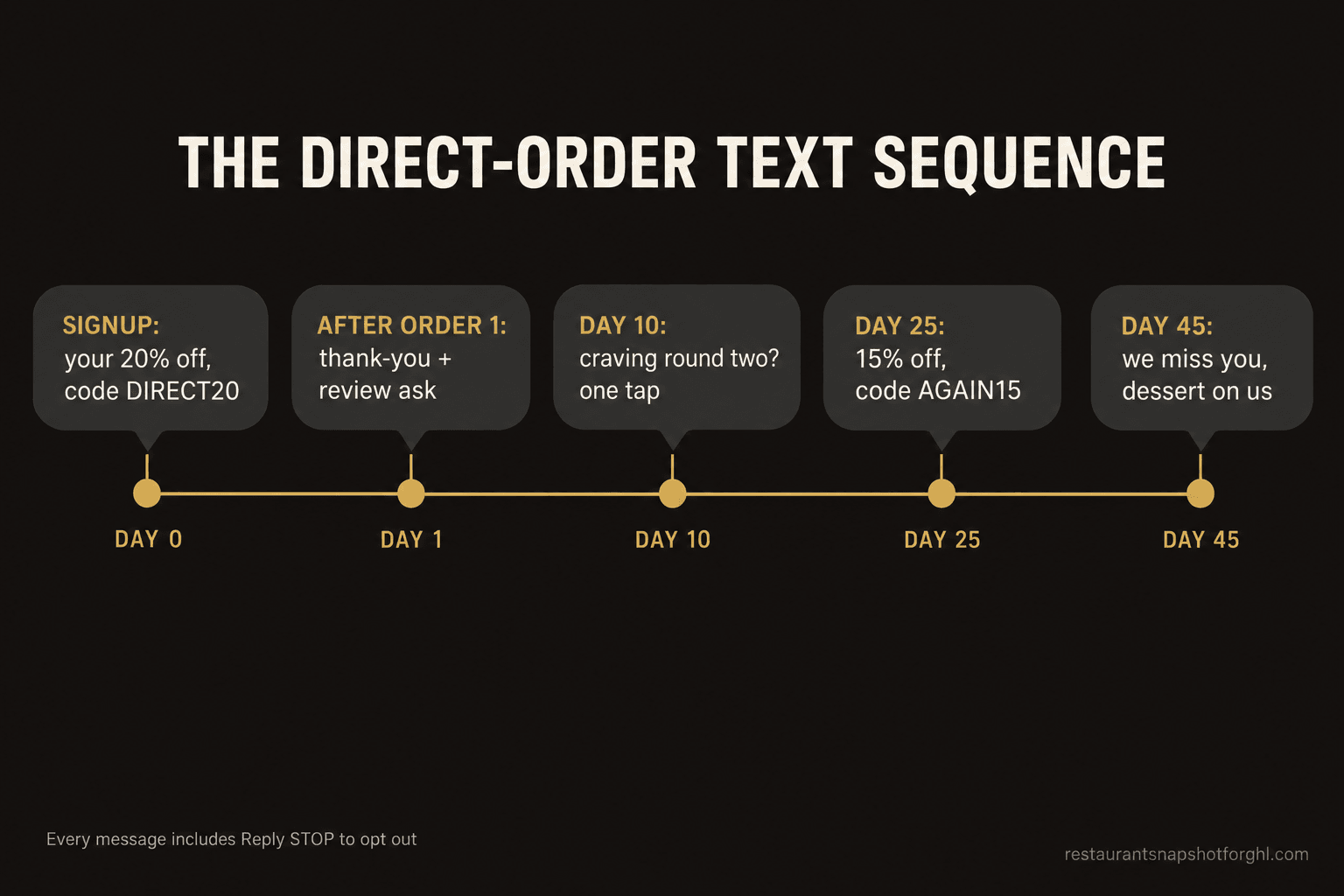
How it breaks (the sequence): The cadence is too aggressive, five texts in a week, and people hit STOP in droves, so spread them out. The second break is sending the same message to everyone, so a loyal weekly customer gets a “we miss you” text they find insulting. That is a segmentation problem: the back half of this system has to know who ordered when. The third break is a dead link or expired code, which turns a win-back into a reason to leave.
Stage 6: Turn Direct Orderers Into Dine-In Regulars
Setup: Delivery is the start, not the finish. A dine-in guest who adds a drink and dessert beats a delivery order, and the apps cannot touch that table. Two mechanisms move your best direct-delivery customers into the dining room. First, a loyalty structure that rewards visits and orders without a plastic card, so every order and visit builds toward something; we built the no-card version in a loyalty program without the punch card. Second, segmented win-backs: when a regular’s pattern breaks, say 60 days of silence from someone who used to order weekly, an automated message brings them back. The invitation to come in is its own message: “You’ve ordered delivery three times this month, come let us cook it for you, here’s a glass of wine with your entree.” That turns a couch customer into a Friday booking.
How it breaks: You treat delivery and dine-in as two separate businesses with two lists, so the same guest is a stranger in each. One profile per guest, every channel attached, or it fragments. The other break is a loyalty program so complicated nobody understands what they are earning. Keep it simple: visits in, reward out.
Three Restaurants, Three Different Plans
The framework is the same. The build changes with your size and team.
The solo operator (one location, no marketing person)
No time, no CRM. Run Stages 1 to 4 only. Print the bag card, point the QR at one landing page, use a single texting tool for the instant code and one monthly text. Even moving 15 percent of delivery customers to direct pays for the effort in a month, because you stop handing the app 25 to 30 percent on those tickets. Food-service net margins run just 3 to 5 percent (Toast, 2026), so every ticket off the app is found money.
The mid-size team (two or three locations, one marketing-ish manager)
You run all six stages, but not by hand across three stores, so automation stops being optional. One system holds every guest profile, tags by location and channel, and fires the sequence automatically. Your manager spends an hour a week on the specials text; the rest runs itself. A shared list means a guest who tries store A by delivery gets invited to dine in at store B.
The large group (four or more locations, a real budget)
Your risk is not effort, it is fragmentation: four chances to build four disconnected lists and four consent practices. Centralize everything: one consent standard, one data model, one report showing cost-per-direct-order and the delivery share clawed back per location. At your volume, a one or two point shift from app to direct is a serious number, and the value is in measuring and pushing it monthly. The 2026 industry is projected at $1.55 trillion in sales with 15.8 million jobs (National Restaurant Association, 2026); the groups that win own the customer relationship instead of renting it.
The Compliance Line You Cannot Skip
Everything above depends on texting people, and in the US that is regulated. Get it right or the savings become legal risk.
The core rule: marketing texts need prior express written consent, the checkbox and disclosure on your landing page. The Federal Communications Commission requires consent to be clear, and every marketing message must offer a simple opt-out, which is why “Reply STOP” appears in the copy above (FCC). Honor it instantly.
The law is also moving. In early 2026 the Fifth Circuit ruled the TCPA does not require written consent in every case, allowing oral consent for some telemarketing in Texas, Louisiana, and Mississippi, while the written standard still applies elsewhere (JD Supra, 2026). The safe move for a multi-state program is to keep capturing written consent to the strictest standard. You also need your numbers registered through A2P 10DLC before sending at volume, or carriers filter your messages. We walk through it in TCPA compliance for restaurant SMS. None of this is hard, but it is non-negotiable.
Objections, Answered Straight
“Won’t DoorDash punish me for an ‘order direct’ card in the bag?” Nothing in a standard marketplace agreement stops you from marketing to your own customers once they have your food. You are inviting your customers to a better deal, not poaching the app’s users. Keep the card about value, not trashing the platform.
“I already pay for the apps. Isn’t this more work for the same customers?” The opposite. You pay 25 to 30 percent on those orders forever, because the customer keeps coming back through the app. Move them to direct once and every future order costs you card processing instead. The apps are a monthly rental; this is a purchase you make once per customer, and keeping one is 5 to 25 times cheaper (HBR, 2014).
“Do I need to be technical to run this?” No. The physical stages are a card and a QR code. The digital stages, the capture page, the consent flow, the automated sequence, are exactly what a done-for-you system handles. Your job is to make great food and staple the card to the bag.
“What if customers find the texts annoying?” They find irrelevant, too-frequent texts annoying. A real offer, well-timed, with an easy opt-out, is a service. If someone opts out, you lose a customer you were about to lose to the app anyway, and the ones who stay are worth far more.
Finishing the Friday
Go back to that 7:15 Friday. Same forty delivery dinners, same chiming tablet, but now every bag leaves with a card stapled to the top. Over a few weeks, a steady share of those customers scan it, join your list, and order the next one direct, at a third of the cost to you and a better deal for them. The apps are good at one thing: putting your food in front of a stranger. Then build the system that turns the stranger into a regular you own.
Frequently Asked Questions
Can I get my DoorDash or Uber Eats customers' phone numbers to text them?
No, not from the marketplace order. DoorDash masks the customer's phone number and it stops working about 30 minutes after delivery, so you cannot market to it later. You have to collect the number directly, with consent, on a channel you control, which is exactly what the bag-insert and capture-page steps are for.
Is it against the rules to put an 'order direct' card in a delivery bag?
Marketing your own restaurant to a customer who already has your food is standard practice, and nothing in a typical marketplace agreement prevents it. Keep the card focused on the value of ordering direct rather than attacking the platform, and you stay on safe ground.
How much should the first direct-order discount be?
Enough to beat the convenience of the app, usually 15 to 20 percent off the first direct order or a free appetizer. Remember you hand the apps 25 to 30 percent on every order anyway, so a one-time 20 percent discount to win a customer for good is cheaper than paying commission forever.
Do I legally need consent to text delivery customers?
Yes. Marketing texts in the US require prior express consent and an easy opt-out. Capture written consent on your signup page, include 'Reply STOP' on messages, honor opt-outs instantly, and register your numbers through A2P 10DLC before sending at volume.
What if my own online ordering is worse than the apps?
Fix that first. A clunky direct ordering page will undo every discount you offer. Your order page needs to be fast on mobile, match your app menu, and ideally remember returning customers. A good direct experience is what makes order two happen without a coupon. Because margins are thin, every ticket you move off a 25 to 30 percent commission is close to pure recovered margin, so the system usually pays for itself within the first month.