
A Popmenu rep gets you on a demo, and it’s a good one. The website looks sharp, the menu is interactive, guests can order direct, the AI answers the phone when your host is in the weeds. You like it, so you ask the one question that decides everything: what does it cost? And this time you actually get a number. Starter, $179 a month. Reasonable. You start doing the math on your napkin.
The trouble is that the number you were quoted is the one part of Popmenu that probably won’t move the needle on its own. The pieces that fill tables, online ordering, the AI phone line, catering, a second location, aren’t on the pricing page. They’re add-ons, priced by quote, that stack on top of the plan you just agreed to. So this is a numbers-first teardown of what Popmenu really costs an independent restaurant in 2026: what’s published, what isn’t, where it breaks, and whether a one-to-three-room operator should pay for it or keep the guest list on its own side.
Table of Contents
- The 30-second answer
- What Popmenu is, and what the base plan buys
- What Popmenu actually costs in 2026
- The add-ons that aren’t on the pricing page (and where each breaks)
- Popmenu vs the alternatives, priced out
- Three real budgets: solo, busy independent, small group
- Steal this: the messages that earn the spend
- The compliance line you can’t skip
- Objections, answered straight
- Frequently asked questions
The 30-Second Answer
Popmenu publishes three base plans, Starter at $179 a month, Essentials at $299, and Premier at $499, with roughly 10% off on annual billing. Online ordering, catering, AI phone answering, and extra locations are not in those plans. They’re add-ons priced by sales, so your real monthly number depends entirely on which of them you turn on (Sauce, 2026; PricingSaaS, 2026).
The upside is real: Popmenu takes no commission on direct online orders, a better deal than letting a marketplace own the transaction (Sauce, 2026). But the honest answer to “what does Popmenu cost” is “more than the number they led with, and you won’t know how much until you’ve named everything you want.”
What Popmenu Is, and What the Base Plan Buys
Popmenu is a restaurant website and marketing platform: a dynamic, SEO-friendly website with an interactive menu, plus email and text marketing, reviews, and a guest database behind it. Higher tiers add direct online ordering, an AI phone-answering line, and automation. It’s independent, not owned by a POS or a booking giant, and it sells itself as the way to stop renting your presence from third parties.
The base plan buys the website and a starter set of marketing tools, and for a restaurant whose current site is a dusty one-pager, the jump is noticeable. But the website is table stakes. A good-looking menu page does not, by itself, bring a lapsed regular back on a dead Tuesday. The follow-up does, and the follow-up, the ordering, the phone coverage, the automation, is where Popmenu’s price stops being the number on the page. It’s the same trap as a POS-native marketing add-on from the other side: we found Toast’s marketing price wasn’t on its pricing page at all. Popmenu is more honest about the base plan, less honest about the parts that matter most.
What Popmenu Actually Costs in 2026
Two independent 2026 trackers agree on the published base numbers.
- Starter: $179/mo monthly, about $159/mo annual (Sauce, 2026).
- Essentials: $299/mo monthly, about $269/mo annual (PricingSaaS, 2026).
- Premier: $499/mo monthly, about $449/mo annual. AI phone answering is included at this tier (Sauce, 2026).
- Enterprise / Build Your Own: custom, quoted by sales, scaled to location count. Annual billing saves roughly 10% across the published tiers (PricingSaaS, 2026).
Popmenu published base-plan pricing, single location, annual billing, before add-ons. Sources: Sauce (2026), PricingSaaS (2026).
Read those plans next to the margin math. The National Restaurant Association projects $1.55 trillion in industry sales for 2026, but the same report found 42% of operators weren’t profitable in 2025 (NRA, 2026), on net margins of 3% to 5% (Level CFO, 2026). At $499 a month for Premier, that’s roughly $5,400 a year on the base before a single add-on: fine if the platform drives covers you’d otherwise lose, a slow bleed if the website looks great and nothing follows up.
The Add-Ons That Aren’t on the Pricing Page (and Where Each Breaks)
The features operators want most are not in the base plan.
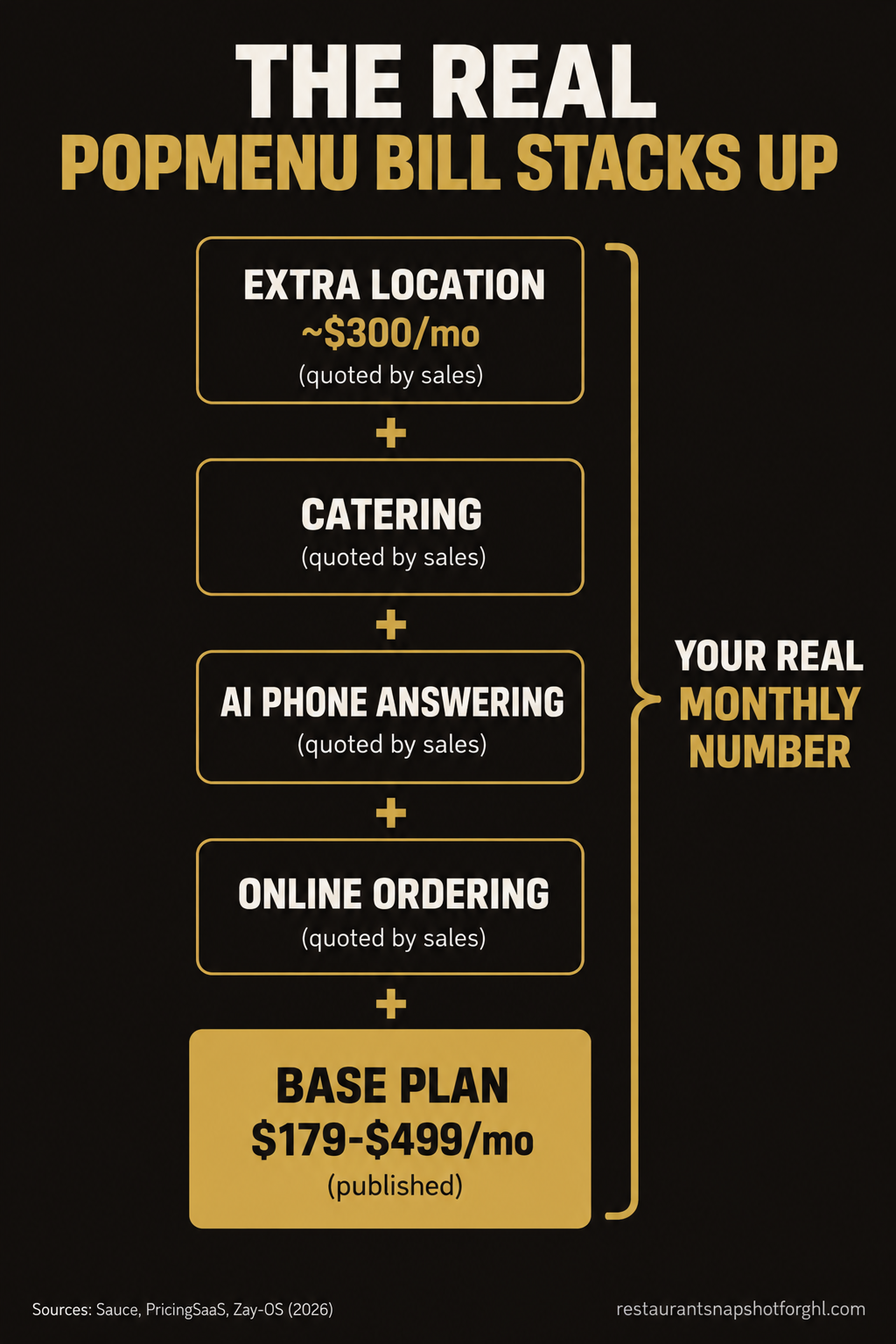
1. Online ordering. Direct ordering is an add-on, not in any base plan (Sauce, 2026). The genuine upside: Popmenu takes no commission on direct orders, so you’re not handing 15% to 30% to a marketplace on your own regulars. But the add-on has its own monthly cost, set by quote. Where it breaks: you buy the website, then discover the thing that captures revenue is a line item you have to negotiate. Budget for it before you sign.
2. AI phone answering. The line that answers when nobody can grab the phone is included on Premier, but a separate add-on on the lower tiers, quoted by sales (Sauce, 2026; Zay-OS, 2026). Where it breaks: if phone coverage is your real problem, and for a lot of small rooms it is, the feature that sold you the demo is the one that pushes you up to the $499 Premier tier.
3. Catering. Catering tools are an add-on even on Starter, and catering orders can carry a separate processing fee (Sauce, 2026). Where it breaks: catering is often an independent’s highest-margin channel, so the stream most worth automating sits behind another line item.
4. Extra locations. Multi-location pricing isn’t published. Popmenu mentions tiered savings but names no rate, and third-party trackers peg each location at roughly $300 a month, reported and unverified (Zay-OS, 2026). Where it breaks: a two-location operator can’t price the deal from the website at all, so you’re negotiating before you know the number.
The pattern under all four: the base plan is the easy yes, and everything that touches revenue is a quote. That’s a sales structure, not a scandal. But the honest cost of Popmenu for most independents is noticeably higher than the $179 that got them on the call.
Popmenu vs the Alternatives, Priced Out
The same money could go to a POS-native marketing add-on, a booking platform with per-cover fees, or a system you own outright. Here’s the honest shape of it, single location.
| Platform | Published starting price | What it’s really for | The catch |
|---|---|---|---|
| Popmenu | $179–$499/mo + add-ons | Website, menu, marketing, direct ordering | Ordering, AI phone, catering, extra locations quoted separately (Sauce) |
| Toast Marketing | ~$185/mo (reported) | Email + SMS on your POS data | Not on the pricing page; per-location; locked to Toast (Restaurant Dive) |
| OpenTable | $149/mo + per-cover fees | Reservations + their diner network | Up to ~$1.50 per network cover, so the bill scales with success (EatApp) |
| Own the list (GHL system) | One setup, no per-door fee | SMS, no-show recovery, reviews, win-backs | You run it or have it installed; the guest list stays yours |
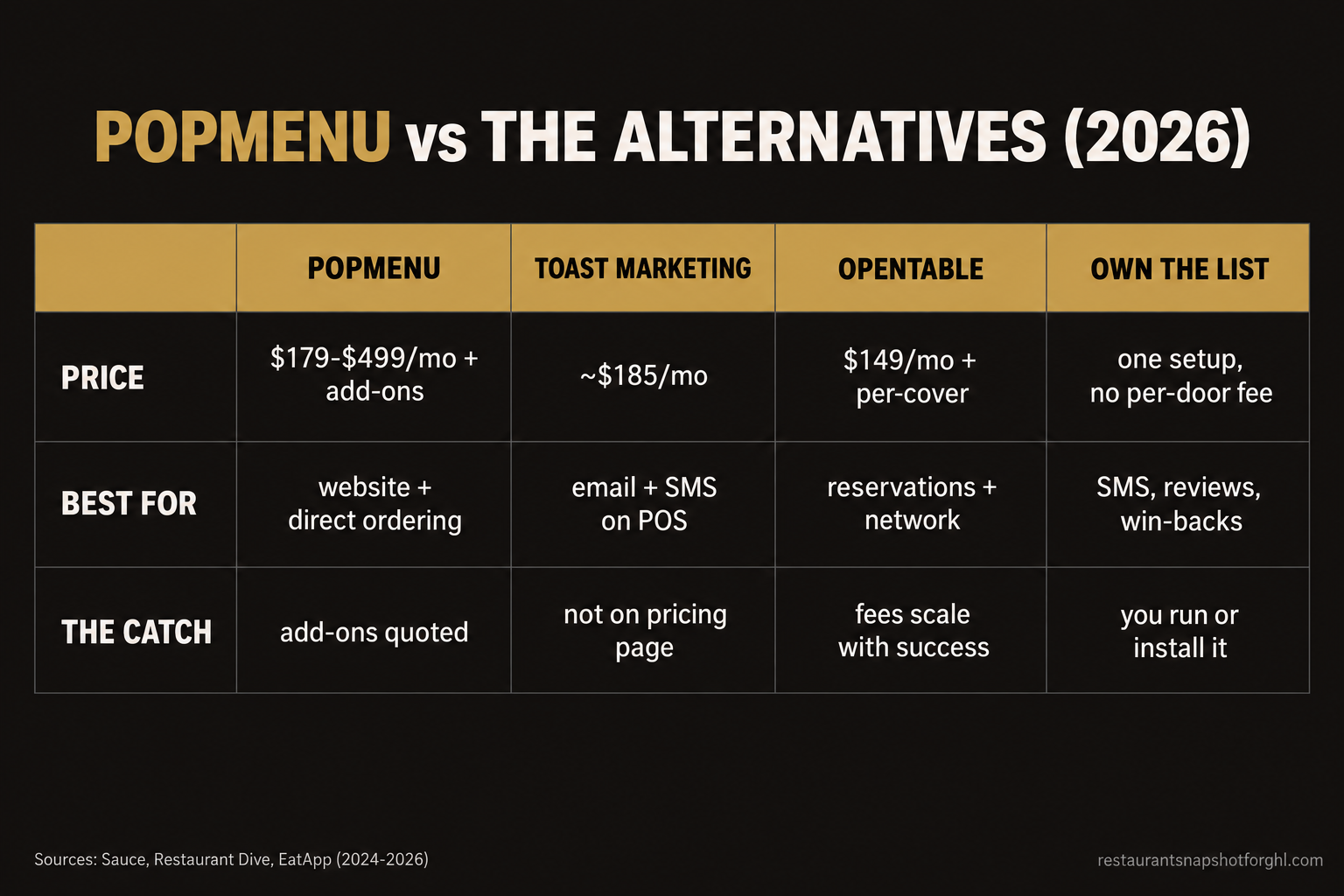
The split is clean. Popmenu is the best of the three rented options if your core problem is a weak website and you want direct ordering without marketplace commissions. If your problem is follow-up, filling slow nights, recovering no-shows, bringing regulars back, you’re paying a website platform for a marketing job it does partly, behind add-ons. We laid out the full trade in best OpenTable alternatives and what restaurant marketing software costs.
Three Real Budgets: Solo, Busy Independent, Small Group
The right answer genuinely changes with the shape of the business. Run the framework three ways.
The solo operator (one room, tight margin). You need a decent website and a reliable way to bring guests back. Popmenu Starter at $179 gets you the site; add online ordering and you’re negotiating a quote on top. For a single room that texts its list twice a month, you’re paying a platform rate for lightly-used marketing. The higher-return move is usually to spend less on the storefront and more on the follow-up: a reminder that stops the no-show, a win-back at 45 days, a specials text to people who opted in. A system you own does that without the per-feature quote.
The busy independent (one full room, real volume). Here Popmenu makes more sense. You have the traffic to justify direct ordering, catering inquiries to automate, and phone volume that makes AI answering pay. You’re likely on Essentials or Premier plus ordering, so budget $400 to $600-plus all-in, and make sure the no-commission direct orders actually displace marketplace fees. If guests still order through DoorDash out of habit, you’re paying for a channel nobody uses (turning delivery customers into regulars).
The small group (two to five locations). Here the pricing gets hardest to read, because per-location rates aren’t published and each room is its own quote (Zay-OS, 2026). At a reported ~$300 per extra location plus base and add-ons, a three-location group can clear $1,000 to $1,500 a month fast, before setup. At that scale, a shared system with one guest database and no per-door fee is usually cheaper and easier to control.
Steal This: The Messages That Earn the Spend
These are the messages that move covers, and a pretty website doesn’t send them. Copy them straight, swap the brackets, and keep the compliance line on anything promotional.
The missed-call text-back (a call rings out during service, the gap an AI line or automation is supposed to close):
“Hi, this is [Restaurant], sorry we missed you, we’re in the middle of service. Reply here and we’ll get you a table or answer anything. Want to book? Tap [link].”
The three-touch win-back for a regular gone quiet (45, 60, and 75 days since last visit):
Day 45: “We saved your usual table, [Name]. It’s been a few weeks. Come see what’s new this week? Reply YES and we’ll hold a spot.”
Day 60: “Miss you at [Restaurant]. Here’s $15 off your next visit this month, our treat. Book here: [link].”
Day 75: “Last one from us, [Name]. The $15 is good through Sunday. [link].”
The direct-order nudge (pulls a delivery-app habit back to your own ordering page, where no commission is skimmed):
“Craving [signature dish], [Name]? Order straight from us this week and skip the app fees, same kitchen, faster: [direct link]. First direct order gets a free [side].”
The review request (send 2 to 3 hours after the check closes, to happy guests only). The “reply here first” line routes an unhappy guest to you before they post publicly:
“Thanks for coming in tonight, [Name]. If we got it right, a quick Google review helps a small local spot like us more than you’d think: [link]. If anything was off, reply here first and we’ll make it right.”
The SMS consent line for your booking form, Wi-Fi splash, or text-to-join prompt. This is the one you can’t skip:
“Text me reservation updates and occasional offers from [Restaurant]. Msg & data rates may apply. Msg frequency varies. Reply STOP to cancel, HELP for help. Consent isn’t a condition of dining with us.”
The platform that sends these matters less than the fact that something does, reliably.
The Compliance Line You Can’t Skip
The moment you text a list you collected at the host stand, you’re bound by the Telephone Consumer Protection Act (TCPA) and A2P 10DLC rules, with statutory penalties of $500 to $1,500 per message (FCC). This applies whether the texts go out through Popmenu, a POS add-on, or a system you own.
The rules in plain English: get express written consent before marketing texts, keep the transactional confirmation separate from the marketing opt-in, log every consent with a timestamp, and honor STOP at once. Alcohol and happy-hour promotion rules vary by state, and several states restrict time-limited drink discounts outright, so scope any boozy promo to where you operate rather than blasting a national template. Our full TCPA and A2P 10DLC guide covers registration and templates. Whatever you pay for, make sure consent and STOP handling are built in, not bolted on.
Objections, Answered Straight
“The base plan is cheap and I just need a website. Isn’t Popmenu fine?” For a website alone it’s a decent product, and the no-commission direct ordering is a genuine plus. But be honest about what you’re buying: a storefront. If the real pain is empty Tuesdays and no-shows, the website was never going to fix it, and the parts that would are the add-ons behind a quote.
“No commission on direct orders sounds like a win. Why wouldn’t I take it?” It is a win, if guests actually order direct. The failure mode is paying for a direct-ordering add-on while your regulars keep tapping the DoorDash app out of habit. The commission you save is only real if you move the behavior, which takes the direct-order nudge above, sent consistently. A done-for-you GoHighLevel system installs that ordering flow and the texting that drives it into an account you own. The tool doesn’t change the habit. The follow-up does.
“We’re small. Is any of this worth it?” You need the follow-up, not necessarily Popmenu’s version of it. Winning a new customer costs about five times more than keeping one you have (Bain & Company), so for a small room the highest-return move is a reliable way to bring a lapsed regular back, and the cheapest durable version keeps the list and automations yours.
The One Line That Changes the Math
Popmenu does the website well, and it doesn’t skim your direct orders, which beats renting the transaction from a marketplace. The problem isn’t the product, it’s the shape of the price: the number that gets you on the call is the storefront, and the features that fill tables are quotes that stack on top. So the highest-return line in your budget usually isn’t the prettiest menu page. It’s the one that keeps the guest list and the follow-up on your side of the table: a reminder that stops the no-show, a win-back at 45 days, a loyalty program without a punch card, and a specials text that only goes to people who asked for it. For a one-to-three-room operator, the better move is usually to buy the marketing you’ll actually run, and own the guest list, not rent a platform whose best parts arrive by quote.
Frequently Asked Questions
How much does Popmenu cost per month in 2026?
Popmenu publishes three base plans for one location: Starter about $179 a month, Essentials $299, and Premier $499, with roughly 10% off on annual billing ($159, $269, $449). Online ordering, catering, AI phone answering on the lower tiers, and extra locations are add-ons priced by sales, so your real monthly number is higher than the sticker. Ask for the all-in quote per location before you sign.
Does Popmenu charge a commission on online orders, and is ordering included?
Popmenu takes no per-order commission on direct online orders, a genuine advantage over marketplaces that skim 15% to 30%. But online ordering (and catering) is a paid add-on not in any base plan, priced by quote rather than published. If direct ordering is your main reason for considering Popmenu, get that add-on price in writing first.
How much does Popmenu cost for multiple locations?
Popmenu doesn't publish per-location pricing. It mentions tiered savings for groups but names no rate, and third-party trackers report roughly $300 per additional location, unverified. A two-to-five-location group can clear $1,000 to $1,500 a month once you add base plans and add-ons, so a shared system with no per-door marketing fee is often cheaper and easier to control.
Is Popmenu worth it for a small independent restaurant?
It depends on your real problem. If you need a strong website with interactive menus and direct ordering that avoids marketplace commissions, Popmenu is a solid independent option. If the problem is empty weeknights and no-shows, you're paying a website platform for a marketing job it does partly, with the best pieces behind add-ons. A solo operator usually gets the same specials blast, review request, and win-back from a system it owns for less.
What are the best Popmenu alternatives for independents?
Toast Marketing runs about $185 a month but isn't on Toast's pricing page and locks you to Toast. OpenTable starts around $149 a month plus per-cover fees that scale with your success. If the goal is to own the guest relationship end to end, running your website, ordering, SMS, reviews, and win-backs from a system you control avoids both the per-feature quotes and the per-location fees.
Related reading
- What Toast’s marketing tools actually cost in 2026
- What restaurant marketing software actually costs in 2026
- Best OpenTable alternatives for independent restaurants
- Own your restaurant guest list instead of renting it
- TCPA & A2P 10DLC: what restaurants need to know before sending one SMS
- Get the done-for-you system installed in 24 hours
Sources
- Popmenu pricing & add-ons: Sauce (2026); PricingSaaS (2026); Sauce, vs Lunchbox (2026); Zay-OS (2026)
- Competitor context: Restaurant Dive, Toast (2024); EatApp, OpenTable
- Industry, margins, retention, compliance: NRA 2026; Level CFO; Bain; FCC TCPA