
It’s 7:50 on a Saturday and the floor is a wall of sound. Every two-top is turned, there’s a wait at the door, and the bar is three deep. You stand at the pass and think the thought every operator thinks on a night like this: we are killing it.
Then the first of the month comes. Rent, payroll, and the food invoice clear, the delivery apps take their cut, and the number at the bottom of the account barely moved. You were slammed for three weeks straight, so where did it go? That gap, between a packed room and a flat bank balance, is the most fixable problem in this business, and the fix has little to do with more covers.
Table of Contents
- The 30-second answer
- Why a full dining room can still lose money
- Leak 1: You rent your covers from the marketplaces
- Leak 2: You buy the same guest over and over
- Leak 3: You pay for traffic you never follow up with
- Leak 4: Your highest-value seats go empty
- Steal this: the messages that plug the leaks
- Three restaurants, three versions of the fix
- What the law says before you text a single guest
- Objections, answered straight
- The one number that actually moves
- Frequently asked questions
The 30-Second Answer
A busy restaurant loses money when its covers are expensive to get, cheap to keep, and impossible to follow up with. You can fill every table and still finish flat if a big slice of those covers arrives through a channel that takes a cut, if the guest never comes back, and if you have no owned way to reach the people who loved the place. The move that changes the bottom line is not more volume. It is owning the guests you already have and turning one great Saturday into three more visits.
Why a Full Dining Room Can Still Lose Money
The number that decides whether a restaurant makes money is prime cost: food plus labor, as a share of sales. A healthy full-service restaurant runs prime cost around 60% to 65%, and anything above 65% is a structural problem, not a bad week (Toast, 2026). Add rent, overhead, and delivery commissions, and the typical restaurant keeps only 3% to 5% as net profit (Level CFO, 2026). The national picture is worse: the NRA pegged the median full-service margin at 2.8% in 2024, down from 4% in 2019 (NRN, 2026). On a good night, roughly 95 cents of every dollar is spoken for before you take a penny home, so a cover that arrived through a channel skimming 25% off the top was near break-even before the first plate hit it.
Where $100 of a busy dinner goes at a typical full-service restaurant. Illustrative, built from the 2026 benchmarks cited above (Toast; Level CFO).
When the sliver you keep is that thin, the whole game is protecting it. The things eating it share one root: you do not own the relationship with your guests. The marketplaces own the booking, the apps own the delivery order, and nobody owns the follow-up, and volume papers over all of it until the first of the month. There are four leaks.
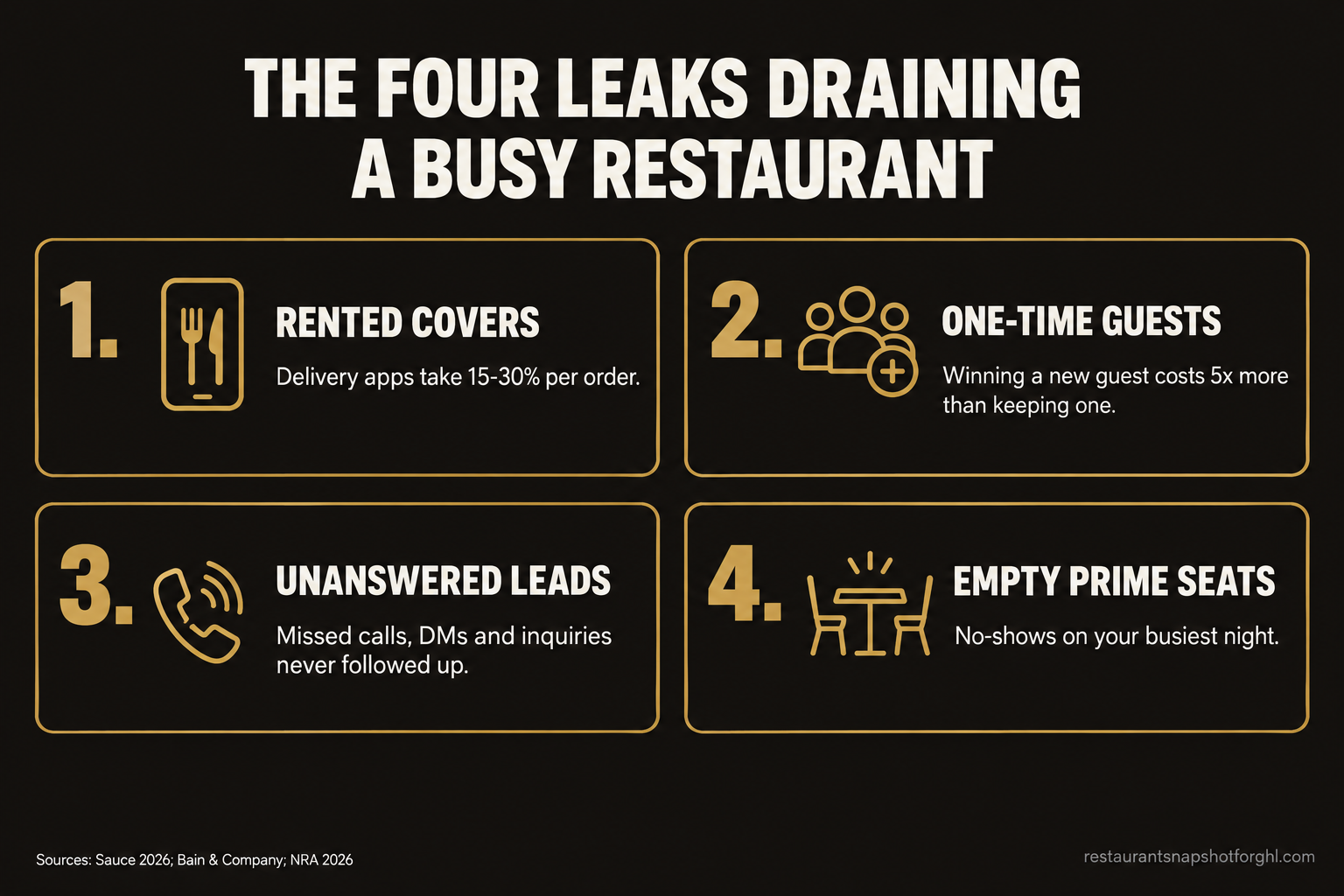
Leak 1: You Rent Your Covers From the Marketplaces
The most expensive cover in your restaurant is the one a third party sends you. Third-party delivery apps take 15% to 30% of every order before processing fees and promoted-listing spend push the effective number higher (Sauce, 2026), and reservation marketplaces charge per diner seated so the bill scales up as you get busier. These channels feel like growth: the orders are real and the room is full. But on a 5% margin, a 25% commission does not shave your profit, it erases it. We broke the math down in the real cost of a marketplace cover and what delivery apps actually cost restaurants.
Where it breaks: the data goes with the cut. When DoorDash sends the order or OpenTable seats the table, the app keeps the guest’s contact information, not you. You pay the toll once and still cannot bring that person back next week without paying it again. You are not buying a customer, you are renting the same transaction over and over.
The fix: do not quit the marketplaces, just stop treating them as your only channel. Capture the guest’s phone or email at the table or on the to-go bag, with consent, and move the second visit to a channel you own. The first order can come through the app. The fifth should come through you.
Leak 2: You Buy the Same Guest Over and Over
Here is the stat that should be taped to every host stand: winning a brand-new customer costs roughly five times more than keeping one you already have (Bain & Company). Every dollar on ads and commissions is spent finding a stranger, while the couple who had a great anniversary dinner last month and meant to come back drifts away because nobody reached out. A busy restaurant with no repeat-visit engine pours expensive new guests in the top and lets them evaporate out the bottom. We covered why regulars stop coming in; they almost never tell you, they just stop.
Where it breaks: most operators confuse the point-of-sale list with a guest list. Your POS knows what was ordered, but it does not run a 45-day win-back or notice when a regular has gone quiet. Without that layer, a guest’s lifetime value collapses to a single visit. See restaurant customer lifetime value for the math.
The fix: a simple automatic repeat-visit loop. Tag a guest when they visit and let a workflow do the rest: a thank-you the next morning, a nudge if they go quiet, a win-back at 45 days, a birthday note a week before. No memory required, just a system that owns the list. See winning back lapsed diners and a loyalty program that doesn’t need a punch card.
Leak 3: You Pay for Traffic You Never Follow Up With
Think about the near-misses in a single week. The phone rings during the rush and nobody grabs it. A catering inquiry gets a reply three days late. A DM about walk-ins sits unread until Monday. Every one is a guest you already paid to reach, walking away because the follow-up never happened. The NRA reported 60% of operators saw softer customer traffic heading into 2026 (NRA, 2026), and when traffic is tight, the covers already knocking on your door are the cheapest you will ever get.
Where it breaks: the missed call is the classic. A ringing phone during service is a booking you cannot answer, so the guest calls the place down the street that picked up, and you never knew the cover existed. Same with the cold inquiry and the ignored DM. The lead was free. The loss is silent.
The fix: instant automatic first response on every channel. A missed call triggers an immediate text back, an inquiry gets an auto-reply that books or qualifies, and a DM gets answered in seconds, not days. We covered the highest-ROI version in missed-call text-back for restaurants. It does not replace your people, it keeps a ready-to-spend guest from slipping away because the room was slammed.
Leak 4: Your Highest-Value Seats Go Empty
A no-show is not one empty chair. It is a table you held, turned away a walk-in for, prepped, and staffed, that produced zero revenue on your busiest night. On a packed Saturday, a no-showed six-top is one of the most expensive events in your week, because you could have sold that table three times over.
Where it breaks: the booking with no reminder and no stakes. A guest reserves Tuesday for Saturday, life happens, they forget. No confirmation text, no easy cancel, no deposit on a large party, so the table sits empty at the one moment you had a line.
The fix: a reminder flow with one-tap confirm and reschedule, a card on file for large parties, and a waitlist that auto-fills a cancelled table. It is reservation plumbing, and it pays for itself on a single saved six-top.
Steal This: The Messages That Plug the Leaks
Whatever system you run, these are the messages that turn a busy night into repeat revenue. Swap the brackets, and keep the compliance line on anything promotional.
The missed-call text-back (fires when a call goes unanswered during service):
“Hi, this is [Restaurant], sorry we couldn’t grab the phone, we’re mid-service. Reply here and we’ll get you a table. Want to book now? Tap [link].”
The next-morning thank-you (starts the relationship you paid to acquire):
“Thanks for coming in last night, [Name]. Hope the [dish] hit the spot. We’d love to see you again soon, reply any time and we’ll hold a table.”
The 45-day win-back (two touches to a guest who has gone quiet, so you stop re-buying a customer you already have):
Day 45: “We saved your usual table, [Name]. It’s been a few weeks. Come see what’s new on the menu this week? Reply YES and we’ll hold a spot.”
Day 60: “Miss you at [Restaurant]. Here’s $15 off your next visit this month, our treat, good through Sunday. Book here: [link].”
The review request (send a couple of hours after the check closes, to happy guests only; the “reply here first” line routes an unhappy guest to you before they post in public):
“Thanks for coming in tonight, [Name]. If we got it right, a quick Google review helps a small local spot like us more than you’d think: [link]. If anything was off, reply here first and we’ll make it right.”
The SMS consent line for your booking form, Wi-Fi splash, or text-to-join sign. This is the one you cannot skip:
“Text me reservation updates and occasional offers from [Restaurant]. Msg & data rates may apply. Msg frequency varies. Reply STOP to cancel, HELP for help. Consent isn’t a condition of dining with us.”
Four of those five convert a cover you already have into a second visit, at close to zero cost. That is the whole fix in a handful of text messages.
Three Restaurants, Three Versions of the Fix
The leaks are the same everywhere; the right first move depends on your size. Every figure below is illustrative, not a promise.
Scenario 1: the solo bistro. One room, heavy delivery mix, no follow-up. The biggest leaks are 1 and 2: commissions on a thin margin and zero repeat engine. Capture guests at the table, turn on missed-call text-back and a next-morning thank-you, and run one win-back a month. You are not growing traffic, you are making it come back twice. Start with owning your guest list.
Scenario 2: the busy independent. One high-volume room or two locations with a real reservation book. The biggest leak is 4: no-shows on prime tables and missed calls during the rush. The fix is reservation plumbing (reminders, card-on-file for large parties, waitlist auto-fill) plus a review engine so a great Saturday shows up on Google. For slow nights, pair it with filling slow weeknights without discounting.
Scenario 3: the small group. Three to five locations, shared guests, a stretched part-time marketer. The biggest leak is the one you cannot see: no single guest list across venues, so every door re-buys the same regional diners. One shared database, loyalty and win-backs across every door, reviews managed centrally. Ownership compounds hardest here, because the rented model’s per-location fees compound against you.
Illustrative annual margin leaking out by size, combining marketplace commissions and the lost value of guests who never return. Built from the figures cited above; your numbers depend on delivery mix and repeat rate.
What the Law Says Before You Text a Single Guest
The moment you text a promotion to a list you collected at the host stand, you are bound by the Telephone Consumer Protection Act (TCPA) and the A2P 10DLC rules carriers enforce. Penalties run $500 to $1,500 per message (FCC), and one careless blast to a few hundred guests is real money against a 3% margin.
The rules are not hard, just non-negotiable. Get express written consent before marketing texts, kept separate from a transactional confirmation, log every opt-in with a timestamp, honor STOP automatically, and never buy or borrow a list. The consent line above is written to clear this bar, and our full TCPA and A2P 10DLC guide for restaurants covers registration and templates.
Objections, Answered Straight
“If I’m busy, why fix anything? We’re full.” Because full and profitable are different numbers, and the first of the month is where you find out. A packed room on a 3% margin is one bad week from flat. Plugging the leaks makes the covers you already have worth more, the only lever that moves a thin margin.
“Won’t guests find the automated texts annoying?” Only if you blast everyone the same thing. The messages that work are triggered and targeted: a win-back only to a guest gone quiet, a review request only to someone who just had a good night. Done right, a well-timed text reads like the restaurant remembered them, because it did.
“I already pay for a POS and the delivery apps. Isn’t that enough?” Those run the transaction, not the follow-up. The POS rings the check, the app takes the order and the guest’s data, and neither brings that person back next month. The repeat-visit layer is the piece nobody sells you.
“I’m not technical. This sounds like a project.” A done-for-you setup installs the capture, reminders, win-backs, and compliant texting into an account you own, so you get the result without becoming a CRM admin. See a done-for-you GoHighLevel system for restaurants.
The One Number That Actually Moves
Go back to that Saturday at 7:50. The night was not the problem, the night was great. The problem is what happens on Sunday, when every guest walks out and the only record of them is a closed check in a POS that will never reach out.
Stop measuring the business by how full the room is, and start measuring how many of tonight’s guests you bring back next month without paying a toll to do it. That number moves the margin, it is cheaper than ads and commissions, and it is sitting in your dining room right now. The fix for a busy restaurant that is not making money was never more covers. It was owning the ones you already have, and giving them an easy reason to come back. When you are ready, see how the done-for-you system works or book a walkthrough.
Frequently Asked Questions
Why is my restaurant busy but not making money?
Because volume and profit are different. A typical restaurant keeps only 3% to 5% as net profit, and the median full-service margin fell to 2.8% in 2024, so almost every dollar is committed before you take any home. If covers arrive through apps that take 15% to 30%, or guests visit once and never return, a packed room still finishes flat. Protect the thin margin you keep, do not chase more low-margin volume.
Are delivery apps worth it if they take such a big cut?
As a discovery channel, yes; as your main channel, no. Third-party delivery takes 15% to 30% per order before fees, which on a 5% margin can erase the profit on that ticket. Use the apps to reach new people, then capture those guests with consent and move repeat visits to a channel you own with no per-order toll.
What is the cheapest way to get more repeat customers?
Follow up with the guests you already served. Winning a new customer costs about five times more than keeping one, so run a simple automatic loop: capture the guest, send a next-morning thank-you, nudge them if they go quiet, and send a win-back around 45 days. That is a few texts against the hundreds of dollars it takes to acquire a stranger.
How much does a no-show actually cost a busy restaurant?
More than the empty seat. On a sold-out night, a no-showed table is one you held, prepped, staffed, and turned away walk-ins for, so it is the full revenue of a cover you could have sold twice over. Reminders with one-tap confirm, a card on file for large parties, and a waitlist that auto-fills cancellations recover most of it.
Is it legal to text my restaurant's guests marketing offers?
Yes, if you follow the rules. Get express written consent before marketing texts, kept separate from transactional confirmations, with every opt-in logged and STOP honored automatically. TCPA penalties run $500 to $1,500 per message. Use a clear consent line on your booking form and Wi-Fi splash, and register for A2P 10DLC first.
Related reading
- Own your restaurant guest list instead of renting it
- The real cost of every cover booked through a marketplace
- Why your regulars stop coming in (and never say why)
- Win back lapsed diners with a timed silent trigger
- Missed-call text-back for restaurants
- TCPA & A2P 10DLC: what restaurants need before sending one SMS
- Get the done-for-you system installed in 24 hours
Sources
- Profitability & industry: NRA 2026 State of the Industry; NRN on 2026 margins & traffic; Level CFO margins
- Prime cost: Toast on restaurant prime cost
- Delivery commissions: Sauce on third-party fees
- Retention economics: Bain & Company on cutting costs
- Compliance: FCC on the TCPA